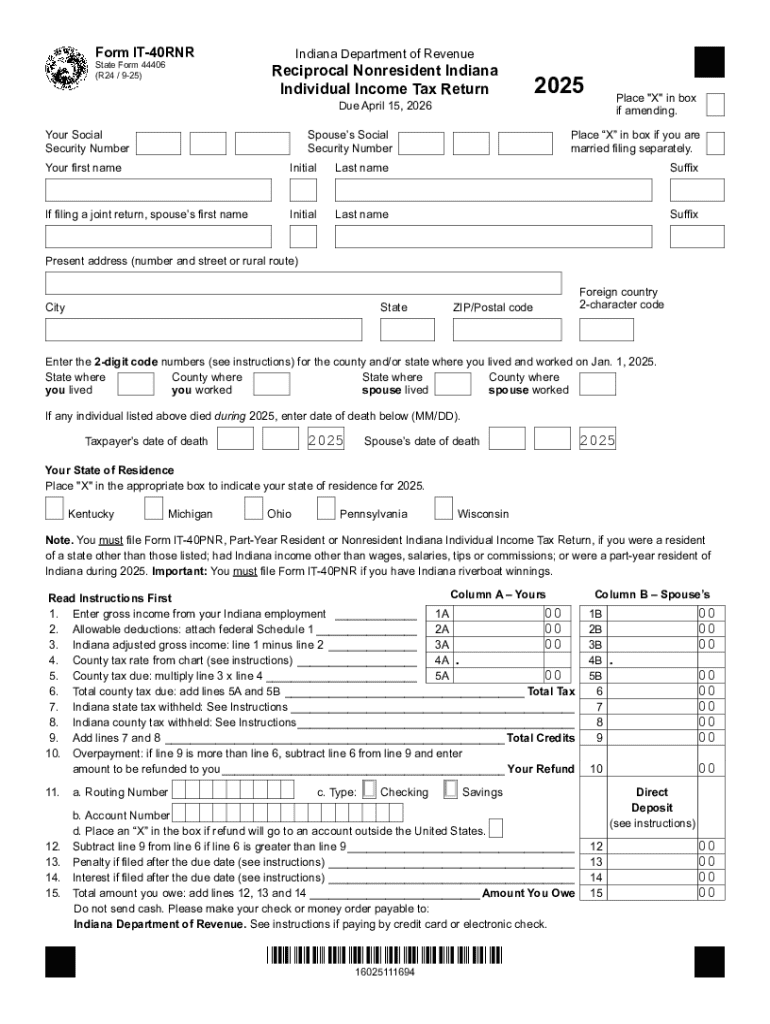







Definition & Meaning of the Indiana Reciprocal Nonresident Individual Income Tax Return
The Indiana Reciprocal Nonresident Individual Income Tax Return is a specialized form used for addressing income tax obligations of nonresident individuals working in Indiana but residing in a neighboring state with a reciprocal tax agreement. These agreements exist to eliminate double taxation, ensuring that income earned by nonresidents in Indiana is taxed only in their home state. This form is crucial for those who earn wages in Indiana but live in states that have reciprocal agreements, such as Kentucky, Michigan, Ohio, Pennsylvania, and Wisconsin.
Eligibility Criteria
To use the Indiana Reciprocal Nonresident Individual Income Tax Return, individuals must meet specific eligibility conditions:
- Reside in a state with a reciprocal agreement with Indiana.
- Earn income from wages, salaries, or tips from an Indiana employer.
- Not maintain a permanent residence in Indiana.
Understanding these criteria helps nonresidents determine whether they qualify to file this tax return and where they should pay their state income taxes.


Steps to Complete the Indiana Reciprocal Nonresident Individual Income Tax Return
- Gather Necessary Information: Collect all pertinent documents, including W-2 forms that report Indiana income and residency status.
- Review Reciprocal Agreements: Verify the states involved in reciprocal agreements with Indiana to confirm eligibility.
- Complete Personal Information: Fill in personal details like name, address, Social Security number, and home state.
- Report Indiana Income: Enter all income earned from Indiana sources, adhering to reporting guidelines.
- Calculate Exemptions and Deductions: Determine applicable exemptions and deductions based on reciprocal agreement conditions and personal circumstances.
- Finalize Tax Liability: Use the form to outline total tax liability owed to the home state instead of Indiana.
- Submit the Form: Choose a submission method, either electronically, through mail, or by utilizing tax software supportive of state forms.
These steps ensure accurate filing and compliance with state tax laws.
Required Documents
Applicants must prepare several documents to accurately complete the Indiana Reciprocal Nonresident Individual Income Tax Return:
- W-2 Forms: Essential for detailing income earned in Indiana.
- Proof of State Residency: Documents such as driver's license or voter registration to substantiate nonresident status.
- Reciprocal Exemption Documents: Specific forms or evidence required by the resident state to claim exemption from Indiana's income tax.
Collating these documents facilitates a smoother filing process and helps avoid discrepancies.
Legal Use of the Indiana Reciprocal Nonresident Individual Income Tax Return
The form is legally bound by reciprocal tax agreements between Indiana and neighboring states, ensuring nonresidents' income is taxed only once. Legal standardization offers:
- Taxation Relief: Emphasizes the prevention of double taxation for nonresidents.
- Accurate State Tax Collection: Aligns with inter-state agreements to streamline the tax collection process.
- Compliance Assurance: Ensures nonresidents' compliance with proper tax protocols specific to interstate income taxation.
Understanding legal implications enforces correct filing practices for eligible nonresidents.
Key Elements of the Indiana Reciprocal Nonresident Individual Income Tax Return
- Personal and Income Information: Details must be filled meticulously to ensure an error-free submission.
- Exemption Certificates: May be required by the resident state to emphasize qualification for reciprocal agreement benefits.
- Deductions and Credits: Opportunities for reducing taxable income aligned with specific agreements and personal circumstances.
Familiarity with these core components bolsters the correct completion of the tax return under reciprocal conditions.
Filing Deadlines / Important Dates
- Typical Filing Deadline: Aligns with the individual’s resident state filing deadline for personal income taxes, commonly April 15.
- Extension Requests: Extensions must be requested following the procedures established by the home state, not Indiana.
Awareness of deadlines and potential extensions ensures timely and compliant filing.
State-Specific Rules for the Indiana Reciprocal Nonresident Individual Income Tax Return
Each state in a reciprocal agreement with Indiana may enforce unique stipulations:
- State-Based Exemptions: Different states have varying requirements for claiming exemptions.
- Supporting Documentation: Specific documents may be necessary to assert exemption status.
- Refund Procedures: Processes to claim refunds from withholding may vary.
Understanding these variances helps nonresidents efficiently manage their tax obligations across state lines.
Taxpayer Scenarios: Employees, Business Owners, and More
Nonresidents interacting with the Indiana tax system may include various types of individuals:
- Employees: Those commuting to Indiana for work but residing in reciprocal states.
- Freelancers: Must understand state-specific implications of earnings from Indiana.
- Part-time Residents: Should assess if they qualify for partial exemptions under unique scenarios.
Knowing the nuances affecting different taxpayer categories aids in accurate filing and relief from inappropriate tax liabilities.