




01. Edit your form online
Type text, add images, blackout confidential details, add comments, highlights and more.

Type text, add images, blackout confidential details, add comments, highlights and more.

Draw your signature, type it, upload its image, or use your mobile device as a signature pad.

Send it via email, link, or fax. You can also download it, export it or print it out.
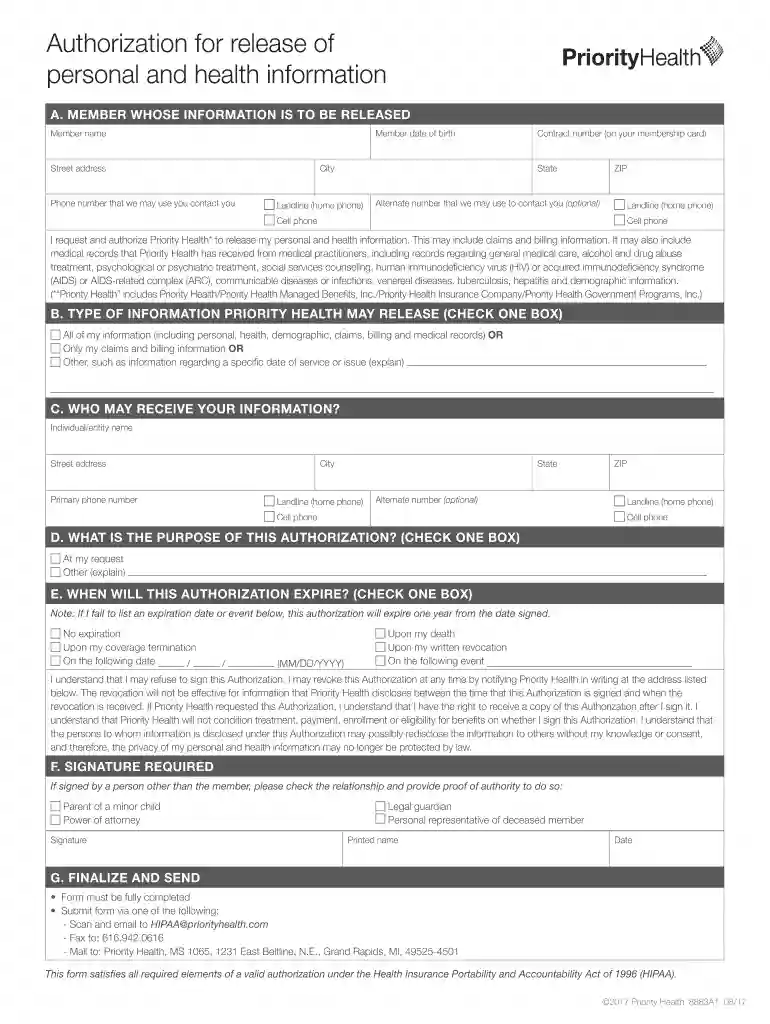
The HIPAA Authorization Form - Priority Health is a critical document that facilitates the legal sharing of protected health information (PHI). This form grants permission to healthcare providers and other entities to disclose patient health data while complying with the Health Insurance Portability and Accountability Act (HIPAA). The primary objective of this form is to maintain confidentiality and enhance patient data protection. By completing this form, patients ensure that their medical information is shared only with parties they have authorized. Understanding the purpose of this form is essential for anyone managing healthcare data or seeking to release personal health information safely.
Accurately completing the HIPAA Authorization Form - Priority Health is crucial to avoid unintentional breaches of privacy. An incorrect or incomplete form can lead to unauthorized data disclosure, resulting in potential legal consequences and a breach of trust between patients and healthcare providers. Therefore, attention to detail in filling out each section correctly ensures compliance and protects against data misuse.
To use the HIPAA Authorization Form - Priority Health, begin by acquiring the form from your healthcare provider or Priority Health directly. Ensure you have the necessary personal identification details and the contact information for the entities you're authorizing to access your health information.
Completing the HIPAA Authorization Form - Priority Health involves a series of methodical steps designed to ensure information accuracy and legal compliance.
Before submitting, review for any errors or omissions. Consider discussing your form with a healthcare provider or legal advisor to ensure full understanding and compliance.
Using the HIPAA Authorization Form - Priority Health provides several benefits. It empowers you to control who has access to your health information, facilitating seamless communication between healthcare providers. This is particularly vital when coordinating care across multiple practitioners. It also enables patients to involve family members or caretakers in their healthcare decisions, ensuring comprehensive support. Moreover, using this form ensures compliance with legal standards, providing peace of mind that your information is protected under HIPAA guidelines.
By explicitly identifying trusted parties, the form supports informed decision-making and patient-centered care, allowing healthcare teams to collaborate more effectively with input from those closest to the patient.


Understanding the legal implications of the HIPAA Authorization Form - Priority Health is fundamental for ensuring all parties are protected under HIPAA regulations. The form allows voluntary sharing of patient information, which must be processed with the utmost respect for confidentiality. Legal use of the form requires accurate and truthful completion to ensure clear permissions are granted. This protects both the patient’s rights and the healthcare providers from potential legal disputes regarding unauthorized information sharing.
Healthcare entities must store and handle these forms in accordance with federal regulations, keeping them readily accessible for audits or investigations should any privacy breaches occur.
At DocHub, your data security is our priority. We follow HIPAA, SOC2, GDPR, and other standards, so you can work on your documents with confidence.


Part B: I authorize the following person or types of people to receive my information (the person receiving the information must be 18 years of age or older):.Read more
Jan 1, 2021 This manual contains samples of the forms needed to fulfill your obligations under your Molina contract. If you are already using forms thatRead more


