
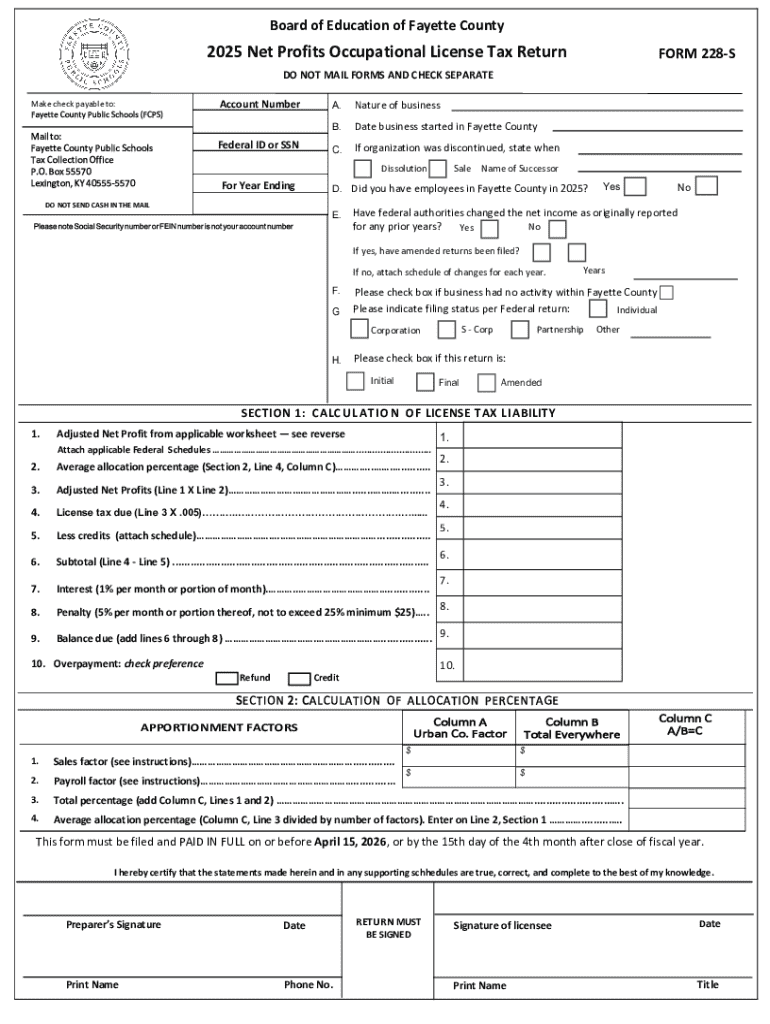







Definition & Meaning
The "Fayette County Net Profits Occupational License Tax Return" is a mandatory form utilized by businesses operating in Fayette County to report and pay their occupational license taxes based on net profits. This form is essential for businesses to comply with local tax regulations and ensure they contribute appropriately to the county's revenue by declaring their net profits accurately.
- Net Profits Tax: This refers to the tax calculated on the net earnings of a business after deducting allowable expenses. It forms a significant part of local revenue streams.
- Occupational License: This type of license is essential for businesses to legally operate within Fayette County. The tax return helps maintain compliance with local ordinances.
Steps to Complete the Fayette County Net Profits Occupational License Tax Return
- Gather Financial Documents: Collect all necessary financial documents, such as income statements and expense summaries, to aid in the accurate calculation of net profits.
- Calculate Net Profits: Determine your business's net profits by subtracting deductible expenses from gross income. This involves careful accounting to ensure precise figures.
- Fill Out the Form Accurately: Enter the calculated net profits, tax rate, and other necessary details into the tax return form following the instructions provided.
- Review and Verify: Double-check the form for completeness and accuracy to prevent potential penalties due to errors or omissions.
- Submit the Form: Depending on preferences, submit the completed form via mail to the appropriate county office or utilize available online submission options.
- Retain a Copy: Keep a copy of the submitted form and any supporting documents for your records and future reference.
Important Terms Related to Fayette County Net Profits Occupational License Tax Return
- Gross Income: Total revenue generated by the business before deducting any expenses or taxes.
- Deductible Expenses: Costs incurred by the business that are permitted to be subtracted from gross income to determine net profits.
- Filing Status: The classification under which a business files tax returns, which affects rates and deductions.
- Compliance: Adherence to local tax laws and deadlines ensures that a business avoids legal penalties.
Legal Use of the Fayette County Net Profits Occupational License Tax Return
Businesses are legally required to use this form to report their net profits and remit the appropriate taxes owed to Fayette County. This compliance ensures that they remain operationally legitimate and contribute to the local economy.
- Mandatory Filing: Non-compliance can result in fines, legal repercussions, or operational restrictions.
- Privacy Assurance: By adhering to guidelines, businesses protect sensitive financial information legally and ethically.
Filing Deadlines / Important Dates
- Annual Submission Date: Typically, the due date aligns with federal tax filing deadlines; however, it is crucial for businesses to confirm specific dates to avoid late fees.
- Extensions: Businesses may apply for filing extensions if extra time is required; however, they must adhere to prescribed procedures and justifications.
Required Documents
To complete the tax return accurately, businesses should prepare the following key documents:
- Income Statements: Reflect all sources of revenue generated during the tax period.
- Expense Records: Detail all operating costs and allowable deductions.
- Previous Tax Returns: Historical data aids in comparing year-over-year tax obligations and ensuring consistency.
Penalties for Non-Compliance
Non-compliance with the Fayette County Net Profits Occupational License Tax Return filing requirements can lead to significant penalties:
- Monetary Fines: Considerable fines can be levied for late submissions or deliberate inaccuracies.
- Interest Charges: Accrued interest on unpaid taxes adds to the financial burden.
- Legal Consequences: Severe cases of evasion may result in legal action, affecting the business’s reputation and operations.
Digital vs. Paper Version
Businesses have the flexibility to choose between digital and paper filing methods depending on convenience and resources:
- Digital Version: Offers benefits such as automated calculations, error checking, and faster processing times.
- Paper Version: Traditional option suitable for businesses without digital infrastructure or those preferring physical documentation.
Business Entity Types (LLC, Corp, Partnership)
Different business structures may have varying tax obligations, and the form accommodates these differences:
- Sole Proprietorship: Simpler tax structure but requires careful allocation of personal and business expenses.
- LLC/Corporation: Often entail more complex tax filings due to distinct corporate income and deductions.
- Partnerships: Require individual partners to report their share of profits and losses on personal tax returns.
Understanding these nuances aids businesses in completing the form accurately and efficiently, ensuring they comply with all Fayette County tax obligations.




