




01. Edit your form online
Type text, add images, blackout confidential details, add comments, highlights and more.

Type text, add images, blackout confidential details, add comments, highlights and more.

Draw your signature, type it, upload its image, or use your mobile device as a signature pad.

Send it via email, link, or fax. You can also download it, export it or print it out.
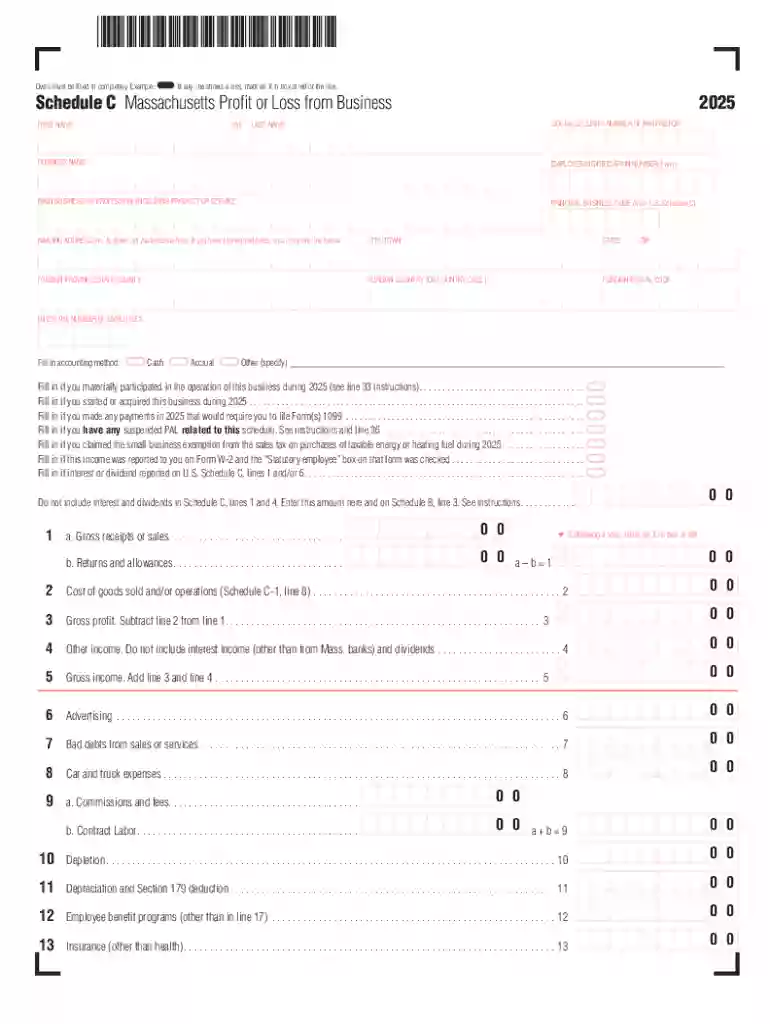
Massachusetts Schedule C 2025 is a tax form used to report income and expenses arising from a sole proprietorship or single-member LLC. This form is critical for accurately calculating taxable income from businesses not classified as corporations. It provides a detailed account of how much was spent and earned, aiding in determining the net profit or loss. Timely and accurate filing of this form ensures compliance with state tax regulations and helps avoid potential audits or penalties.
For Massachusetts-based businesses, this form adapts federal requirements to state-specific tax laws. Adjustments on this schedule align state calculations with federal tax reporting, maintaining consistency across jurisdictions. The form supports small businesses by offering a thorough method for recognizing deductible expenses and evaluating business performance.
Understanding the critical components of Massachusetts Schedule C 2025 is essential to comprehensive and compliant filing. Major sections include:
Accurate completion of these sections is vital for arriving at the correct net profit or loss, subsequently impacting taxable income.
Massachusetts Schedule C 2025 is primarily utilized by individuals engaged in internal business operations such as:
These entities are distinct from corporations and partnerships primarily because of their simplified tax obligations and the need to report business income and expenses via a different form.


This form serves as the principal method for reporting business income and expenses. Use should be consistent and systematic to ensure all income is captured, and available deductions are claimed. Steps include:
Accuracy in these steps optimizes your tax return potential and ensures compliance with state tax obligations.
Detailed steps to prepare and submit the Massachusetts Schedule C 2025 are as follows:
These steps, when followed meticulously, enhance accuracy and compliance.
Legal compliance is of paramount importance when using Massachusetts Schedule C 2025. Correct use involves adherence to statutory requirements regarding income recognition and deductibility. Risks of non-compliance include:
Taxpayers should consult the Massachusetts Department of Revenue or tax professionals if unclear about specific provisions to ensure legal compliance.
Timely filing of Massachusetts Schedule C 2025 is essential to avoid penalties. Important deadlines include:
Ensure all forms and payments are submitted by these deadline dates to maintain compliance and avoid additional charges.
Practical scenarios where Massachusetts Schedule C 2025 is essential:
These examples highlight how the form assists various self-employed individuals in managing their tax responsibilities effectively by allowing for transparent and detailed financial reporting.
We've got more versions of the Massachusetts Schedule C 2025 form. Select the right Massachusetts Schedule C 2025 version from the list and start editing it straight away!
| Versions | Form popularity | Fillable & printable |
|---|---|---|
| 2025 | 4.5 Satisfied (38 Votes) | |
| 2024 | 4.1 Satisfied (24 Votes) | |
| 2023 | 4.3 Satisfied (39 Votes) | |
| 2022 | 4.9 Satisfied (28 Votes) | |
| 2021 | 4.8 Satisfied (37 Votes) | |
| 2020 | 4.3 Satisfied (124 Votes) | |
| 2019 | 4.2 Satisfied (62 Votes) | |
| 2018 | 4.4 Satisfied (157 Votes) | |
| 2017 | 4.3 Satisfied (106 Votes) | |
| 2016 | 4.4 Satisfied (214 Votes) | |
| 2004 | 4.6 Satisfied (56 Votes) |
At DocHub, your data security is our priority. We follow HIPAA, SOC2, GDPR, and other standards, so you can work on your documents with confidence.


This section provides guidelines for IEP team members and educators who develop 504 plans to determine how each student with a disability will participate inRead more
NEW/REVISED MATERIAL--EFFECTIVE DATE: Cost Reporting Periods Beginning on or After May 1, 2010. This transmittal introduces Chapter 40, Hospital andRead more
Fill in if you made any payments in 2025 that would require you to file Form(s) 1099. Fill in if you have any suspended PAL related to this schedule.Read more


