Definition & Meaning
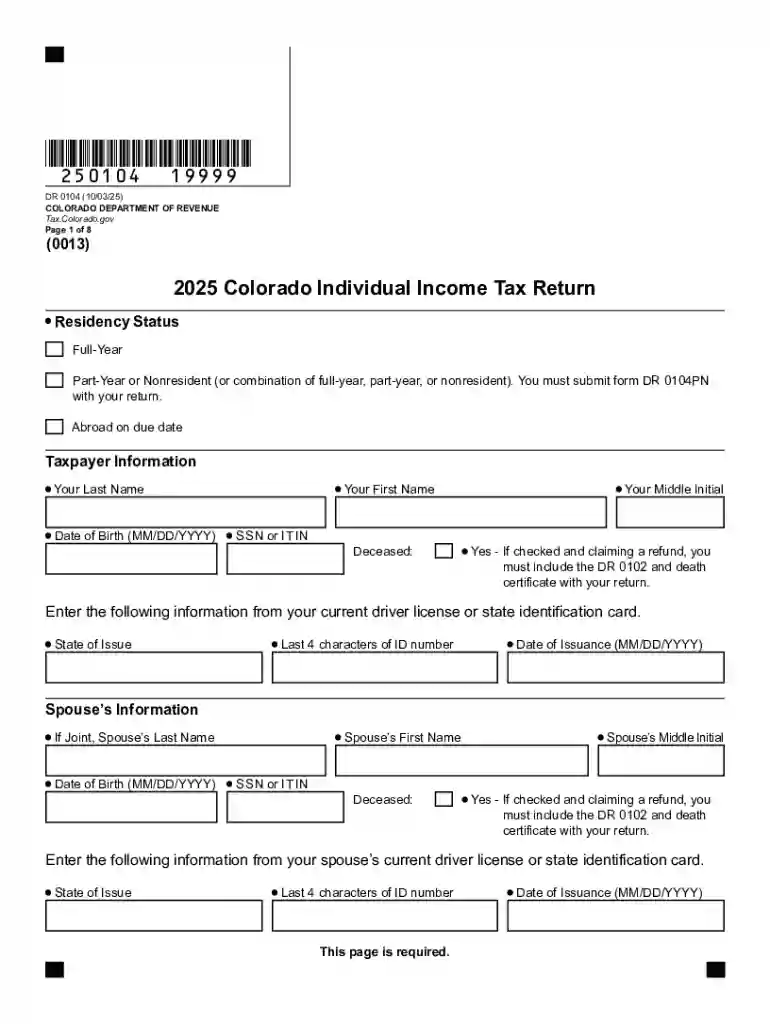
The DR 0104, Colorado Individual Income Tax Return, is a critical document used by residents and certain non-residents to report their annual income to the Colorado Department of Revenue. This form is essential for calculating taxes owed or refunds due based on an individual's income, deductions, and credits. The DR 0104 serves as a means for taxpayers to comply with state tax obligations, ensuring that funds are appropriately allocated for state services and infrastructure.
- Purpose: Primarily used to report income, claim deductions, and determine tax liabilities at the state level.
- Scope: Applicable to full-year residents, part-year residents, and non-residents earning income in Colorado.
- Legal Standing: Filing the DR 0104 is mandated by the Colorado tax code, making it a legally binding document.
Practical Examples
- Resident Taxpayer: A Colorado resident must report all income received, regardless of where it was earned, using the DR 0104.
- Non-Resident with Colorado Income: An individual living outside Colorado but earning rental income from a property in the state would also file this form.
Steps to Complete the DR 0104, Colorado Individual Income Tax Return
Completing the DR 0104 effectively ensures accurate tax computations and adherence to state tax laws. The process involves several key steps, each designed to gather comprehensive financial data.
- Gather Required Documents: Collect all necessary documents, including W-2s, 1099s, and prior-year tax returns.
- Determine Residency Status: Identify whether you are a full-year resident, part-year resident, or non-resident.
- Calculate Total Income: Sum up all income from wages, investments, and other sources.
- Claim Deductions and Credits: Review eligible deductions and tax credits to reduce the taxable income.
- Calculate Tax Liability: Use the instructions provided to compute the total tax due.
- Submit the Return: Choose an appropriate method for submission—online, by mail, or in-person.
Special Considerations
- Marital Status: The form takes into account filing status, such as single, married filing jointly, or married filing separately.
- Deductions: Taxpayers may choose between standard deduction or itemized deductions based on their financial situations.
Filing Deadlines / Important Dates
Timely submission of the DR 0104 is crucial to avoid penalties. The standard deadline aligns with federal tax deadlines, but it’s essential to note Colorado-specific dates for certain actions.
- Standard Filing Deadline: Typically, April 15, or the next business day if it falls on a weekend or holiday.
- Extension Filing Date: If an extension is filed, the deadline can extend to October 15.
- Quarterly Payment Deadlines: Estimated tax payments are due April 15, June 15, September 15, and January 15 for taxpayers obligated to make such payments.
Potential Penalties
- Late Filing: Submitting the DR 0104 after the deadline without an approved extension incurs late fees.
- Underpayment: Failing to pay the full amount by the deadline can result in additional interest and penalties.
Key Elements of the DR 0104, Colorado Individual Income Tax Return
The DR 0104 encompasses various sections, each capturing specific taxpayer information essential for accurate processing.
- Personal Information: Includes taxpayer's name, Social Security Number, and residency details.
- Income Report: Detailed breakdown of all sources of income, including wages, dividends, and other earnings.
- Deductions and Credits: Sections that cover entitlement to various state-specific deductions and tax credits that reduce overall tax liability.
Important Sections
- Adjustments: Any income adjustments for more precise taxable income reporting.
- Health Care Coverage Status: Compliance with state health insurance mandates.
- Signature and Declaration: Taxpayer’s affirmation of the form’s accuracy.
Digital vs. Paper Version
Taxpayers have the flexibility to choose between filing the DR 0104 in a digital format or using paper versions, each offering distinct advantages.
Digital Version
- Efficiency: Processing is generally faster, with digital submissions.
- Error Validation: Many software options include error-checking features to reduce filing mistakes.
- Convenience: Documents can be saved electronically, reducing physical storage issues.
Paper Version
- Traditional Preference: Some taxpayers prefer a tangible form for personal record-keeping.
- Accessibility: Individuals without access to the internet or technology might find paper submissions more feasible.
How to Obtain the DR 0104, Colorado Individual Income Tax Return
Acquiring the DR 0104 is straightforward, with several routes available for taxpayers to access the form.
- Online Download: Available for download directly from the Colorado Department of Revenue’s official website.
- Tax Preparation Software: Programs like TurboTax and QuickBooks include the DR 0104 within their filing options.
- Local Tax Offices: Physical copies can be picked up by visiting a local Department of Revenue office.
Additional Resources
- Instructions: Detailed instructions accompany the form to aid taxpayers in correctly filling out sections.
- Assistance: Various help lines and online resources are accessible for additional guidance.
Important Terms Related to DR 0104, Colorado Individual Income Tax Return
Understanding specific terminology associated with the DR 0104 aids in accurate completion and compliance.
- Tax Year: The calendar year for which the tax return is being filed.
- Adjusted Gross Income (AGI): Total gross income minus specific deductions, a crucial figure for determining tax liability.
- Filing Status: Determines tax rate and standard deduction, with options such as single, married, or head of household.
Clarifications
- Withholding: Amounts withheld from income throughout the year and applied to one's tax obligation.
- Tax Credits vs. Deductions: Credits directly reduce tax owed, while deductions lower taxable income.
Penalties for Non-Compliance
Non-compliance with filing the DR 0104 can lead to significant penalties that are financially burdensome.
- Failure to File: Results in penalties, calculated based on the tax due and length of delay.
- Failure to Pay: Additional charges accrue based on unpaid tax amounts, escalating with time.
- Interest on Late Payments: Accumulates from the original due date until full payment is made.
Avoiding Penalties
- Timely Extensions: Filing for an extension when unable to meet the deadline can prevent penalties related to late filing.
- Estimated Payments: Ensuring that enough taxes are paid throughout the year via withholding or estimated payments can avoid underpayment penalties.