






Definition & Meaning
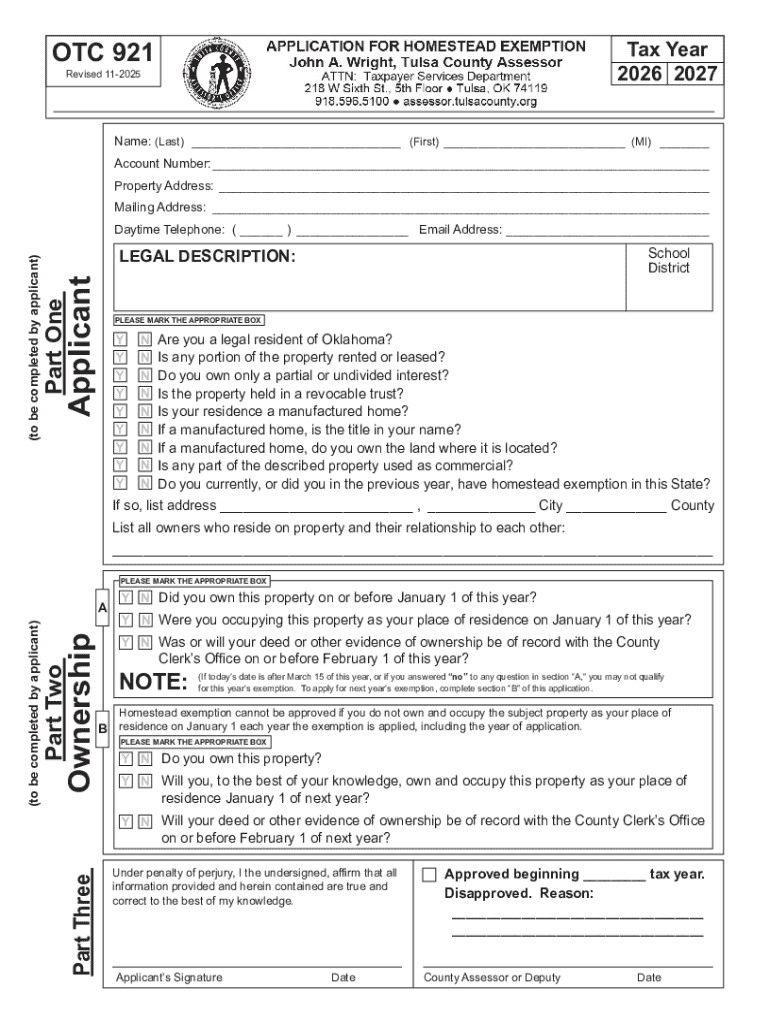
The 2 Form 921 Application for Homestead Exemption is a crucial tax document for homeowners in the United States, serving as an application to claim a reduction in property taxes for one's primary residence. This form allows eligible taxpayers to benefit from lower taxable property value by applying the homestead exemption. The exemption is particularly advantageous for those who reside permanently in their homes, as it mitigates the amount of property taxes owed by reducing the property's assessed value.
Practical Examples
- Retirees: A retired individual might use Form 921 to reduce the property tax burden on their fixed income.
- New Homeowners: A first-time homebuyer may file Form 921 to ensure they benefit from homestead exemptions for the upcoming tax years.
How to Use the 2 Form 921 Application for Homestead Exemption
Using Form 921 effectively requires understanding the instructions and necessary details it asks for. Homeowners must provide accurate personal information, property details, and proof of residence.
Key Steps in Using the Form
- Complete Personal Information: Enter your full name, mailing address, and contact details.
- Property Details: Include the address of the property for which you seek the exemption.
- Required Documentation: Attach proof of residence, such as a utility bill or driver's license.
- Signature & Date: Sign and date the form, attesting to the accuracy of your information.
How to Obtain the 2 Form 921 Application for Homestead Exemption
Joing to your local county tax assessor's office is a primary method to obtain the Form 921. Many states also offer the form online, allowing you to download and complete it digitally.
Methods for Acquisition
- In-Person: Visit the local county tax office to get a physical copy.
- Online Download: Access the form on your state or county tax authority's website.
- Request by Mail: Some counties may offer to send the form by mail upon request.
Steps to Complete the 2 Form 921 Application for Homestead Exemption
Filling out the Form 921 requires attention to detail to ensure it is processed without delay. Follow these steps for a seamless experience.
Detailed Instructions
- Review the Instructions: Before starting, read all instructions provided with the form.
- Provide Accurate Information: Double-check the entries for personal and property details.
- Attach Necessary Documents: Ensure all supporting documents are attached.
- Check for Completeness: Review the entire form to guarantee nothing is missed.
- Submit Timely: File the completed form before the stated deadline.
Important Terms Related to 2 Form 921 Application for Homestead Exemption
Understanding relevant terminology helps in accurately completing and understanding Form 921.
Key Terms
- Homestead: The primary residence that qualifies for tax exemption.
- Assessed Value: The property's valuation that serves as the basis for taxation.
- Exemption Limit: The maximum amount of property value that can be exempted from taxes.
Eligibility Criteria
Eligibility for the homestead exemption through Form 921 has specific requirements that homeowners must meet.


Criteria for Qualification
- Primary Residence: The property must be the homeowner's primary residence.
- Proof of Residency: Include proof such as utility bills or ID showing the property address.
- Ownership Requirement: The applicant must own the property as of January 1 of the application year.
Filing Deadlines / Important Dates
Timeliness is critical when submitting Form 921 to ensure eligibility for the tax exemption within the specified period.
Key Dates
- Deadline: Typically, must be filed by March 1 of the tax year unless otherwise stated by the county.
- Valuation Appeals: If contesting the property value, adhere to any county-specific deadlines for appeals.
Required Documents
When submitting Form 921, specific documentation must be included to support the application.
Necessary Attachments
- Proof of Identity: A driver’s license or government ID.
- Proof of Ownership: A copy of the property deed or closing statement.
- Residence Verification: Recent utility bill or other documentation confirming occupancy.
State-Specific Rules for the 2 Form 921 Application for Homestead Exemption
Each state may have unique requirements and rules governing the homestead exemption process.
Variations by State
- Exemption Amounts: Some states vary in the exemption limits.
- Additional Benefits: Veterans or seniors might qualify for additional exemptions.
- Application Renewals: Determine if your state requires annual or one-time submission.
Penalties for Non-Compliance
Failing to comply with the rules surrounding Form 921 can result in penalties, including loss of exemption.
Consequences
- Loss of Tax Benefits: Errors or missed deadlines can lead to ineligibility for the current year.
- Back Taxes: Some states may reassess and levy back taxes for exemptions improperly claimed.
By understanding and addressing all relevant aspects of the 2 Form 921 Application for Homestead Exemption, homeowners can ensure they fully benefit from potential property tax reductions and avoid any compliance issues.