




01. Edit your form online
Type text, add images, blackout confidential details, add comments, highlights and more.

Type text, add images, blackout confidential details, add comments, highlights and more.

Draw your signature, type it, upload its image, or use your mobile device as a signature pad.

Send it via email, link, or fax. You can also download it, export it or print it out.
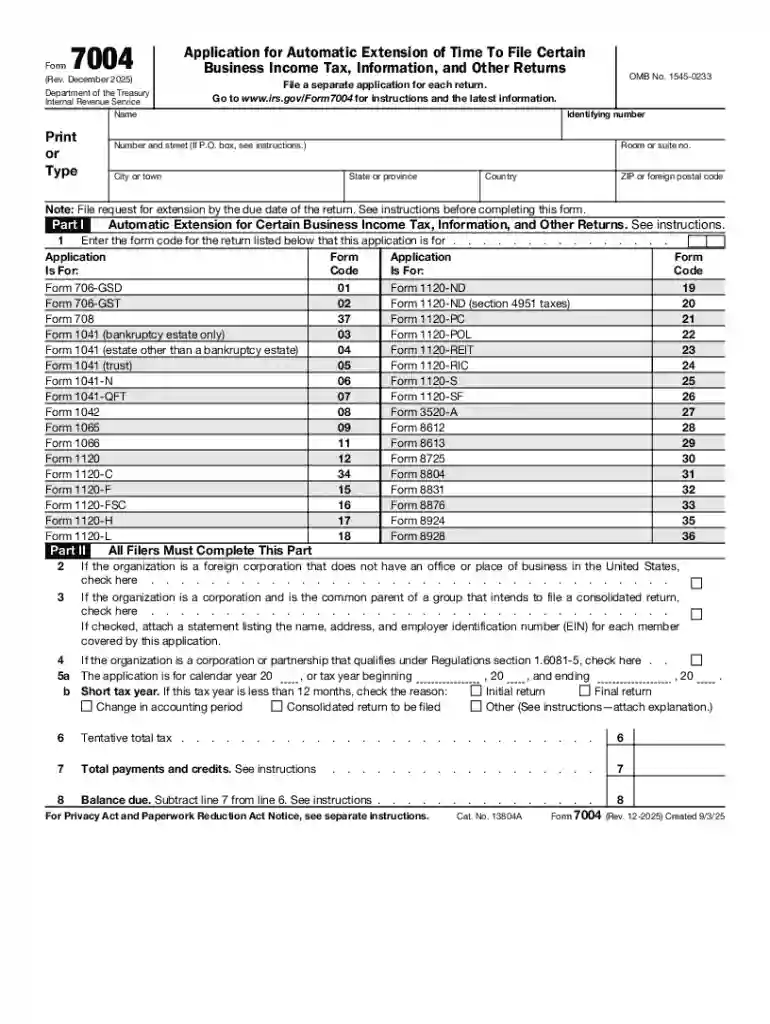
Form 7004, revised in December 2025, serves as an Application for Automatic Extension of Time to File Certain Business Income Tax, Information, and Other Returns. It is a pivotal document issued by the IRS allowing businesses to request extra time for filing specific tax returns. By securing an automatic extension, businesses avoid the potential pitfalls of late filing, although it does not extend the time for payment of any taxes due. This form reflects a streamlined federal filing process for businesses seeking operational efficiency and regulatory compliance.
Gather Necessary Information:
Select Tax Type:
Calculate Estimated Tax:
Fill In Business Information:
Sign and Date Form:
Review and Submit:
Form 7004 provides an essential service by granting automatic extensions for business income tax filings, ensuring compliance without the fear of penalties associated with late filings. This form is particularly beneficial for businesses that require additional time to gather necessary documentation and for those undergoing complex financial reviews. Additionally, utilizing Form 7004 can mitigate stress by providing a legal avenue to methodically finalize year-end financial statements or audit reports.
The IRS guidelines for Form 7004 emphasize accuracy and timeliness. Key efficiency markers include:
Filing Deadlines: The form must be filed on or before the original due date of the tax return. Common deadlines, such as March 15 or April 15, must be strictly observed depending on the business type.
Extension Periods: Typically, Form 7004 provides various extension periods (up to six months) based on specific returns applicable to the business entity.
Payments: Although an extension for filing is granted, any estimated tax liabilities remain due by the original tax return deadline to avoid interest and penalties.
Form 7004 is relevant to a wide array of business entities:
Filing Form 7004 involves a straightforward process where, once submitted, the IRS generally grants the extension if correctly filled, without requiring detailed explanations. Approval times are prompt, typically with electronic filings leading to faster confirmations of granted extensions. This streamlined procedural adherence supports programmatic tax planning operations across business units.
Modern conveniences allow Form 7004 to be:
Failing to file Form 7004 or doing so incorrectly can lead to significant financial penalties and accrued interest on unpaid taxes:
By understanding the significance and process of executing Form 7004 accurately, businesses can proactively manage tax duties, enhance their fiscal readiness, and ensure ongoing compliance within a fast-evolving regulatory landscape.
At DocHub, your data security is our priority. We follow HIPAA, SOC2, GDPR, and other standards, so you can work on your documents with confidence.




Feb 23, 2023 7004. File Form 7004 on or before the due date of Form. 1042. Form 7004 does not extend the time for payment of tax. Form 7004 extends onlyRead more
Sep 3, 2025 Part I. Automatic Extension for Certain Business Income Tax, Information, and Other Returns. See instructions. 1. Enter the form code for theRead more
This Form 40-F/A, which includes the exhibits filed herewith (other than the section of the AIF entitled Ratings), is incorporated by reference into the.Read more


