






Definition & Meaning
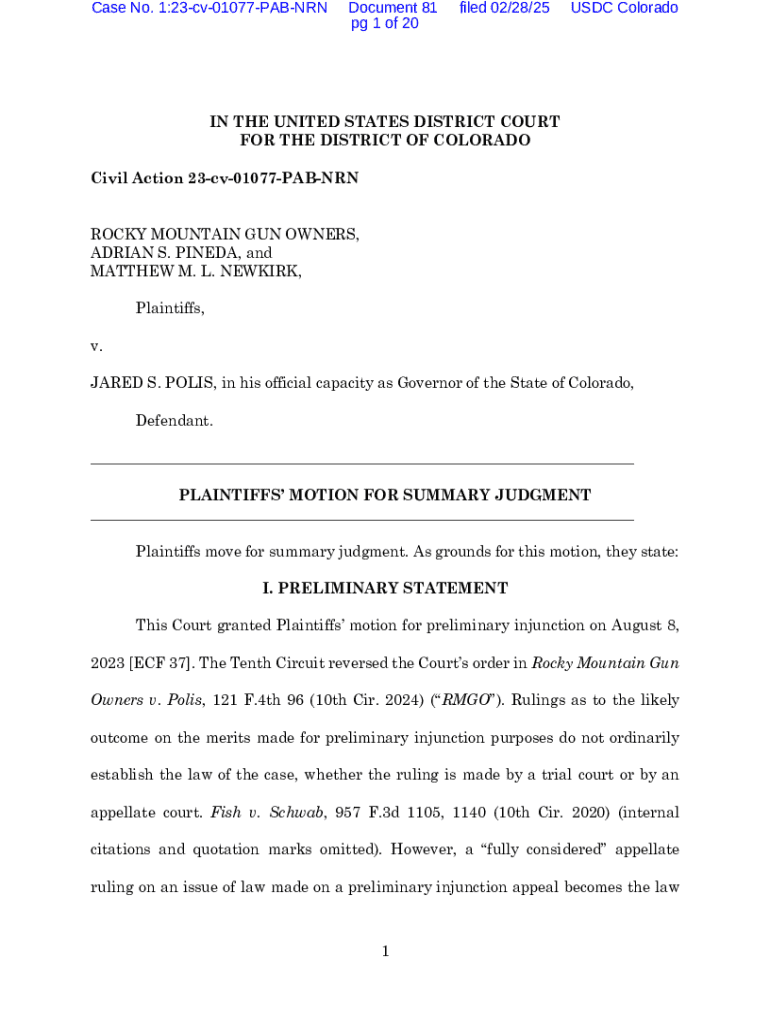
A Plaintiffs' Motion for Summary Judgment is a legal maneuver in the United States judicial system. It is used to request the court to rule in favor of the plaintiffs without a full trial, asserting that there are no significant factual disputes that need to be resolved by a jury. This motion argues that based on the law and the evidence presented, the case can be decided by the judge at this stage. In practice, it involves submitting documentation and evidence that demonstrate the absence of material factual conflicts.
How to Use the Plaintiffs' Motion for Summary Judgment
Using a Plaintiffs' Motion for Summary Judgment effectively requires a strategic approach. Legal practitioners typically submit this motion after discovery has been completed, enabling them to present a comprehensive set of evidence. The motion must include affidavits, depositions, admissions, and other credible materials to support the claim that there are no factual disputes. Ensuring these documents are well-organized and clearly articulated can significantly increase the chances of a favorable court ruling.
Steps to Complete the Plaintiffs' Motion for Summary Judgment
-
Gather Evidence: Collect all relevant documents, depositions, and exhibits that support your claim.
-
Draft the Motion: Compose the motion, ensuring it includes a statement of undisputed facts, a memorandum of law, and the necessary legal arguments.
-
File the Motion: Submit the motion to the appropriate court, often electronically or through mail, adhering to jurisdiction-specific requirements.
-
Serve Other Parties: Ensure that all parties involved in the litigation receive a copy of the motion and any supporting documents.
-
Prepare for Opposition: Be ready to counter any objections or responses, presenting further evidentiary support if necessary.
Important Terms Related to Plaintiffs' Motion for Summary Judgment
- Material Facts: Facts that could influence the outcome of the case if disputed.
- Affidavits: Written statements confirmed by oath, used as evidence.
- Discovery: Pre-trial phase where parties exchange information pertinent to the case.
- Memorandum of Law: A document that outlines the legal arguments supporting the motion.
Legal Use of the Plaintiffs' Motion for Summary Judgment
This motion is a critical tool in civil litigation, used to avoid unnecessary trials and expedite cases where the facts are clear. It serves to conserve judicial resources and reduce litigation costs by disposing of cases that can be resolved without a full trial. The motion must adhere to proper legal protocols, substantiating claims with appropriate evidence and legal reasoning to avoid dismissal.
Key Elements of the Plaintiffs' Motion for Summary Judgment
- Statement of Undisputed Facts: A clearly articulated list of facts that both parties acknowledge as true.
- Supporting Evidence: Documents, affidavits, and other evidence substantiating the motion.
- Legal Argument: Interpretation and application of the relevant laws and precedents.
- Relief Sought: Clear articulation of what the plaintiffs are requesting from the court.
Examples of Using the Plaintiffs' Motion for Summary Judgment
In a breach of contract case, plaintiffs may use this motion to demonstrate that the contract was breached, supported by clear evidence such as the contract itself, communications between parties, and expert testimonies. If all material facts are undisputed and support the plaintiffs' claims, the court might grant the motion, ruling in favor of the plaintiffs without proceeding to a full trial.
State-Specific Rules for the Plaintiffs' Motion for Summary Judgment
Each state in the U.S. may have varying rules and procedures regarding when and how this motion can be filed. For example, some states may require specific timing for the submission relative to trial dates, while others might have unique criteria for what constitutes sufficient evidence. Legal representatives must be aware of these variations to ensure compliance and increase the motion's likelihood of success.
Required Documents
The filing process for a Plaintiffs' Motion for Summary Judgment often necessitates a comprehensive collection of documents, including:
- Motion and Supporting Memorandum: The primary document outlining the request and justifying the motion.
- Exhibits and Attachments: Relevant contracts, emails, and other physical evidence.
- Sworn Affidavits: Statements from parties or witnesses affirming the authenticity of the information.
- Statement of Facts: A detailed presentation of the facts agreed upon as undisputed by all parties involved.