




01. Edit your form online
Type text, add images, blackout confidential details, add comments, highlights and more.

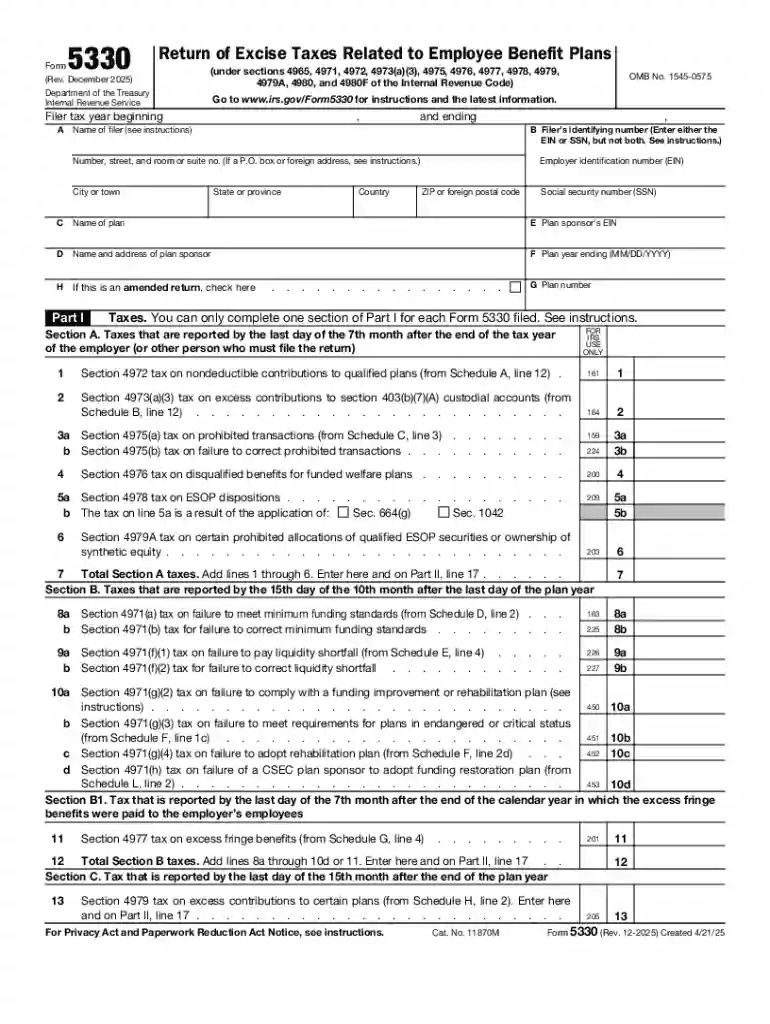
Type text, add images, blackout confidential details, add comments, highlights and more.

Draw your signature, type it, upload its image, or use your mobile device as a signature pad.

Send it via email, link, or fax. You can also download it, export it or print it out.
Form 5330, officially titled "Return of Excise Taxes Related to Employee Benefit Plans" (Rev December 2025), is a tax document used to report and pay excise taxes linked to specific employee benefit plans. These taxes apply to retirement plans when certain compliance standards aren’t met. Form 5330 ensures transparency in plan management and helps the IRS enforce adherence to tax codes related to employee benefits.
The form covers various sections of the Internal Revenue Code (IRC), specifically targeting excise taxes under sections like 4965, 4971, 4972, and others. Each section deals with different compliance issues, such as excess contributions or prohibited transactions, necessitating a thorough understanding to file correctly.
To complete Form 5330, begin by obtaining the latest version from the IRS website or through tax software that supports this form. The form consists of several parts, each corresponding to different IRC sections. It's crucial first to identify which section(s) apply to your specific situation.
Carefully read the instructions accompanying each part to ensure correct completion. Misreporting can lead to penalties, so if in doubt, consult with a tax professional.
Filing deadlines for Form 5330 vary depending on the excise tax type. Generally, it should be filed by the last day of the seventh month after the event causing the excise tax. For instance, taxes related to excess contributions should be reported and paid by this deadline, ensuring compliance and avoiding late penalties.
It’s essential to note these deadlines, as late submissions can incur significant penalties. Keep a calendar of key dates as outlined in the IRS instructions to manage timely filing.
The IRS provides detailed instructions for completing Form 5330, outlining the requirements and processes for different excise tax scenarios. Adhering to these guidelines is crucial for correct filing:
Understanding these guidelines minimizes errors and ensures compliance with federal tax obligations related to employee benefit plans.
Failing to file Form 5330 or misreporting the excise taxes due may result in severe penalties. Penalties are typically a percentage of the excise tax owed, which can increase if late payments persist. The IRS can also impose penalties for each day the return is late.
Timely and accurate completion of the form is essential to avoid these financial setbacks. If unsure of how to proceed, it’s advisable to seek assistance from a tax advisor who is well-versed in employee benefit plan regulations.
Understanding specific terms related to Form 5330 is pivotal:
Several tax software options, such as TurboTax and QuickBooks, may offer support for completing Form 5330. These tools often provide guidance and calculations to help ensure accuracy. Ensure the software is updated to reflect the latest IRS revisions before beginning.
Research software options to find those that best support Form 5330 requirements, simplifying the process and reducing the risk of errors.
At DocHub, your data security is our priority. We follow HIPAA, SOC2, GDPR, and other standards, so you can work on your documents with confidence.




Dec 8, 2025 You may claim exemption from withholding for 2026 if you meet both of the following conditions: you had no federal income tax liability in 2025Read more
Mar 12, 2021 The Directors present their Strategic Report on the Rolls-Royce plc Group (the Group), together with the audited financial statements for the.Read more
Apr 21, 2025 You can only complete one section of Part I for each Form 5330 filed. See instructions. Section A. Taxes that are reported by the last day ofRead more


