
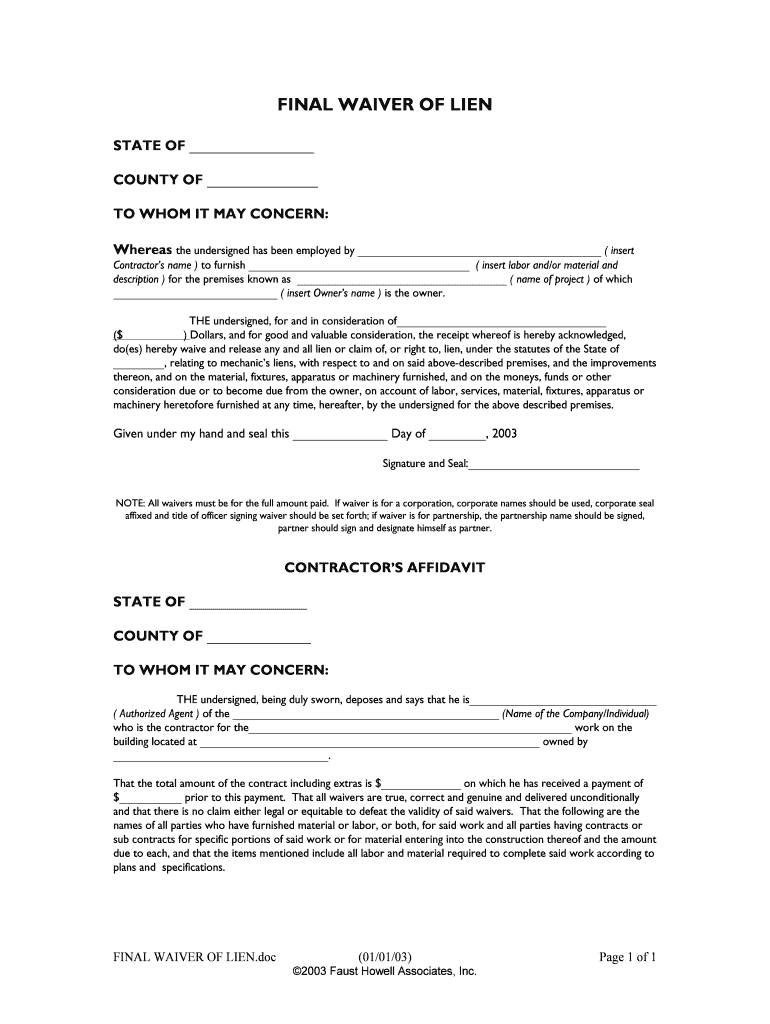







Definition and Meaning
The "Final Waiver of Liendoc" is a legal document used in the construction industry to waive any remaining claims or rights to a mechanic's lien upon completion of a project. When a subcontractor, laborer, or supplier completes work on a property, a lien is often retained on the property to ensure payment. This final waiver represents a formal acknowledgment that all payments have been received, relinquishing the right to file any future lien claims against the project.
- Purpose: Ensures that the property owner has clear title to the property with no outstanding liens.
- Parties Involved: Typically signed by contractors or subcontractors.
- Importance: Prevents legal disputes by confirming no further claims will be made.
How to Use the Final Waiver of Liendoc
Successfully executing a Final Waiver of Lien requires careful attention to detail and understanding of the applicable legal framework.
-
Preparation:
- Download the correct form, ensuring compliance with state-specific requirements.
- Verify all outstanding invoices or payments have been settled.
-
Filling the Form:
- Accurately enter personal and project-related information, such as contract details and amounts received.
- Clearly state that payment has been fully settled and no further claims will be made.
-
Signing and Notarization:
- Ensure the document is signed by an authorized representative of the company waiving the lien.
- Depending on jurisdiction, have the document notarized to affirm its legality and validity.
-
Distribution:
- Provide copies of the signed and notarized waiver to the property owner and relevant parties for their records.
- Confirmation: Follow up to ensure that the waiver has been processed, leaving no outstanding liens.
Legal Use of the Final Waiver of Liendoc
Understanding the legal context in which a Final Waiver of Lien is used can prevent complications down the line.
- Binding Agreement: Legally binds the signee to relinquish any future lien-related claims on the property.
- Compliance: Must adhere to state laws regarding lien waivers, which can vary significantly.
- Verification: Courts may require proof that payment was made before a waiver is considered valid.
- Storage: Retain a copy for legal protection, ensuring all parties have access to the finalized document.
Important Terms Related to Final Waiver of Liendoc
Familiarity with key terminology ensures a comprehensive understanding of the document's implications.
- Mechanic’s Lien: A security interest in the title to property for the benefit of those who have supplied labor or materials that improve the property.
- Conditional Waiver: A lien waiver contingent upon payment. Often contrasted with an unconditional waiver.
- Unconditional Waiver: Waives lien rights regardless of whether payment has been received.
- Retention: An amount held back from payment until project completion, affecting final payment and lien waiver initiation.
Key Elements of the Final Waiver of Liendoc
Each section of the waiver is critical in accurately conveying claims and responsibilities.
- Identifying Information: Names, addresses, and details of involved parties and projects.
- Payment Acknowledgement: Detailed accounting of payments received, specifying balance settlements.
- Waiver Declaration: Language that specifically states waiver of lien rights upon receiving final payment.
- Signatures: Must be executed properly by the waiving party's authorized representative to be valid.
State-Specific Rules for the Final Waiver of Liendoc
Requirements and formats for lien waivers are not universally standardized across the United States.
- Variations: Different states may have unique formatting, notarization, and lien filing deadlines.
- Legal Advice: Consulting with an attorney may be beneficial, especially in states with complex regulations.
- Filing Process: Some states require waivers to be filed within a specific period post-completion.
Steps to Complete the Final Waiver of Liendoc
Completing a Final Waiver of Lien accurately requires careful attention to detail and verification.
- Download the Form: Ensure you have the appropriate form for your state, as requirements differ.
- Information Review: Double-check all project details, payment amounts, and parties involved.
- Complete All Fields: Accurately fill in all required sections with precise information.
- Attachment of Evidence: Attach documentation or receipts proving payment receipt, if applicable.
- Sign and Date: Sign the waiver and ensure it is dated accurately.
- Notarization: If required, have the document notarized.
- Distribution: Share copies with all relevant parties and retain one for your records.
Who Typically Uses the Final Waiver of Liendoc
Understanding the typical users of this form can aid in identifying its applicability.
- Contractors and Subcontractors: Use the form when work is completed, and they have been paid.
- Property Owners: May require this document to ensure all claims are settled before finalizing project payments or sales.
- Legal and Financial Advisers: May assist their clients in mitigating risks related to unpaid work on properties.


Examples of Using the Final Waiver of Liendoc
Real-world scenarios illustrate the utility and common practices related to the waiver.
- Residential Construction: A subcontractor finalizes a bathroom remodel, receives payment, and issues a waiver to the homeowner.
- Commercial Projects: A supplier delivers materials for a high-rise building renovation; upon receiving payment in full, they release a lien waiver.
- Public Infrastructure: A paving company completes a contract with a city public works department and submits the waiver as confirmation of payment receipt.
This guide provides a thorough exploration of the Final Waiver of Liendoc, ensuring stakeholders effectively utilize this critical document.




