




01. Edit your form online
Type text, add images, blackout confidential details, add comments, highlights and more.

Type text, add images, blackout confidential details, add comments, highlights and more.

Draw your signature, type it, upload its image, or use your mobile device as a signature pad.

Send it via email, link, or fax. You can also download it, export it or print it out.
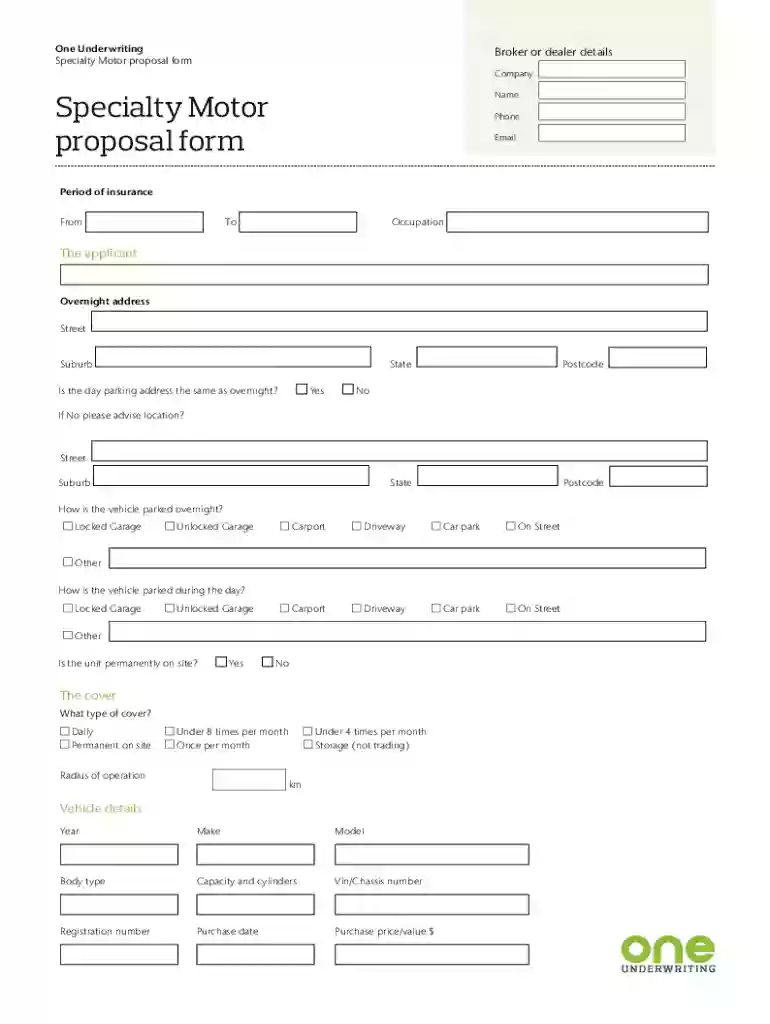
The Specialty Motor Proposal Form is a vital document used in the insurance industry, particularly for specialty motor vehicles. This form collects essential information, such as the applicant's identity, vehicle specifications, and coverage details. By detailing these critical components, the form supports insurance providers in assessing risks and determining suitable coverage options for unique vehicles. Specialty vehicles are often individualized and can include classic cars, motorcycles, or custom-modified vehicles, requiring comprehensive details to assess their insurance needs accurately.
The Specialty Motor Proposal Form includes several important elements that ensure an all-encompassing submission. Key elements consist of:
These elements help insurers to offer precise and tailored policies that cover the specific risks associated with specialty motor vehicles.
Completing the Specialty Motor Proposal Form requires attention to detail and precision. Follow these step-by-step instructions for accuracy:
Understanding and completing this form correctly is vital for ensuring comprehensive coverage and avoiding any potential claims issues.
Acquiring the Specialty Motor Proposal Form can be straightforward if you know where to look. Options for obtaining this form include:
Having the form easily accessible simplifies the application process and ensures timely submission.
This form is typically used by individuals and businesses with unique motor vehicles that require specialized insurance coverage. Common users include:
These users rely on the Specialty Motor Proposal Form to secure adequate protection for their valuable assets.


The use of the Specialty Motor Proposal Form is regulated to ensure compliance with insurance laws and regulations. Some legal considerations include:
Adhering to these legal standards helps prevent disputes and ensures valid policy coverage.
Several real-world scenarios highlight the use of the Specialty Motor Proposal Form:
These examples illustrate the versatility of the form for ensuring proper coverage of specialized vehicles under various conditions.
While completing the Specialty Motor Proposal Form, many users benefit from software integration solutions that streamline the process:
Such digital solutions reduce complexity, enhance efficiency, and improve accuracy in completing and submitting the form.
A clear understanding of specific terminology related to the form aids in accurate completion and interpretation:
Knowing these terms ensures applicants can make informed decisions regarding their insurance needs.
At DocHub, your data security is our priority. We follow HIPAA, SOC2, GDPR, and other standards, so you can work on your documents with confidence.


To renew your registration, please include your completed renewal application, Form MV-105, Pennsylvania. Registration Renewal Application, or Form MV-140Read more
The specialty plate fee is $30 or $40 per year, as indicated on page 2, in addition to the annual registration fee. License plates may be personalized for anRead more
High performance. Cost effective. Optimized motors for both low-voltage and high- voltage applications. Static torques from 6.5 to. 1285 in-oz). LV 11Read more


