



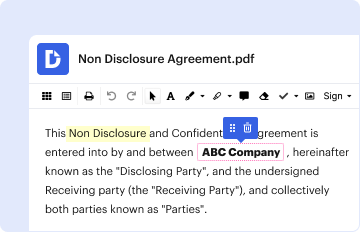
01. Edit your form online
Type text, add images, blackout confidential details, add comments, highlights and more.

Type text, add images, blackout confidential details, add comments, highlights and more.
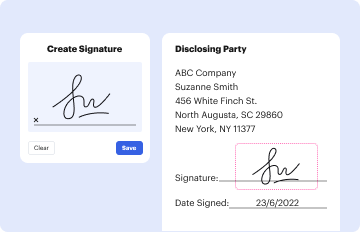
Draw your signature, type it, upload its image, or use your mobile device as a signature pad.
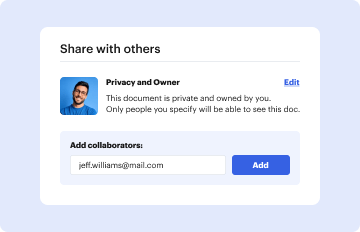
Send it via email, link, or fax. You can also download it, export it or print it out.
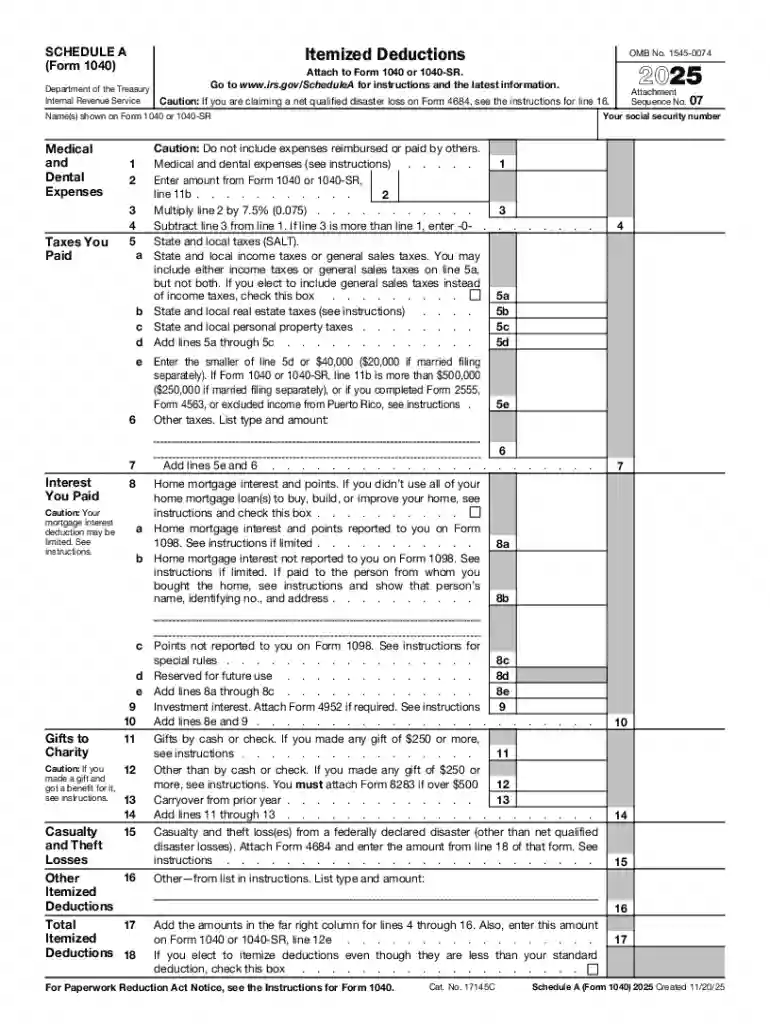
The 2025 Schedule A (Form 1040) Itemized Deductions is an IRS form used by taxpayers in the United States to report specific deductions that can reduce their taxable income. This form allows you to itemize particular expenses instead of taking the standard deduction, potentially lowering your overall tax bill if the total itemized deductions exceed the standard deduction amount. Common expenditures included in this form are medical expenses, mortgage interest, state taxes, and charitable contributions.
Using Schedule A entails compiling eligible expenses and detailing them on the form. This process requires thorough record-keeping and knowledge of deduction categories.
Filling out the Schedule A involves several detailed steps to ensure compliance and accuracy.
While the standard deduction suits many, Schedule A is particularly beneficial for individuals with higher expenses in specific categories.


Understanding key terminology is crucial for completing Schedule A correctly.
Compiled documentation ensures accuracy in reporting deductible expenses.
Timely submission of Schedule A is essential for compliance.
Understanding these blocks deeply integrates the 2025 Schedule A into the broader tax preparation process, ensuring accurate and strategic use of itemized deductions.
We've got more versions of the 2025 Schedule A (Form 1040) Itemized Deductions form. Select the right 2025 Schedule A (Form 1040) Itemized Deductions version from the list and start editing it straight away!
| Versions | Form popularity | Fillable & printable |
|---|---|---|
| 2025 | 4.1 Satisfied (27 Votes) | |
| 2024 | 4.9 Satisfied (59 Votes) | |
| 2023 | 4.9 Satisfied (45 Votes) | |
| 2022 | 4.6 Satisfied (38 Votes) | |
| 2021 | 4.8 Satisfied (181 Votes) | |
| 2020 | 4.3 Satisfied (81 Votes) | |
| 2019 | 4.1 Satisfied (40 Votes) | |
| 2018 | 4.2 Satisfied (65 Votes) | |
| 2017 | 4.4 Satisfied (61 Votes) | |
| 2016 | 4.4 Satisfied (673 Votes) | |
| 2015 | 4 Satisfied (35 Votes) | |
| 2014 | 4.3 Satisfied (52 Votes) | |
| 2013 | 4 Satisfied (21 Votes) | |
| 2012 | 3.9 Satisfied (29 Votes) | |
| 2010 | 4 Satisfied (56 Votes) |
At DocHub, your data security is our priority. We follow HIPAA, SOC2, GDPR, and other standards, so you can work on your documents with confidence.


Nov 3, 2025 Information about Schedule A (Form 1040), Itemized Deductions, including recent updates, related forms, and instructions on how to file.
For 2025, the standard deduction amount has been increased for all filers. If you dont itemize your deductions, you can take the 2025 standard deduction listedRead more
Dec 6, 2017 Modified taxable income is the amount figured on line 9 of Schedule B. If you carry two or more NOLs to a tax year, figure your modified taxableRead more


