






Definition & Meaning
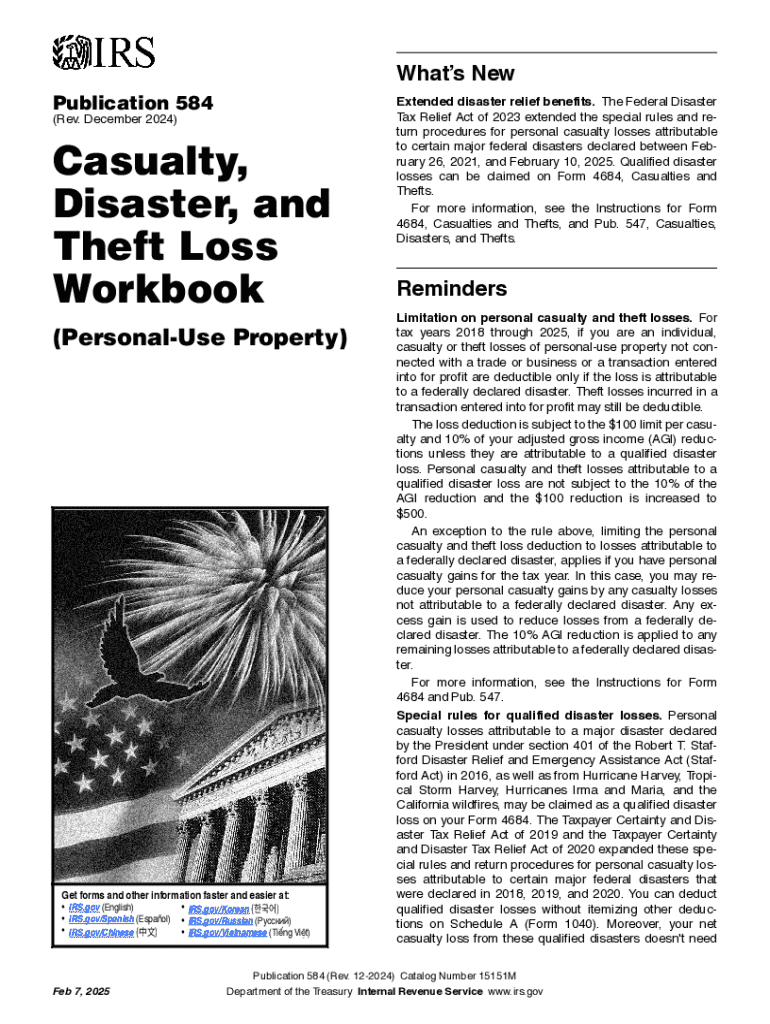
"Publication 584 (Rev December 2024)" is a comprehensive workbook designed by the Internal Revenue Service (IRS) to assist individuals in calculating casualty, disaster, and theft losses for personal-use property. This particular publication serves as a guide to help taxpayers determine the accurate amount of loss they can claim as a deduction on their tax returns. It is especially useful for individuals who have suffered losses due to unforeseen events, providing a structured approach to document and report these losses in compliance with IRS regulations.
Purpose of the Publication
The primary purpose of this publication is to simplify the complicated process of calculating deductions related to personal property loss. By offering a step-by-step worksheet and detailed explanations, it ensures taxpayers have the necessary tools to meticulously record the value of lost or damaged property, the cost of repairs, and any insurance reimbursements. This helps in determining whether the losses qualify for a deduction and the exact amount that can be claimed.
Steps to Complete the Publication 584 (Rev December 2024)
Completing Publication 584 requires a structured approach, detailed recording, and accurate calculation to ensure compliance with the tax code.
-
Gather Financial Records: Begin by collecting all relevant financial documents, such as original purchase receipts, repair invoices, and insurance claim documents. These records are critical for establishing the value of the property before and after the loss.
-
Document the Loss: Use the forms provided in the publication to list each item of personal property affected, including description, purchase price, estimated value before and after the event, and any insurance reimbursements received. This detailed record is essential for substantiating claims during an IRS review.
-
Calculate the Deduction: Follow the worksheet's instructions to compute the potential deduction. Consider any limitations imposed by the IRS guidelines, such as the 10% of adjusted gross income rule or the $100 reduction per event.
-
Review and Verify: Double-check all entries and calculations to ensure accuracy. It's crucial for avoiding discrepancies that may lead to audits or rejected claims.
-
Complete Tax Return Integration: Integrate the results from Publication 584 into your federal income tax return, specifically on the appropriate schedules or forms where casualty and theft losses are reported.
Key Elements of the Publication 584 (Rev December 2024)
Publication 584 includes essential components crucial for proper documentation and deduction of losses.
Worksheet for Determining Deductions
The worksheet is a pivotal part of the publication, providing a structured format for calculating potential deductions. It considers factors such as the decrease in fair market value and insurance reimbursements to derive the eligible deduction amount.
Instructions and Explanations
Detailed instructions accompany each section of the publication, offering guidance on how to accurately complete the forms and worksheets. This includes clarifications on technical terms and processes, ensuring users understand each step involved in the calculation.
Examples and Scenarios
Real-world examples are provided within the publication to illustrate typical cases and how the worksheet should be applied. These scenarios offer taxpayers a practical understanding of the form's application in different situations.
Important Terms Related to Publication 584
Understanding specific terms is crucial when using Publication 584 to ensure correct and legitimate calculations.
Casualty Loss
This refers to damage, destruction, or loss of property resulting from a sudden, unexpected event, such as a natural disaster or theft. It's a central element in determining eligible deductions using the publication.
Fair Market Value (FMV)
The fair market value represents the price at which the property would be sold on the open market before and after the casualty event. Accurately determining FMV is essential for calculating the deductible loss.
Adjusted Gross Income (AGI)
AGI is a taxpayer’s gross income minus specific deductions. It plays a crucial role in determining the deductible amount, as certain losses can only be claimed if they exceed a percentage of the taxpayer's AGI.
IRS Guidelines
The IRS outlines specific regulations surrounding casualty, disaster, and theft loss deductions using Publication 584.
Deduction Eligibility
According to IRS guidelines, only losses exceeding $100 and 10% of the taxpayer's AGI are deductible. This publication helps ascertain if a loss meets these thresholds.
Documentation Requirements
Adequate documentation, such as photographs of the damaged property, repair estimates, and insurance claim records, is necessary to support the loss claimed. The publication emphasizes diligently maintaining these records.
Filing Deadlines / Important Dates
Timeliness is crucial for claiming casualty and theft loss deductions.
Tax Filing Season
Publication 584 must be completed and integrated into the taxpayer's federal tax return by the April filing deadline each year, ensuring compliance with IRS mandates.
Extensions and Amendments
If required, taxpayers can file for an extension, but they should still aim to complete the publication by the original deadline to avoid late penalties. Amendments to the claims can also be filed later if new information becomes available.
Penalties for Non-Compliance
Failing to comply with IRS regulations when using Publication 584 can result in serious repercussions.
Consequences of Incorrect Calculations
Inaccurate calculations or failure to provide adequate documentation can lead to penalties, disallowed deductions, or increased scrutiny from the IRS, highlighting the need for thoroughness and precision.
Importance of Adhering to Guidelines
Adhering to all provided instructions and IRS rules ensures taxpayers avoid penalties and receive all eligible deductions, providing financial relief after a loss.
Digital vs. Paper Version
In today's digital age, Publication 584 is available in both digital and paper formats.
Benefits of the Digital Version
The digital version offers easy access, portability, and the ability to quickly update information or recalculate figures. It integrates with tax filing software, simplifying the process for users.
Paper Version Availability
For those preferring traditional methods, the paper version is obtainable from the IRS. Maintaining a physical copy can be advantageous for those without reliable digital access.
These blocks collectively furnish a detailed guide for managing casualty, disaster, and theft loss deductions using IRS Publication 584, ensuring compliance and maximizing taxpayer benefits.