




01. Edit your form online
Type text, add images, blackout confidential details, add comments, highlights and more.

Type text, add images, blackout confidential details, add comments, highlights and more.

Draw your signature, type it, upload its image, or use your mobile device as a signature pad.

Send it via email, link, or fax. You can also download it, export it or print it out.
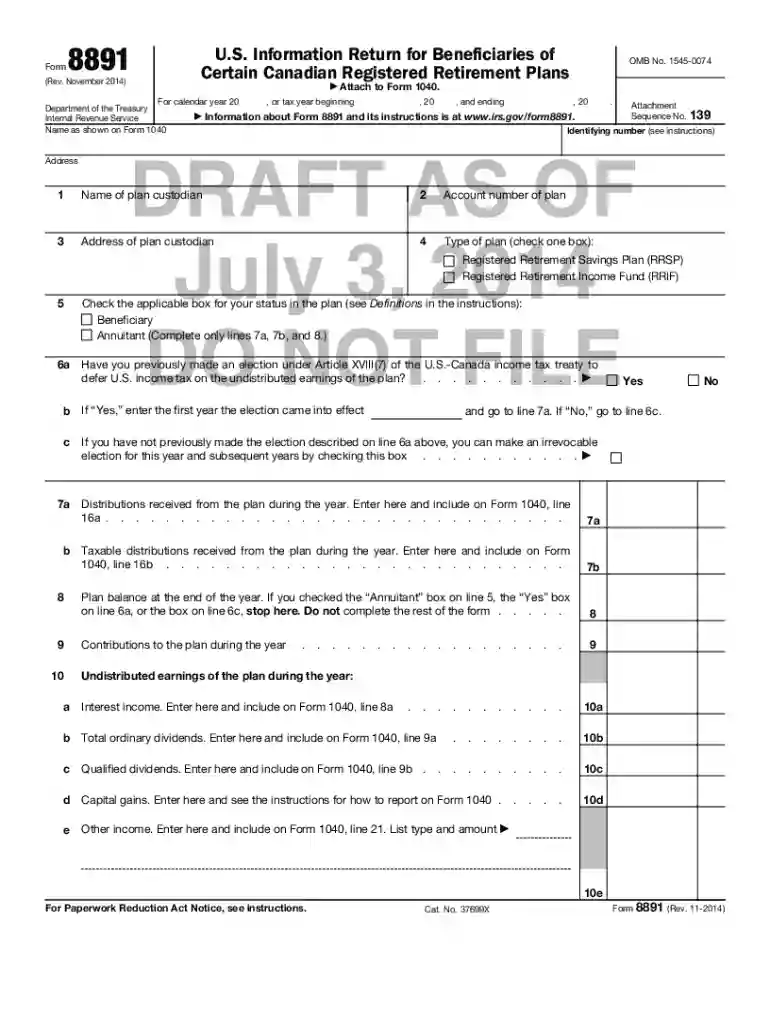
Form 8891 (Rev November 2014), known as the U.S. Information Return for Beneficiaries of Certain Canadian Registered Plans, is designed for use by U.S. taxpayers who are beneficiaries of specific Canadian Registered Retirement Savings Plans (RRSPs) or Registered Retirement Income Funds (RRIFs). This form serves a dual purpose: it reports contributions to, and distributions from, these Canadian accounts, helping ensure compliance with U.S. tax laws.
This form helps the IRS track income generated from foreign financial accounts, ensuring U.S. residents accurately report their global income.
To effectively use Form 8891, a taxpayer needs to understand the specifics of completing and filing it. This involves providing information regarding the RRSP or RRIF, including the account's value, contributions, and distributions.
Utilizing this form accurately helps avoid potential penalties for underreporting foreign accounts.
Form 8891 can be obtained directly from the IRS website. The form is downloadable and printable in PDF format, making it accessible for those preparing their tax documentation.
By utilizing these resources, acquiring this form becomes straightforward, allowing you to remain compliant with U.S. tax regulations.
Completing Form 8891 involves a detailed understanding of the sections that need to be filled out. Following a systematic approach ensures accuracy in reporting.
Ensuring each section is completed accurately is critical to avoid discrepancies and potential audits.
Form 8891 is a critical document for U.S. taxpayers with Canadian RRSPs or RRIFs, primarily to remain compliant with tax laws and avoid potential penalties.
Using Form 8891 facilitates transparent and honest reporting of foreign financial activities.
Form 8891 is commonly used by U.S. taxpayers who hold Canadian RRSPs or RRIFs. These individuals may be dual citizens, expatriates, or those maintaining investment interests in Canada.
Identifying who needs this form helps ensure compliance across different financial and residency scenarios.
Understanding the terminology associated with Form 8891 is essential for accurate completion and comprehension of its requirements.
Having clarity on these terms aids in ensuring that entries on Form 8891 are correct and comprehensive.
Form 8891 must be used in accordance with specific legal guidelines to preserve its validity and prevent legal issues for the taxpayer.
By adhering to legal standards, taxpayers can confidently fulfill their obligations without facing unintended legal challenges.
The IRS provides comprehensive guidelines for the correct filing of Form 8891, ensuring that taxpayers are well-informed of their tax obligations.
Following these guidelines closes any gaps in understanding that could lead to filing errors or oversight.
We've got more versions of the Form 8891 (Rev November 2014) U S Information Return for Beneficiaries of Certain Canadian Registere form. Select the right Form 8891 (Rev November 2014) U S Information Return for Beneficiaries of Certain Canadian Registere version from the list and start editing it straight away!
At DocHub, your data security is our priority. We follow HIPAA, SOC2, GDPR, and other standards, so you can work on your documents with confidence.



by C Blum 2023 Cited by 6 For Canadian RRSPs or RRIFs, I.R.S., Form 8891, U.S. Information. Return for Beneficiaries of Certain Canadian Retirement Plans, had been required in lieuRead more
Jul 3, 2014 Form 8891 is used by U.S. citizens or residents (a) to report contributions to Canadian registered retirement savings plans. (RRSPs) andRead more
Apr 15, 2015 Whats New. Premium tax credit. You may be eligible to claim the premium tax credit if you, your spouse, or a dependent.Read more


