




01. Edit your harris motion online
Type text, add images, blackout confidential details, add comments, highlights and more.

Type text, add images, blackout confidential details, add comments, highlights and more.

Draw your signature, type it, upload its image, or use your mobile device as a signature pad.

Send harris motion via email, link, or fax. You can also download it, export it or print it out.
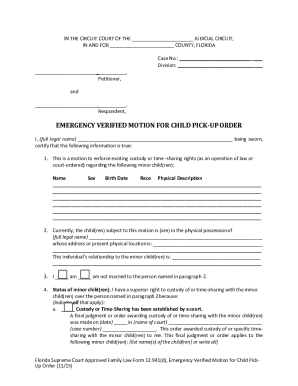
A Harris Motion refers to a specific legal procedure often used within the United States legal system. It is typically filed in court to request a specific action or ruling related to a case, which could include matters such as suppressing evidence, dismissing charges, or compelling discovery. The motion's purpose is to ensure fair legal proceedings and to protect the rights of individuals involved. Understanding the Harris Motion's application and relevance is crucial for legal professionals and defendants, as it can significantly affect the outcome of a legal case.
Identify the Legal Requirement: Determine the specific legal issue or evidence that the Harris Motion seeks to address. This step may involve consulting legal counsel or reviewing the case details to understand what the motion aims to accomplish.
Draft the Motion: Prepare a formal legal document detailing the motion's request. The document must include relevant case information, the specific legal issue at hand, and the desired outcome of the motion. Clear and precise language is essential to convey the request effectively.
Gather Supporting Evidence: Collect documents, testimonies, or legal precedents that support the motion's argument. This evidence is crucial for justifying the motion and persuading the court to rule in favor of the request.
File the Motion in Court: Submit the completed motion to the appropriate court where the case is being heard. Ensure that the filing complies with the court's procedural rules, including deadlines and required formats.
Serve the Motion: Provide copies of the motion to all relevant parties involved in the case, such as opposing counsel and the court clerk. Proper service of the motion is vital for ensuring that all parties are informed of the request.
Attend the Hearing: Be prepared to present the argument in court if a hearing is scheduled. This may involve further clarification of the motion's purpose and addressing any questions from the judge or opposition.
Objective: Clearly state the purpose and desired outcome of the motion, ensuring the court understands the specific relief being sought.
Legal Basis: Reference relevant statutes, case law, or constitutional provisions that support the motion. This legal foundation is essential for validating the request.
Factual Background: Provide a concise summary of the case's background, highlighting pertinent facts that justify the need for the motion.
Supporting Arguments: Present logical and persuasive arguments that demonstrate why the court should grant the motion. This should include any mitigating circumstances or errors that the motion seeks to address.
Suppression of Evidence: A request within a Harris Motion to exclude specific evidence from being considered in the trial, often due to its illegal acquisition.
Discovery: Refers to the pre-trial process where parties obtain evidence from each other. A Harris Motion may seek to compel or limit certain discovery actions.
Due Process: A constitutional guarantee that legal proceedings will be fair, and a Harris Motion may be used to uphold these principles.
The Harris Motion is commonly used in criminal cases to protect defendants' rights and ensure fair trials. It is designed to address issues like improper evidence handling or procedural violations that could impact the integrity of the case. Legal professionals often use this motion strategically to challenge the prosecution’s case and safeguard the legal rights of the accused.
Evidence Suppression: In a case where evidence was obtained without a warrant, a Harris Motion might be filed to suppress the evidence and prevent it from being used in court.
Case Dismissal: If prosecutorial misconduct is suspected, a Harris Motion could be used to request the dismissal of charges against a defendant.
The application and acceptance of a Harris Motion can vary by state. Each jurisdiction may have its own procedural requirements, filing deadlines, and legal standards that influence how the motion is processed in court. Legal practitioners must be familiar with the specific rules governing Harris Motions in their state to effectively utilize this legal tool.
Harris Motions are predominantly used by defense attorneys in the United States, especially in criminal cases. They serve as an essential instrument for protecting defendants' constitutional rights, challenging unfair legal procedures, and ensuring a balanced trial process.


At DocHub, your data security is our priority. We follow HIPAA, SOC2, GDPR, and other standards, so you can work on your documents with confidence.
Dec 5, 2025 {1} Defendant-appellant Christopher Harris appeals his convictions for felony offenses arising from a shooting that took place at the start ofRead more
Nov 12, 2025 This was the vanity card of Harve Bennett and Harris Katleman, independent producers known for Salvage I, the 1978 syndicated version of Quiz Kids.Read more
by GR Burkhart 1993 Cited by 37 Abstract. The dynamics of charged particles in x-dependent magnetotail models is examined, where x is along the Sun-Earth direction.Read more


