




01. Edit your form online
Type text, add images, blackout confidential details, add comments, highlights and more.

Type text, add images, blackout confidential details, add comments, highlights and more.

Draw your signature, type it, upload its image, or use your mobile device as a signature pad.

Send it via email, link, or fax. You can also download it, export it or print it out.
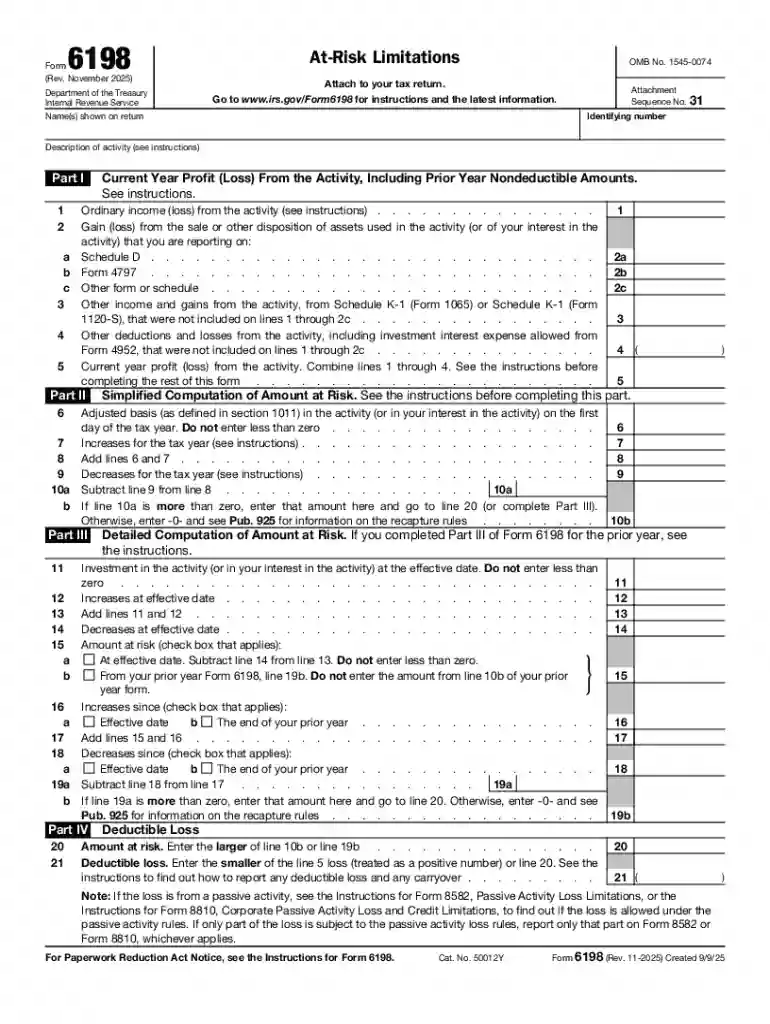
Form 6198, also known as At-Risk Limitations, is a document used primarily by taxpayers involved in certain types of financial activities, including partnerships and S-corporations, to determine the limit of their deductible losses. The form assesses how much a taxpayer has at risk in a given activity, which directly affects the deductible loss claimable for that activity. Understanding this form is crucial because it directly impacts how much you can claim as a deduction, thus potentially lowering your taxable income significantly.
A practical application may involve a taxpayer who has invested in a small business partnership. The form helps assess the deductible portion of any losses sustained by confirming the invested and borrowed funds genuinely at risk.
Successfully using Form 6198 involves careful completion to ensure compliance and maximize deduction benefits. Here are essential steps:
Identify the Activities: Determine the financial activities that may be subject to at-risk limitations. This typically involves any involvement in partnerships, S-corporations, or other retail investments.
Calculate At-Risk Amount: Establish the total amount at risk. Include any cash contributions, adjusted basis of contributed property, and certain amounts borrowed with personal liability.
Complete the Form: Fill in the form, starting with Part I, which involves calculating the total amount you have at risk. Part II provides details on income, deductions, and losses related to the activity.
Submit with Tax Return: Attach the completed Form 6198 to your annual tax return, ensuring all information is accurate to avoid IRS complications.
Completing Form 6198 involves specific steps that ensure accuracy and compliance. Here's a step-by-step guide:
Detail Investment and Activity: Begin by detailing the nature of the investment or financial activity.
Calculate Total Investment: Calculate the total sum invested in the activity, including loans secured by personal asset involvement.
Assess Losses: Document any losses sustained in the activity during the fiscal year.
Detail Adjustments: Make necessary adjustments for prior recoveries and prior losses not allowable under at-risk provisions.
Complete Sections Appropriately: Ensure each section concerning deductions and losses is accurately filled out in Part I and II.
Each completed form impacts your tax deductions profoundly, ensuring compliance with IRS regulations and maximizing the return benefits.
Understanding specific terminology associated with Form 6198 is crucial for correct completion and useful deductions. Here are key terms:
At-Risk Amount: Amount personally at stake in any financial activity, influencing deductible loss eligibility.
Qualified Activity: Refers to businesses where the taxpayer is actively involved, possibly influencing the at-risk limits.
Nonrecourse Loan: Debt that sticks only to the collateral, not personally to the borrower, affecting the at-risk calculation.
These terms require familiarization as they directly influence how an individual should complete and benefit from Form 6198.
Key elements in Form 6198 determine compliance and deduction limits. These elements include:
Investment Details: Specifics about financial contributions and assets exposed to risk.
Borrowed Funds: Detailing all funds borrowed under secured and unsecured terms.
Income and Deductions: Provides clarity on the returns from the financial activity and applicable deductions.
These elements must be accurately documented to ensure the form fulfills its role in financial deduction considerations.
IRS guidelines bring clarity to how Form 6198 should be managed. Key instructions include:
Report All Activities: All applicable business activities serving as risk elements must be reported.
Ensure Accuracy: Verify that all figures and information are accurate to prevent errors.
Follow Filing Dates: Adherence to IRS deadlines ensures compliance and avoids penalties.
Understanding these guidelines ensures proper handling, minimizing risks of audits or fines from the IRS.
Submitting Form 6198 offers various methods:
Online Filing: Enables quick submissions through IRS-sanctioned e-filing systems.
Mail-In: Traditional method by preparing a hard copy and mailing it with your tax return.
In Person: Direct submission at IRS offices, less common but a secure option.
Choosing a method depends on convenience and specific circumstances, like accessibility or confidence in electronic filing.
Failing to comply with Form 6198 requirements can lead to significant penalties:
Inaccurate Reporting: Leads to potential penalties, especially with exaggerated deductions.
Missing Deadlines: Late submissions lead to fines, interest, and audits.
Omitted Information: Important activity omissions may directly impact tax compliance status with possible back auditing consequences.
Different taxpayers frequently use Form 6198, including:
Self-Employed Workers: Those with varied income streams from risky ventures.
Partnership Entities: Business partners facing collective risks in commercial projects.
These scenarios present a need to complete Form 6198 accurately to minimize avoidable financial risks.


Business entities benefiting from Form 6198 include:
Limited Liability Companies (LLC): Allows proprietary risk management through calculated deductions.
Corporations: Particularly S-corporations require accurate at-risk calculations for fiscal audits.
Understanding entity types involved helps with proper form application, ensuring all risk-related attributes mirror the legal frameworks.
We've got more versions of the Desktop: Form 6198 - At-Risk Limitations form. Select the right Desktop: Form 6198 - At-Risk Limitations version from the list and start editing it straight away!
At DocHub, your data security is our priority. We follow HIPAA, SOC2, GDPR, and other standards, so you can work on your documents with confidence.


An S corporation shareholder is required to file Form 6198, At-Risk Limitations, when the losses exceed the amount at risk in a trade or business activity. ThisRead more
If the charge for an item of Durable Medical Equipment exceeds the price indicated for that item, attach an invoice to the claim form which shows the actualRead more
Sep 9, 2025 14. 15. Amount at risk (check box that applies): a. At effective date. Subtract line 14 from line 13. Do not enter less than zero. b. From yourRead more


