




01. Edit your form online
Type text, add images, blackout confidential details, add comments, highlights and more.

Type text, add images, blackout confidential details, add comments, highlights and more.

Draw your signature, type it, upload its image, or use your mobile device as a signature pad.

Send it via email, link, or fax. You can also download it, export it or print it out.
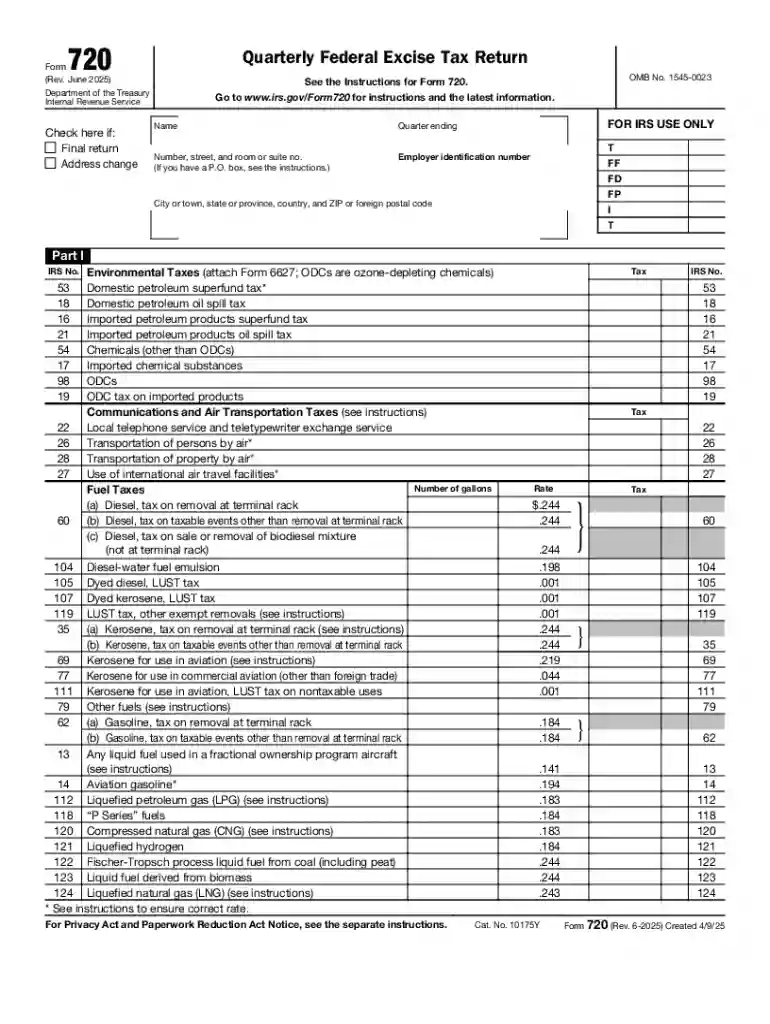
Form 720, the Quarterly Federal Excise Tax Return, is a critical document used by businesses to report and pay federal excise taxes. These taxes apply to specific goods, services, and activities, such as environmental and fuel taxes. Using this form is essential for businesses to remain compliant with IRS regulations concerning excise tax obligations. The form includes sections dedicated to tax liabilities, claims for refunds, and payment details. Understanding its structure and purpose is key for businesses affected by excise taxes.
The instructions for Form 720 guide users in accurately completing the form. These instructions detail the specific excise taxes that must be reported, provide clarification on where to input data, and offer information on potential exemptions and applicable credits.
Filing deadlines for Form 720 follow a quarterly schedule, which businesses must adhere to in order to remain compliant. The specific due dates are as follows:
Meeting these deadlines is crucial to avoid penalties and ensure timely processing by the IRS.
The IRS provides detailed guidelines that businesses must follow when completing Form 720. Compliance with these guidelines is mandatory to ensure accurate reporting and payment of excise taxes.
Failure to comply with IRS regulations when filing Form 720 can lead to penalties. These may include:
Different business structures have varied implications for filing Form 720. It's important for business owners to understand whether their entity type affects how excise taxes are reported and paid:
Businesses have the option to submit Form 720 in either digital or paper format. While electronic filing is often more efficient and can speed up processing times, paper submissions are still accepted. Choosing the right submission method depends on the business's existing processes and infrastructure.
To ease the filing process, many businesses utilize software systems compatible with Form 720. Common platforms include:
Different taxpayer scenarios illustrate when and how Form 720 might be relevant:
Understanding these practical applications helps businesses accurately complete Form 720 according to their specific needs and obligations.


We've got more versions of the Instructions for Form 720, quarterly federal excise tax return form. Select the right Instructions for Form 720, quarterly federal excise tax return version from the list and start editing it straight away!
| Versions | Form popularity | Fillable & printable |
|---|---|---|
| 2025 | 4.5 Satisfied (21 Votes) | |
| 2025 | 4.5 Satisfied (23 Votes) | |
| 2024 | 4.2 Satisfied (28 Votes) | |
| 2024 | 4.3 Satisfied (26 Votes) | |
| 2023 | 4.6 Satisfied (31 Votes) | |
| 2023 | 4.4 Satisfied (58 Votes) | |
| 2022 | 4.1 Satisfied (22 Votes) | |
| 2022 | 4.8 Satisfied (140 Votes) | |
| 2021 | 4.3 Satisfied (170 Votes) | |
| 2021 | 4.4 Satisfied (97 Votes) | |
| 2020 | 4.2 Satisfied (117 Votes) | |
| 2020 | 4.4 Satisfied (333 Votes) | |
| 2019 | 4.3 Satisfied (79 Votes) | |
| 2018 | 4.3 Satisfied (189 Votes) | |
| 2017 | 4.3 Satisfied (128 Votes) |
At DocHub, your data security is our priority. We follow HIPAA, SOC2, GDPR, and other standards, so you can work on your documents with confidence.




Instructions for Form 720, quarterly federal excise tax return. Check request options from Main Library Government Information - Lower Level Room B190 (T
Apr 27, 2017 For federal income tax purposes, reduce your section 4081 excise tax liability by the amount of excise tax credit allowable under section 6426(c).
Jun 30, 2025 If you file the second quarter Form 720 only to report the PCOR fee, no filing is required in other quarters unless you have to report other.


