
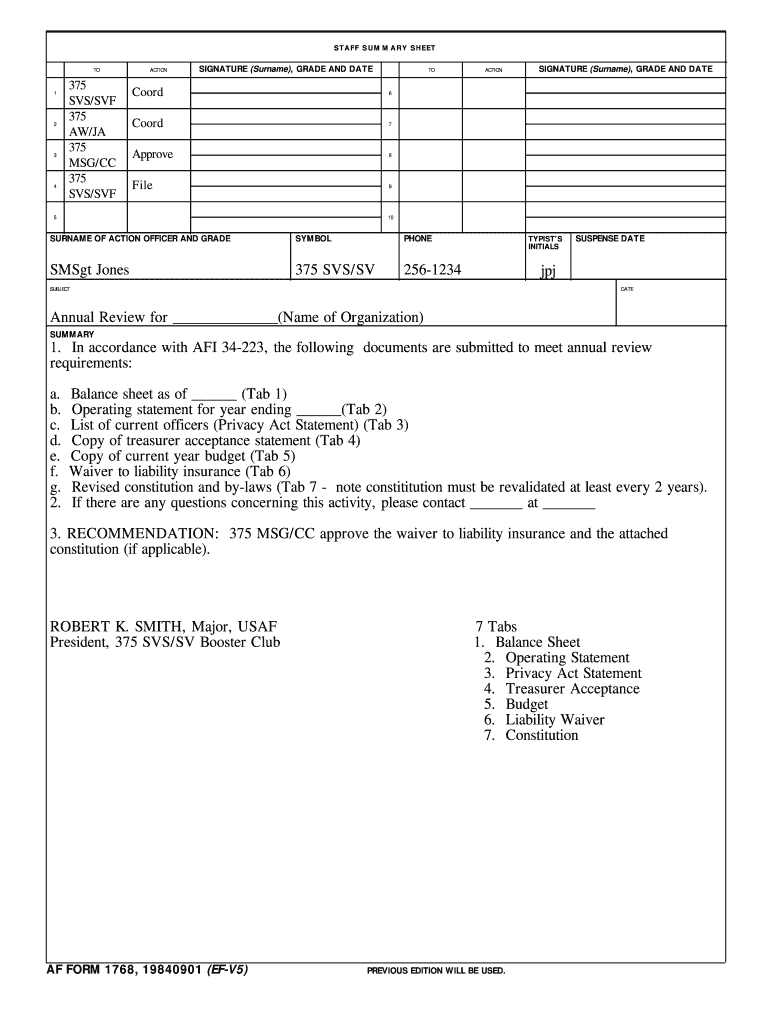







Definition & Meaning
The AF 1768, also known as the AF Form 1768 or Air Force Form 1768, serves as an essential administrative document used within the United States Air Force. This form is primarily employed for the purpose of presenting and summarizing information related to staffing, requests, and various actions taken within the organization. The role of this form extends to enhancing communication and ensuring proper documentation of decisions made at different levels of command. It is commonly utilized in conjunction with official submissions and evaluations like the Electronic Staffing Summary Sheet (ESSS), which further streamlines processes within the Air Force.
Key Elements of AF 1768
- Identification Information: This includes details such as the office symbol, document number, and date. This information establishes the context of the document and helps track its relevance and history.
- Request Summary: A concise overview of the action or information being submitted for review or approval, ensuring clarity in communication.
- Justification Section: This component outlines the rationale behind the request, providing the necessary background to facilitate informed decision-making by reviewers.
- Official Signatures: Signatures from appropriate authorities affirm the validity and acceptance of the content presented in the form, adding a layer of accountability.
- Tracking Information: Indicates the status of the request or action, such as pending review or final approval, to maintain visibility throughout processing.
Steps to Complete the AF 1768
Filling out the AF Form 1768 requires careful attention to detail to ensure all relevant sections are accurately completed.
- Gather Necessary Information: Collect all relevant data, including previous correspondence, related documents, and essential details that are required to support your request.
- Fill Out Identification Section: Enter the office symbol, date, and document number in the designated fields. This step establishes the framework for tracking your form within the Air Force system.
- Draft the Request Summary: Clearly articulate the matter at hand in a brief paragraph. This summary should be straightforward and encompass the core issue or action being proposed.
- Provide Justification: Detail the reasons for submitting the request. It’s critical to include pertinent facts or previous actions taken that support your case. Additionally, any relevant policies or directives that apply should be cited here.
- Obtain Required Signatures: After completing the form, secure the necessary approvals from your supervisors or other authority figures. This step is crucial to validate the request and initiate the official review process.
Important Considerations
- Accuracy is Critical: Ensure all information entered is correct to prevent unnecessary delays.
- Know Your Audience: Tailor the content of the form to match the expectations and priorities of the decision-makers who will review it.
- Timeline Awareness: Consider internal deadlines for submission to facilitate a timely response from reviewing parties.
Legal Use of AF Form 1768
The AF Form 1768 is recognized as an official document within the military administrative framework and must be utilized in accordance with established Air Force guidelines. Compliance with relevant legal and regulatory frameworks is essential when using this form for the following reasons:
- Policy Adherence: Submissions must align with Air Force Instructions (AFIs) and applicable directives to be considered valid.
- Accountability: The signatures present on the AF 1768 demonstrate responsibility and acknowledgment of the contents by those who authorize actions represented within the form.
- Retention Requirements: Completed AF forms may be subject to retention schedules defined by organizational policies, ensuring that documentation remains accessible for any future audits or examinations.
Penalties for Non-Compliance
Failure to comply with the proper use protocols of the AF Form 1768 can result in several administrative consequences, including:
- Delayed Approvals: Submissions that do not meet required specifications may be returned for correction, slowing down processes and impacting mission readiness.
- Increased Scrutiny: Non-compliance can lead to heightened scrutiny during audits or inspections, potentially undermining organizational credibility.
- Formal Reprimands: In severe cases, individuals who perpetually neglect proper form usage may face disciplinary action or additional reviews.
Common Non-Compliance Issues
- Incomplete Forms: Failing to fill out all required sections can lead to the rejection of the form.
- Missing Signatures: Submissions lacking necessary approvals delay processing and require resubmission.
Examples of Using AF Form 1768
In practice, the AF Form 1768 can be leveraged in a variety of scenarios within the Air Force. Here are a few illustrative examples:
- Staffing Requests: When a unit requires additional personnel, the AF 1768 can be used to outline the request succinctly, justifying the need based on mission requirements.
- Resource Allocation: If a department needs additional funding or resources to support operations, the form can summarize the request, provide justification, and document approval from leadership.
- Policy Changes: When proposing changes to existing policies or procedures, the AF Form 1768 serves as a formal mechanism to document the proposed revisions and ensure all stakeholders are aware of and support the initiative.
Each example not only demonstrates the form's utility but also illustrates its role in promoting transparency and accountability within Air Force operations.
Summary of AF Form Features and Uses
The AF Form 1768, integral to Air Force documentation practices, enhances processes while ensuring efficient communication across various administrative levels. It has broad applicability, from staffing and resource allocation to policy proposals, and serves as a critical instrument in maintaining organized and accountable operations. Correctly utilizing the form can prevent delays and reinforce the integrity of administrative actions, underscoring its significance in the military framework.




