






Definition and Meaning of Publication 6292-A
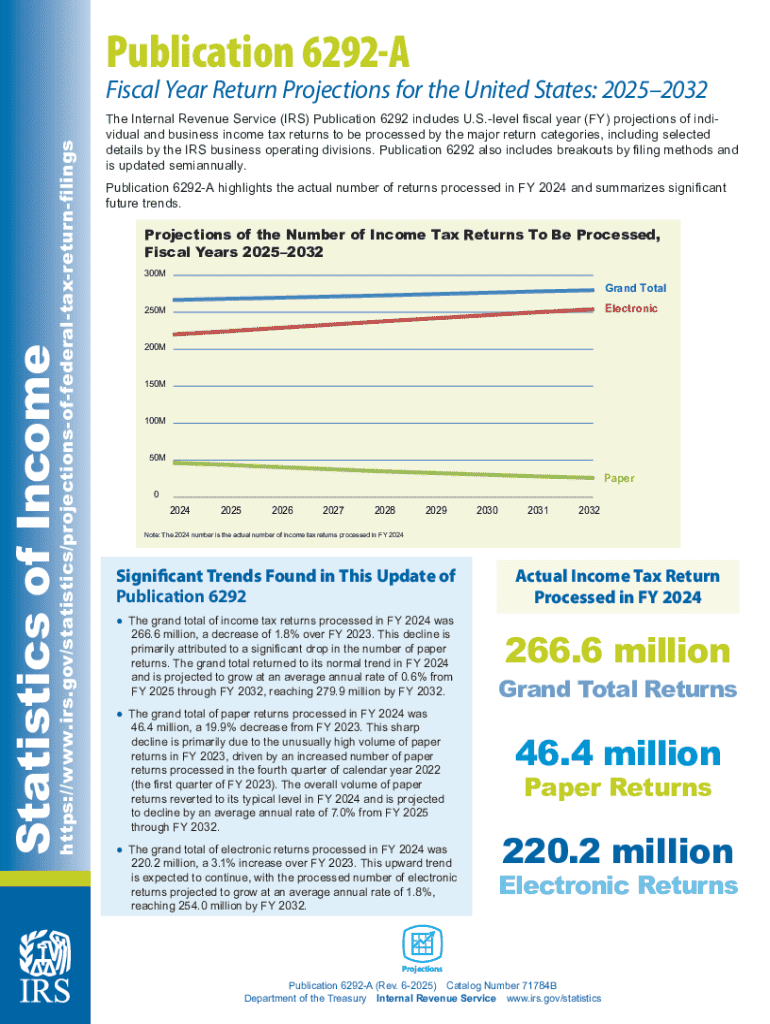
Publication 6292-A serves as an essential resource by providing detailed projections for federal tax return filings in the U.S. from FY 2025 to FY 2032. This document offers insights into the anticipated number of tax returns, highlighting processing trends, potential changes in filing methods, and demographic shifts impacting overall filing statistics. It provides a comprehensive overview that assists taxpayers, accountants, and policy-makers in understanding future tax landscape shifts and strategic planning.
How to Use Publication 6292-A
Users of Publication 6292-A can employ the document to anticipate and prepare for shifts in tax filing processes. For instance, accountants can leverage the information to advise clients on transitioning from traditional paper submissions to the increasingly prevalent electronic filing systems. Tax consultants can also use this data to optimize client strategies, adapt to evolving IRS practices, and comply with emerging regulatory requirements tailored to the projected volumes and processing shifts.
Steps to Complete Tasks with Publication 6292-A
- Review the Projections: Begin by evaluating the future filing trends and predicted volumes.
- Analyze Trends and Patterns: Identify shifts in client demographics or filing behaviors.
- Strategize Filing Processes: Develop approaches for adapting to increased electronic filings.
- Update Client Advisory Services: Integrate the projections into advisory services, highlighting efficiency improvements.
- Consult with Stakeholders: Share insights with partners to ensure aligned strategies for anticipated changes.
Key Elements of Publication 6292-A
- Filing Volume Projections: Understand projected changes in the total number of filings.
- Electronic vs. Paper Filings: Analyze the shift towards electronic submissions, which are expected to rise by 1.8%.
- Annual Growth Rate: Account for the average annual growth rate of 0.6% to strategize effectively.
- Detailing Drop in Paper Returns: Pay attention to the significant decrease in paper returns, falling by 19.9% initially.
Penalties for Non-Compliance with Filing Projections
Failure to adhere to the filing projections and prepare accordingly could lead to under-preparation and non-compliance. The IRS may impose penalties for late submissions, incorrect filing methods, or inadequate adaptation to filing shifts, which can negatively impact financial planning and tax strategy outcomes. Organizations must prioritize understanding and acting on the insights provided to mitigate such risks.
IRS Guidelines for Publication 6292-A
The IRS utilizes the predictions from Publication 6292-A to encourage strategic shifts in taxpayer behavior toward digital methods. Guidelines facilitate a smooth transition to electronic filing, promoting convenience and compliance. IRS recommendations also aid in reducing volumes of paper returns and streamlining submission processes, aligning with automation and technological advancements.
Software Compatibility
Publication 6292-A can enhance planning for software developers integrating tax filing features into platforms like TurboTax and QuickBooks. Understanding forthcoming trends informs the evolution of existing software, enabling timely updates to support electronic filing capabilities. Developers can thereby ensure their applications remain compatible with IRS projections, facilitating seamless user experiences and minimal disruption during the transition.
Taxpayer Scenarios: Self-employed, Retired, and Students
Different taxpayer groups, such as the self-employed, retirees, and students, can utilize Publication 6292-A predictions to forecast their tax obligations.
- Self-Employed: Anticipate quarterly tax estimates and adapt record-keeping for digital submissions.
- Retired Individuals: Project potential changes in taxable income sources and filing methods.
- Students: Understand possible benefits and deductions, facilitating accurate tax submissions in alignment with filing behavior trends.


State-Specific Rules and Differences
Publication 6292-A, while federal in scope, must be contextualized with state-specific filing rules. Variations in state regulations may impact the interpretation of projections, necessitating a tailored approach to tax planning. Each state may exhibit distinct responses to filing trends, affecting localized taxpayer strategy and compliance requirements.