






Definition & Meaning
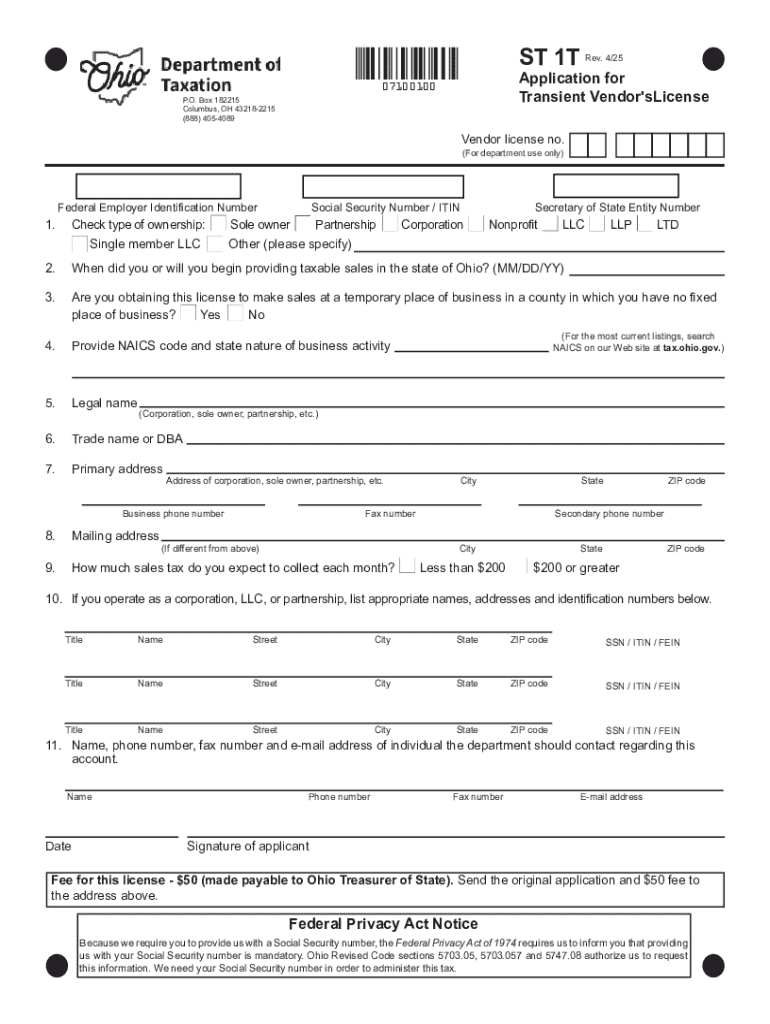
The Department of Taxation Application for Transient Vendor's License is a crucial document for individuals or businesses intending to sell goods or services on a temporary basis in various jurisdictions. This form allows vendors to operate legally across different regions, ensuring compliance with state-specific sales tax regulations. A transient vendor's license permits the seller to conduct sales at various locations, often at markets, fairs, or other temporary venues, without the need for a permanent business location in each area.
Key Components of the Application
-
Personal and Business Information: Applicants must provide detailed information about their identity and business. This includes the business name, address, and type of ownership (such as sole proprietorship, partnership, or corporation).
-
Tax Identification: The form requires the vendor's tax identification number, which can be a Social Security number for individuals or an Employer Identification Number (EIN) for businesses.
-
Business Activity Description: A clear description of the goods or services to be offered must be included. This helps state authorities determine the appropriate tax obligations.
How to Use the Department of Taxation Application for Transient Vendor's
To use the transient vendor's application, follow a structured approach beginning with gathering necessary documents and information, filling out the form accurately, and submitting it according to state guidelines.
Steps for Utilization
-
Document Preparation: Ensure all personal and business information is up-to-date. Gather necessary tax documents and ensure the correct identification numbers are available.
-
Filling the Application: Complete each section of the form carefully, ensuring no fields are left blank unless specified as optional. Pay special attention to areas requiring detailed business activity descriptions.
-
Submission: Depending on state requirements, submit the application via mail, online, or in-person. Stick to the format and medium preferred by the local Department of Taxation.
Steps to Complete the Department of Taxation Application for Transient Vendor's
Completing the application involves several detailed steps, requiring careful attention to ensure compliance with tax regulations.
Detailed Step-by-Step Process
-
Gather Required Information: Have on hand all personal and business information, including full legal names, addresses, and contact details.
-
Provide Tax Identification: Insert accurate tax identification numbers, ensuring consistency with previous filings and documentation.
-
Detail Business Operations: Include comprehensive details about the nature of the business, highlighting the types of goods or services offered.
-
Complete Financial Sections: Accurately report any financial estimates, such as expected sales revenue and potential tax liabilities.
-
Review and Sign: Double-check all entries for accuracy and completeness. Sign and date the application to affirm the truthfulness of the provided information.
-
Submit to Appropriate Authority: Follow specific state guidelines for submission, whether electronically or physically delivering the document.
Required Documents
Submitting the Department of Taxation Application for Transient Vendor's necessitates several supporting documents that prove business legitimacy and enable tax calculation.
Commonly Required Documents
-
Proof of Business Registration: Documentation demonstrating legal business entity status, such as articles of incorporation or a business license.
-
Identification Proof: Government-issued identification for individual applicants or business partners.
-
Tax Documentation: Previous tax filing records or documentation supporting claims made within the application, such as a recent tax return.
-
Financial Statements: If necessary, recent financial statements that illustrate the business's operational status and capacity.
Eligibility Criteria
To qualify for a transient vendor's license, applicants must meet specific criteria, ensuring the legitimacy and proper operation of their business.


Basic Eligibility Requirements
-
Legal Age: Applicants must generally be at least eighteen years of age.
-
Business Registration: The business must be legally registered within the state where the application is made, even if the vendor operates across multiple jurisdictions.
-
Tax Compliance: The applicant must have no outstanding tax liabilities or unresolved tax disputes, ensuring all previous obligations are settled.
-
Classification of Sales: The sales activities must fall under categories defined as transient or temporary by state law.
Form Submission Methods
Submitting the transient vendor's application can often be done through multiple channels, tailored to accommodate preferences for digital or traditional methods.
Submission Options
-
Online Submission: Most states offer an online portal where applications can be submitted quickly and securely. This method often provides immediate confirmation of receipt.
-
Mail: For those preferring traditional methods, completing a physical form and sending it through the postal service is an option. Ensure all documents are included to prevent processing delays.
-
In-Person: Some jurisdictions allow for direct submission at local tax offices, providing the opportunity for immediate feedback and correction of potential errors.
Penalties for Non-Compliance
Failure to comply with transient vendor licensing regulations can result in significant penalties that impact the business's financial health and operational legality.
Possible Consequences
-
Fines and Fees: Non-compliance often leads to monetary penalties, including fines that can increase over time with continued disregard.
-
Legal Action: Persistent violations of licensing requirements can lead to legal action, resulting in court appearances and additional legal fees.
-
License Suspension or Revocation: Severe or repeated non-compliance may result in the suspension or permanent revocation of the transient vendor's license, hindering business activities.
Filing Deadlines / Important Dates
Understanding and adhering to filing deadlines is critical to maintaining compliance and avoiding penalties associated with late submissions.
Important Timeframes
-
Initial Application Deadline: Vendors should file the application well in advance of their intended start date to ensure timely issuance of the license.
-
Renewal Periods: Many states require annual renewals, necessitating vendors remain aware of their specific renewal timeframe to avoid lapses in licensure.
-
Change Notifications: Any changes in business structure or operations must often be reported within a specified period to maintain accurate records with the Department of Taxation.