






Definition and Purpose
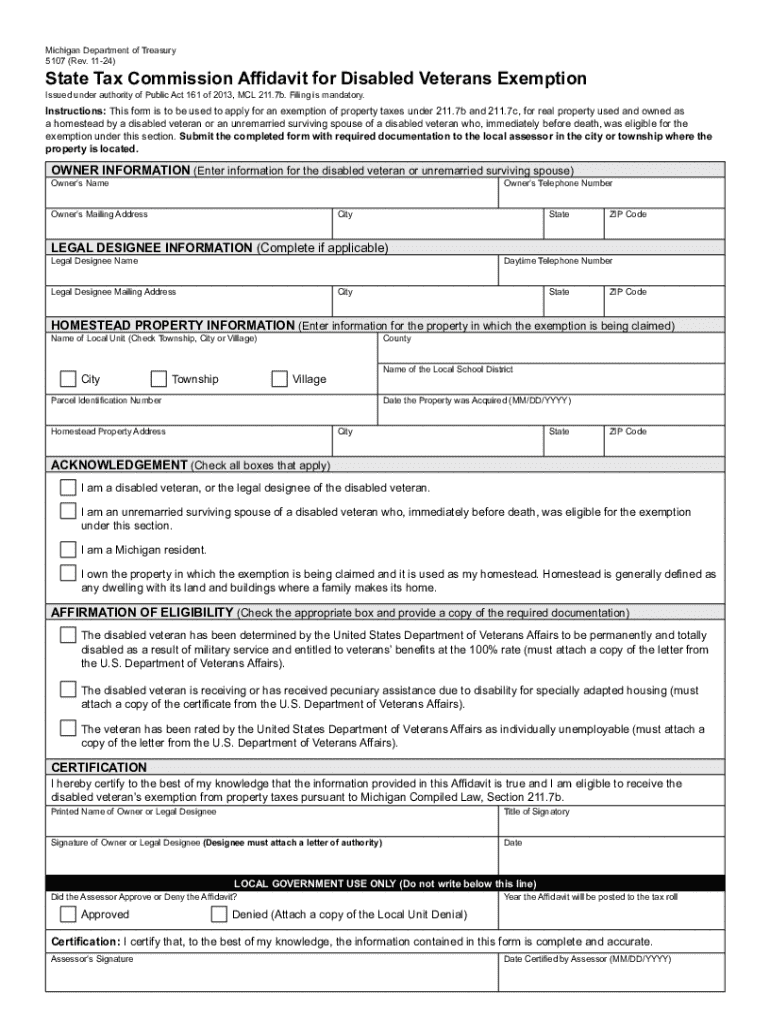
This form, officially known as "Instructions: This form is to be used to apply for an exemption of property taxes under 211," is issued by the Michigan Department of Treasury. It serves as an application for disabled veterans or their unremarried surviving spouses to seek a property tax exemption. The form, governed by Public Act 161 of 2013, requires specific details about the property owner and the property itself, alongside verifying eligibility criteria.
Eligibility Criteria
To apply for an exemption of property taxes under 211, the applicant must meet specific eligibility requirements. This primarily includes being a disabled veteran recognized by the U.S. Department of Veterans Affairs, or being the unremarried surviving spouse of such a veteran. The applicant must own and occupy the property as a primary residence in Michigan. It's crucial to provide valid documentation supporting the veteran's status and property ownership.


Steps to Complete the Form
-
Gather Required Information: Collect details about the property, including its description, assessed value, and property identification number.
-
Complete Owner Details: Fill in personal information such as the name, address, and contact details of the applicant.
-
Provide Eligibility Documentation: Attach necessary documents proving eligibility, such as a DD Form 214 for veterans, and a marriage or death certificate if applying as a surviving spouse.
-
Submit to Local Assessor: Deliver the form and supporting documents to the local assessor's office in the city or township where the property is located.
Required Documents
- Proof of Veteran Status: Official documentation from the Department of Veterans Affairs.
- Ownership Proof: Deed or other proof of ownership showing the property as the residence.
- Eligibility Verification: Disability rating certification or relevant documents for surviving spouses.
Legal Use and Compliance
The form must be used strictly for the purpose of applying for the tax exemption. The submitted information and attached documentation are subject to verification by the local assessor. Falsifying or providing misleading information can lead to a rejection of the application and possible legal consequences for fraud.
State-Specific Rules
The exemption is applicable only to properties located within Michigan. Each local jurisdiction may have specific submission requirements or deadlines. Applicants are advised to contact their local assessor for precise guidelines, ensuring all aspects of the application meet local rules.
Filing Deadlines and Important Dates
Applications should be filed before the close of the property tax year for which the exemption is desired. It's important to check with the local assessor for any deadline extensions or annual submission instructions. Submissions made after the deadline may not be eligible for exemption that year.
Submission Methods (Online, Mail, In-Person)
While many localities accept submissions via mail or in-person delivery, some jurisdictions might offer online submission options. Checking with the local assessor's office will provide the most up-to-date information on acceptable submission methods.
Approval Process and Timing
Once submitted, the local assessor will review the application and attached documents. The review process may take several weeks, during which the assessor may request additional information. Applicants will be notified of approval or denial, typically within one to two months of submission.