



Definition & Meaning
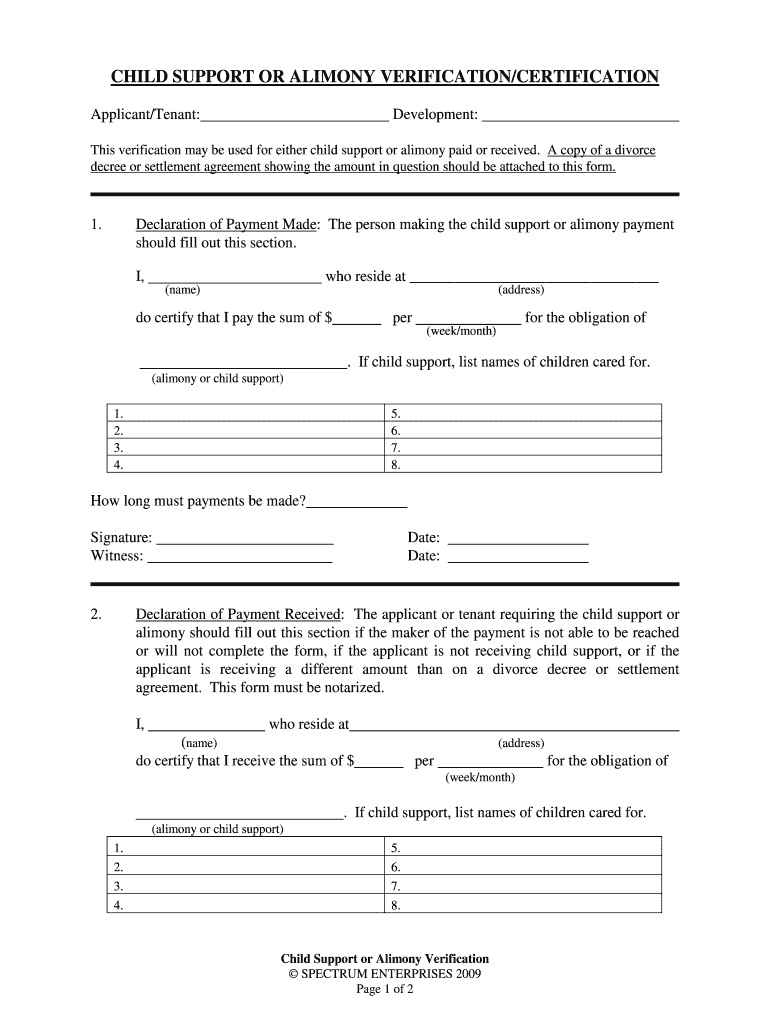
The Child Support or Alimony Verification Certification is a legal document used to verify the payments of child support or alimony. It serves as an official record for applicants or tenants to certify the amounts they pay or receive in the context of child support and alimony agreements. Recognized in the legal system, it ensures transparency and accountability regarding the financial responsibilities established during a divorce or separation settlement. By filling out this form, the involved parties provide a clear declaration of their financial dealings, which is crucial for legal and personal record-keeping.
How to Use the CHILD SUPPORT OR ALIMONY VERIFICATION CERTIFICATION
To effectively use the Child Support or Alimony Verification Certification, follow these steps:
-
Gather Required Information: Collect necessary details such as personal identification, case numbers, and financial transaction records related to child support or alimony.
-
Complete the Form: Fill in all relevant sections, including the payer's and recipient's information, payment amounts, and any pertinent case details.
-
Signature and Notarization: Ensure that all declarations are signed. Some jurisdictions may require notarization to validate the signatures and attestations made on the form.
-
Documentation: Attach any required supplementary documents, such as payment receipts or court orders, to support the information provided on the form.
This form is often used during legal proceedings or when verifying income for purposes such as applying for a rental property or government aid. Accuracy and completeness are vital to avoid discrepancies and misunderstandings.
Steps to Complete the CHILD SUPPORT OR ALIMONY VERIFICATION CERTIFICATION
When completing this certification form, adhere to the following steps for a smooth process:
-
Identify the Purpose: Understand the reason for the certification, whether it's for court submission, personal record-keeping, or financial verification.
-
Input Accurate Data: Fill out each section with precise data. This includes the amount paid or received, frequency of payments, and any arrears.
-
Verification: Double-check your entries against financial records and court documents to ensure correctness.
-
Review Legal Terms: Familiarize yourself with legal jargon and terms related to alimony and child support to accurately interpret and complete each section.
-
Proof of Payment: Attach copies of bank statements or checks that evidence payments made or received.
-
Submit: Determine the submission method – online, mail, or in-person, as required by the body requesting the form.
Following these steps diligently ensures that the form serves its intended purpose without legal obstacles.
Key Elements of the CHILD SUPPORT OR ALIMONY VERIFICATION CERTIFICATION
The success of the Child Support or Alimony Verification Certification hinges on several key elements:
-
Personal Information: Full names, addresses, and contact details of both the payer and recipient.
-
Payment Details: Clear representation of payment amounts, frequency (monthly, bi-weekly), and dates of transactions.
-
Legal References: Case numbers or legal references to the original decree or settlement agreement.
-
Signatures: Authorization from the relevant parties to validate the information provided, including any applicable witness or notary.
-
Explanations: Sections explaining any variances from the expected payments or discrepancies with legal agreements, such as missed payments or changes in financial agreements.
Ensuring all these elements are meticulously addressed enhances the form's credibility and utility in legal and financial contexts.
Legal Use of the CHILD SUPPORT OR ALIMONY VERIFICATION CERTIFICATION
This certification form holds critical importance in legal settings. It provides documentation for:
-
Court Proceedings: Used as evidence in family law courts to establish the status of child support or alimony agreements.
-
Financial Audits: Acts as proof during audits or financial reviews, reinforcing transparency in personal financial dealings related to divorce settlements.
-
Settlements and Negotiations: In divorce amendments or negotiations, this form can substantiate claims for modified support arrangements.
Legal integrity depends on the accuracy and completeness of this form, making it a significant legal document for individuals involved in family law proceedings.
State-Specific Rules for the CHILD SUPPORT OR ALIMONY VERIFICATION CERTIFICATION
State regulations can influence how these certifications are structured and enforced:
-
Documentation Requirements: Some states may have specific forms or additional documentation required alongside the certification.
-
Notarization Laws: Varying requirements for notarization can affect how certifications are validated in different jurisdictions.
-
Filing Procedures: Due dates and filing locations may differ, thus necessitating knowledge of your specific state's guidelines and legal frameworks.
Understanding state-specific rules is vital for ensuring compliance and validity of the certification in legal matters.
Examples of Using the CHILD SUPPORT OR ALIMONY VERIFICATION CERTIFICATION
Consider scenarios where this form proves essential:
-
Rent Applications: Landlords may request this form to verify an applicant's income source in rental applications.
-
Legal Disputes: In cases of delinquent payments, this certification serves as critical evidence in court disputes to establish compliance or non-compliance with child support obligations.
-
Government Aid Applications: When applying for financial assistance, showing certified proof of alimony or child support income can affect eligibility.
These use cases show the form's relevance across multiple real-world scenarios, emphasizing the importance of accurate completion and submission.
Required Documents
Before initiating the process, compile pertinent documents:
-
ID Proofs: Government-issued identification for all involved parties.
-
Financial Records: Bank statements, canceled checks, or digital payment records highlighting child support or alimony transactions.
-
Legal Documents: Copies of divorce decrees or settlement agreements that reference or outline the payment terms.
These documents support the information in the certification and are essential for validation and notarization purposes.