






Definition & Meaning
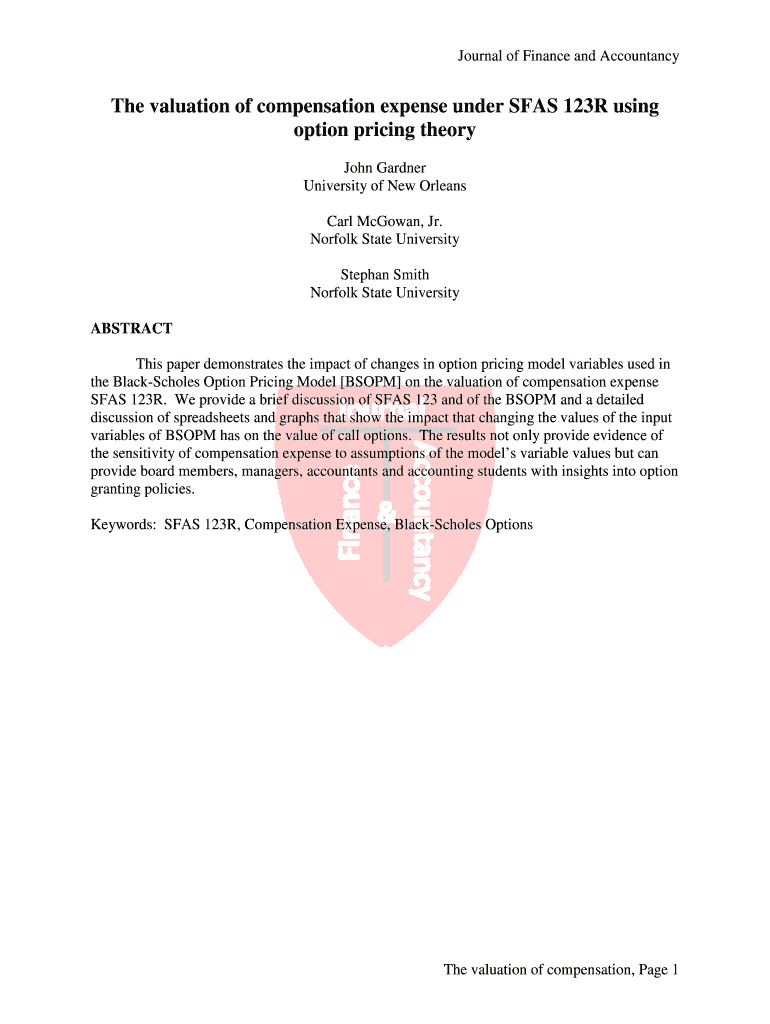
The valuation of compensation expense under SFAS 123R focuses on the accounting standards set by the Financial Accounting Standards Board (FASB) for stock-based compensation. Specifically, it pertains to measuring the cost of equity and liability instruments, such as employee stock options, over their requisite service period. SFAS 123R requires entities to recognize the cost of employee services received in exchange for awards of equity instruments based on the grant-date fair value.
Important Terms Related to SFAS 123R
Understanding the valuation process requires familiarity with key terms:
- Grant Date: The date when an entity and an employee reach a mutual understanding of the terms of a share-based payment arrangement.
- Fair Value: The price that would be received to sell an asset or paid to transfer a liability in an orderly transaction between market participants at the measurement date.
- Requisite Service Period: The period during which an employee must provide service for their share-based payment to vest.
Steps to Complete the Valuation
- Identify the Share-Based Payment: Determine if the compensation involves equity or liability instruments.
- Determine Grant Date: Establish when the mutual understanding of the award's terms occurs.
- Calculate Fair Value: Use the appropriate valuation model, such as the Black-Scholes Option Pricing Model, to estimate the grant-date fair value of the share-based payment.
- Record the Expense: Allocate the expense over the requisite service period by recognizing it in the financial statements.
Key Elements of the Valuation Process
The valuation of compensation expense under SFAS 123R involves several critical components:
- Valuation Models: Primarily utilises models like Black-Scholes, reflecting the variability of inputs such as volatility, interest rate, and time to expiration.
- Assumptions: Factors like expected volatility, expected term, and risk-free interest rates are pivotal in determining fair value.
- Financial Reporting: Requires accurate and timely reporting of expenses in income statements over the requisite service period.
Examples of Using SFAS 123R
Consider an organization that grants stock options to its employees:
- The company determines the grant-date fair value using the Black-Scholes Model, taking into account expected volatility, expected life, risk-free rate, and the stock price at grant date.
- This fair value is then expensed over the period the employee is required to provide service, often the vesting period.
Who Typically Uses SFAS 123R
SFAS 123R is predominantly used by:
- Public Companies: Mandated to provide transparent, consistent financial reporting.
- Private Companies: Although not legally required, many adopt these standards for accurate reporting and valuation.
- Accountants: Ensure compliance with financial reporting standards.
- Financial Analysts: Use this information for valuation and performance assessments.
Software Compatibility
Various accounting software platforms facilitate SFAS 123R compliance by providing tools to automate and manage stock compensation plans:
- QuickBooks: Assists in tracking stock compensation-related expenses.
- TurboTax: Provides integration features for reporting purposes, ensuring alignment with financial documents.
- SAP or Oracle: Offers enterprise-level modules to handle complex elements of equity compensation.
Compliance and Penalties
Non-compliance with SFAS 123R can lead to significant repercussions, including:
- Financial Penalties: Misstated earnings can result in penalties from regulatory bodies like the Securities and Exchange Commission (SEC).
- Reputational Damage: Failing to adhere to standard accounting practices can erode trust among investors and stakeholders.
Legal Use and State-Specific Rules
While SFAS 123R is federally mandated, some states may have additional regulations concerning the taxation and reporting of equity compensation:
- California: May have specific tax implications for stock options exercised within the state, demanding careful alignment with state regulations.
- New York: Requires attention to state income tax when dealing with equity-based compensation granted within its jurisdiction.
Each section provides a comprehensive exploration of the aspects surrounding the valuation of compensation expense under SFAS 123R, offering clarity for businesses and individuals engaging with these accounting standards.