Definition & Meaning
The "Tort Claims Act - North Carolina General Assembly" delineates the legal parameters under which individuals can initiate lawsuits against state government entities in North Carolina. This act embodies the rules and limitations governing the state's waiver of sovereign immunity, allowing citizens to seek redress for injuries attributed to negligence by state employees or agencies. It also provides a framework for understanding the obligations and rights of both the claimant and the state, defining the standards of liability, and the process for filing a claim.
Key Concepts
- Sovereign Immunity: Traditionally, the state is immune from lawsuits unless it consents to be sued. The Tort Claims Act serves as a crucial exception to this principle, permitting lawsuits under defined conditions.
- Negligence: Claimants must establish that the state or its employees acted negligently, resulting in injury or damage.
- Jurisdiction: The act specifies that the North Carolina Industrial Commission has jurisdiction over these claims, further complicating the filing process for laypersons.
How to Use the Tort Claims Act - North Carolina General Assembly
Utilizing the Tort Claims Act involves understanding the detailed process of submitting a claim for damages against the state. This process requires strict adherence to procedural rules and timelines. Potential claimants should familiarize themselves with the necessary steps and requirements to improve their chances of a successful claim.
Submission Process
- Determine Eligibility: Verify that your claim falls under the conditions allowed by the act, typically involving state employee negligence.
- Gather Evidence: Compile all relevant evidence that supports the claim of negligence and resultant damages.
Filing Steps
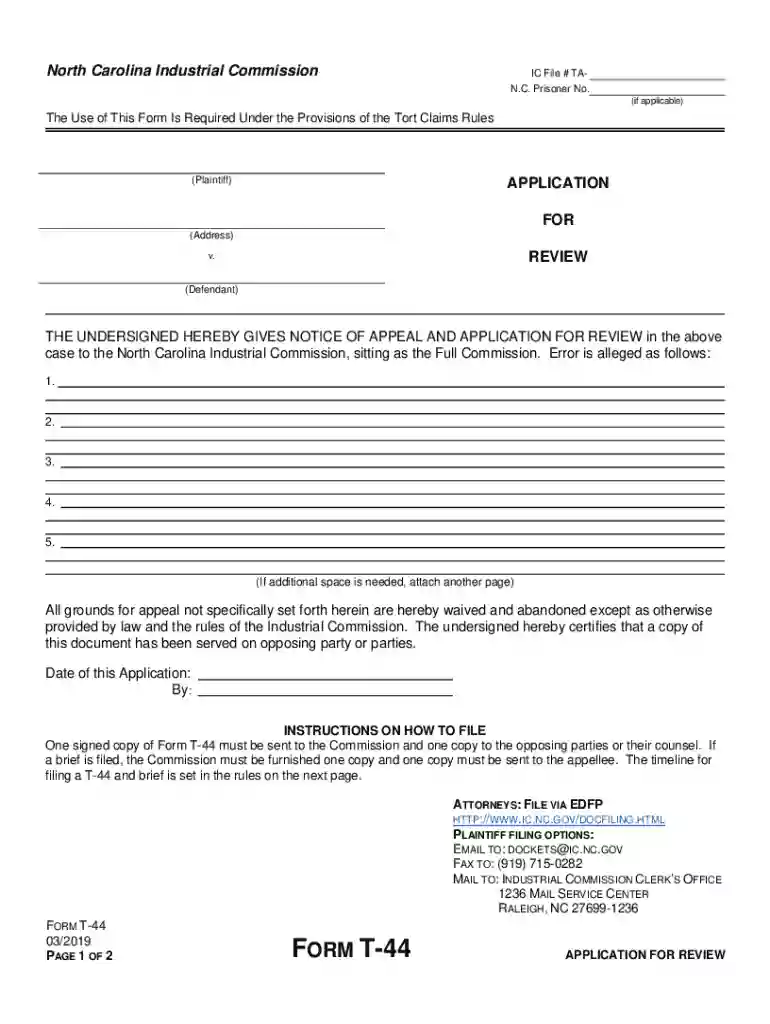
- Form Completion: Fill out the requisite forms, such as the Form T-1 for Claims Under the Tort Claims Act.
- Documentation: Attach necessary supporting documents, including evidence of harm and any witness statements.
- Submission: Submit the completed claim form and accompanying documents to the North Carolina Industrial Commission within the stipulated time frame.
Steps to Complete the Tort Claims Act - North Carolina General Assembly
Comprehensively completing the act's requirements demands attention to detail and punctuality. Each procedural step contributes to establishing a legitimate claim before the Industrial Commission.
Detailed Instructions
- Download or Access Forms: Obtain the correct forms from the North Carolina Industrial Commission’s website or their physical office.
- Complete Required Information: Accurately fill out all personal and case-specific information on the form.
- Ensure Clarity and Precision: Provide clear and precise descriptions of the incident, specifying dates, locations, and involved parties.
- Submit Evidence: Attach all necessary documents, such as medical reports and witness accounts, to support the claim.
Verification
- Reviewed by Legal Counsel: If possible, have the submission reviewed by an attorney knowledgeable in state tort law to prevent common filing errors.
- Confirmation of Submission: After submission, obtain a receipt or confirmation for your records.
Important Terms Related to Tort Claims Act - North Carolina General Assembly
Understanding the vocabulary associated with the Tort Claims Act is invaluable for comprehending and navigating its use effectively. Here are some key terms explained:
Essential Terminology
- Claimant: The person making the claim against the state.
- Respondent: The state entity or employee alleged to have been negligent.
- Industrial Commission: The body responsible for resolving tort claims against the state.
Legal Implications
- Waiver of Immunity: The act's allowance for lawsuits under specific conditions represents a waiver of the state's usual immunity.
- Due Process: The legal obligation to afford claimants a fair and impartial hearing as part of the claims process.
Legal Use of the Tort Claims Act - North Carolina General Assembly
The act is specifically designed to cater to claims of negligence involving state employees and entities, providing a legal avenue for compensation in North Carolina.
Usage Conditions
- Public Roads and Facilities: Claims often involve incidents on public roads maintained by the state or within state-run facilities.
- Educational Institutions: Cases might include negligence claims against public universities and colleges for various grounds-related incidents.
Legal Precedents
- Case Studies: Review previous successful claims to understand the benchmarks needed for a compelling case.
Filing Deadlines / Important Dates
Meeting deadlines is critical when dealing with the Tort Claims Act to ensure the validity of the claim. Missing these can often lead to a denial.
Timelines
- Notice of Claim: Typically, a claim must be filed within three years from the date of injury.
- Exceptions: Certain situations may extend or shorten this period, such as when the claimant was under legal disability.
Key Dates
- Incident Occurrence: Date of the alleged negligent act.
- Filing Deadline: Three-year mark from the date of incident or injury for submission of the claim.
Required Documents
Submitting a tort claim requires a comprehensive set of documents to establish a case's credibility and adherence to procedural rules.
Document Checklist
- Claim Form: Properly filled out and signed.
- Evidence of Injury: Medical reports, photographs, and repair bills.
- Witness Statements: Accounts from individuals who observed the incident.
Additional Recommendations
- Legal Opinions: Where applicable, affidavits from experts that support the narrative of negligence.
- Documentation of Damages: Receipts, invoices, and other such paperwork demonstrating the financial impact of the incident.
Form Submission Methods (Online / Mail / In-Person)
Claimants can choose among several submission methods depending on their preference and resources, each with its protocol.
Online Submissions
- Digital Upload: Some documents can be submitted via the Industrial Commission’s online portal for initial review and processing.
- Email Confirmation: Automated responses often confirm the receipt of submissions.
Traditional Methods
- Mail: Completed forms and documents can be sent via certified mail to ensure a record of delivery.
- In-Person: Visiting the commission's office enables direct handover and immediate acknowledgment of receipt.