Definition & Meaning
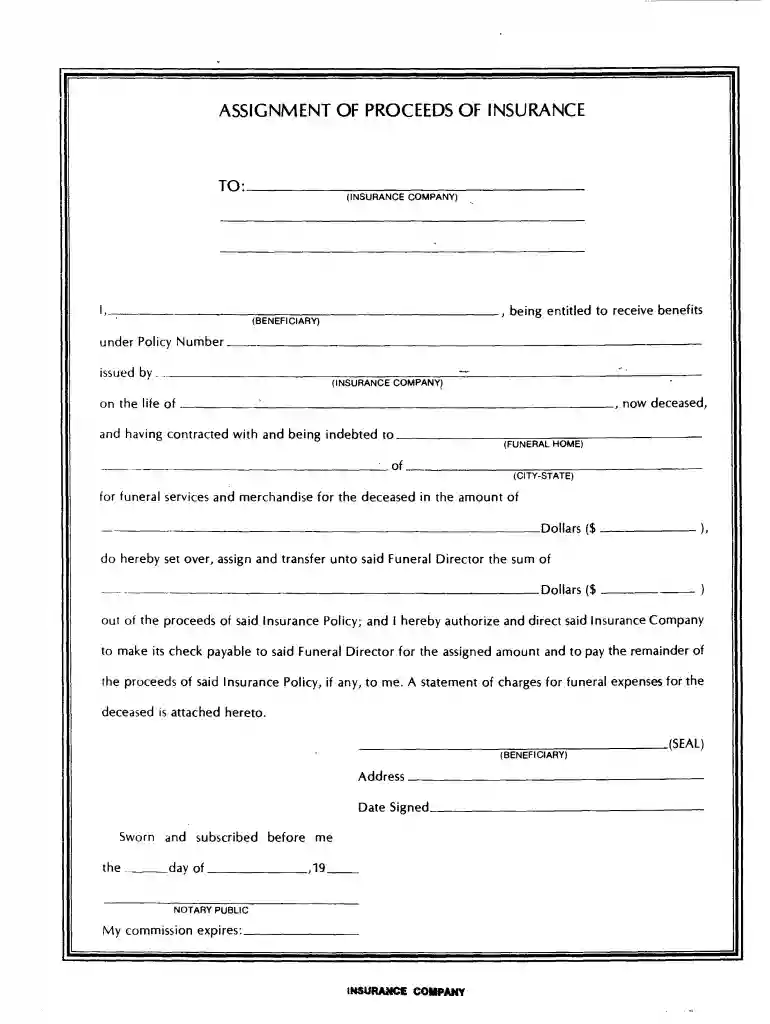
An assignment insurance form is a legal document used to transfer the rights and benefits, typically the proceeds, of an insurance policy from the policyholder to another party. This transfer is often made to secure a loan or satisfy a financial obligation where the assignee would receive the funds directly from the insurance company in the event of a claim. Understanding this form is crucial as it affects the policy's control and advantages.
Key Legal Implications
- Transfer of Rights: Upon completion, the policyholder relinquishes their rights to the proceeds in favor of the assignee.
- Binding Agreement: This form is a binding document once executed, impacting both parties.
- Revocation Conditions: The policyholder may have limitations on revokability once the assignment is in effect, unless specified conditions are met.
Practical Example
Imagine a business owner took out a loan and secured it with a life insurance policy. By using an assignment insurance form, they ensure if they pass away before the loan is repaid, the lender would receive the insurance payout directly to cover the outstanding debt.
How to Use the Assignment Insurance Form
Step-by-Step Process
- Identify the Parties: Clear identification of the assignor (policyholder) and assignee (entity receiving the benefits).
- Insurer Notification: Inform the insurance provider about your intention to assign the policy benefits.
- Complete the Document: Accurately fill out all sections of the form with details like policy number and beneficiary information.
- Witness Requirement: Depending on the insurer, a witness or notary may be required during signing for validation.
- Submit the Form: Deliver the completed document to the insurance company for processing.
Real-World Application
A borrower using an insurance policy as collateral must carefully complete the form, ensuring full understanding of commitments. The insurance company often provides guidance to mitigate errors or delays.
Steps to Complete the Assignment Insurance Form
Detailed Completion Guide
- Policy Information: Enter the policy number, type, and specific terms of the insurance coverage.
- Assignor Details: Include personal, financial, and contact information clearly.
- Assignee Details: Accurately fill in the assignee’s details, focusing on any specifics as required by the insurer.
- Scope of Assignment: Specify if the assignment covers the full policy or a specified portion.
- Signing Protocol: Follow any required protocols for signatures—witnessed or notarized, as per insurer guidelines.
- Review and Confirm: Double-check all entered information for accuracy.
Common Mistakes to Avoid
- Incomplete Information: Often leads to delays or rejection.
- Unclear Terms: Misunderstanding assignment scope can cause complications later.
Legal Use of the Assignment Insurance Form
Overview of Legal Context
- Contractual Agreement: This form constitutes a contract and is subject to contract law.
- State Regulations: Various states may have specific requirements dictating the legal use and execution of the form.
Enforcement
- Insurance Company Awareness: The insurer's acknowledgment is critical for enforcement. Legal rights are not fully transferred until the company updates its records.
- Dispute Resolution: Clear dispute mechanisms should be outlined within the form to handle any disagreements.
Key Elements of the Assignment Insurance Form
Essential Components
- Policyholder and Assignee Information: Detailed information including full names, contact details, and relationships.
- Insurance Policy Details: Precise description of the policy, including type and coverage.
- Terms of Assignment: Define what is being assigned and any limits to this assignment.
Variations
- Full vs. Partial Assignment: Policyholder decides on total benefit assignment or a specified fraction.
- Condition-Based Assignment: Allows assignment based on specific conditions or events.
Practical Scenario
A small business owner might use it to gain approval for a line of credit. By assigning their current life insurance, they provide security and assurance of repayment to the lender.
Examples of Using the Assignment Insurance Form
Case Studies
- Business Loan: A company seeks financial support and uses its policy for securing the loan, directly assigning benefits to the bank.
- Real Estate Transactions: In complex deals, the form might protect investments by assigning proceeds to the lender until obligations are met.
Lessons Learned
- Clarity is Critical: Ambiguity can lead to costly disputes. Ensure all terms are clearly defined.
- Documentation Needed: Maintain records of the transaction and communication with the insurer for future reference.
Form Submission Methods (Online / Mail / In-Person)
Available Methods
- Online Submission: Fast, secure electronic submission might be available, subject to insurer capabilities.
- Mail Delivery: Traditional option ensures delivery of paper forms but potentially slower processing.
- In-Person Submission: Allows for real-time confirmation and resolution of submission issues at insurance offices.
Comparative Analysis
- Speed: Online submission typically faster, but dependent on digital literacy.
- Reliability: In-person often ensures no step is skipped, while mail can be subject to postal delays.
By maintaining detailed information and adhering to requirements, users can ensure effective communication and processing efficiency with their insurance provider.