




Definition & Meaning
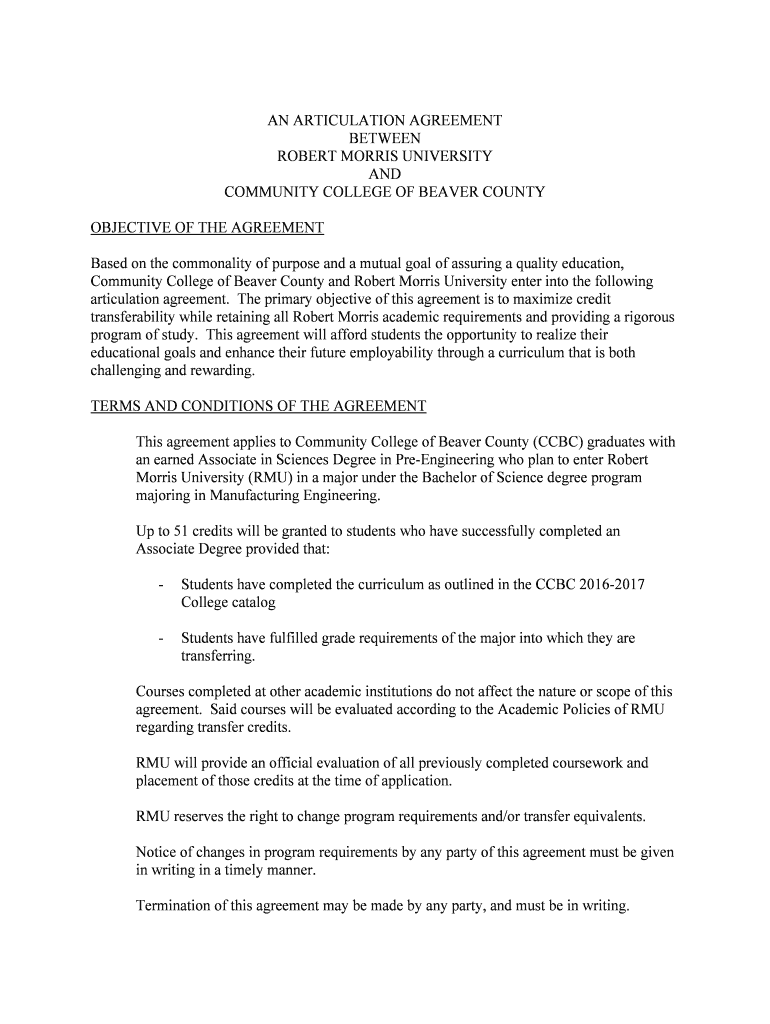
An articulation agreement is a formal partnership between two educational institutions, such as a community college and a university, to facilitate the smooth transfer of students from one school to another. These agreements specify which courses are transferable, ensuring that students do not have to retake equivalent classes and can seamlessly transition to pursue a higher degree. Articulation agreements aim to streamline the educational process, reduce redundant coursework, and support students in achieving their academic and career goals more efficiently.
Key Elements of the AN ARTICULATION AGREEMENT
An articulation agreement typically includes several critical elements:
-
Course Equivalencies: Lists specific courses that are considered equivalent at both the sending and receiving institutions, allowing students to transfer credits without complications.
-
Admission Requirements: Details the academic prerequisites and application process that students must fulfill to be admitted to the receiving institution’s program.
-
Degree Requirements: Outlines how transferred credits apply toward degree requirements at the receiving institution, helping students understand how their prior coursework fits into their new academic program.
-
Maximum Transfer Credits: Specifies the maximum number of credits that can be transferred, which prevents students from exceeding allowed limits.
-
Duration of Agreement: Indicates the period during which the agreement is in effect, which is crucial for students planning their educational timeline.
How to Obtain the AN ARTICULATION AGREEMENT
To obtain an articulation agreement, students should follow these steps:
-
Contact Academic Advising: Begin by contacting an academic advisor at your current institution to inquire whether an articulation agreement exists with your desired transfer destination.
-
Research Online Resources: Many institutions provide online databases of their established articulation agreements, which students can access to find relevant information.
-
Direct Communication: Reach out directly to the admissions or registrar’s office of the institution you wish to transfer to, to request details about existing agreements and obtain a copy for review.
-
Attend Information Sessions: Participate in information sessions or workshops offered by your institution that focus on transfer processes and articulation agreements.
Steps to Complete the AN ARTICULATION AGREEMENT
Completing an articulation agreement involves the following steps:
-
Review Eligibility Requirements: Verify that you meet the eligibility criteria specified in the agreement, such as GPA or prerequisite courses.
-
Complete Necessary Coursework: Ensure all courses slated for transfer are completed with the required grades to satisfy agreement conditions.
-
Submit Transfer Application: Apply to the receiving institution, making sure to indicate your interest in transferring under the terms of the articulation agreement.
-
Consult with Advisors: Work closely with academic advisors at both institutions to confirm that all courses and credits are accurately reflected and accepted.
-
Monitor Progress: Keep track of submissions and approvals to ensure that all parts of the agreement are fulfilled.
Examples of Using the AN ARTICULATION AGREEMENT
Consider a student aiming to transfer from Community College A to University B under an articulation agreement that guarantees credit transfer for an Associate of Science degree into a Bachelor’s program.
-
Case Study 1: A student completes an associate degree with a focus on business administration. The agreement allows for 60 credits to transfer, placing them in the junior year of the university’s business management program.
-
Case Study 2: Another student completes a computer science associate degree. Due to the articulation agreement, they transfer directly into the Bachelor of Computer Science program with sophomore standing, having satisfied the university’s math and programming prerequisites.
Why Should You Use an Articulation Agreement?
Articulation agreements provide numerous benefits:
-
Cost-Efficiency: Reduce educational expenses by minimizing redundant coursework and shortening the time needed to obtain a degree.
-
Streamlined Process: Simplify the transition between institutions by clearly outlining which credits transfer, reducing uncertainty.
-
Enhanced Planning: Allow students to strategically plan their academic journey, knowing in advance which courses will fulfill degree requirements at their future institution.
-
Academic Focus: Enable students to focus on core areas of interest without the need to repeat courses, supporting timely graduation and career progression.
Who Typically Uses the AN ARTICULATION AGREEMENT?
-
Community College Students: Individuals aiming to transfer to a four-year institution to complete a bachelor’s degree often utilize articulation agreements to ensure a smooth transition.
-
Adult Learners and Returning Students: Those returning to academia to advance their careers leverage these agreements to obtain advanced standing based on prior coursework.
-
Career Changers: Individuals switching fields who need to transfer relevant credits into a new academic program at a different institution.

Important Terms Related to AN ARTICULATION AGREEMENT
-
Transfer Pathway: A recognized sequence of courses allowing for credit transfer between institutions under an agreement.
-
Credit Articulation: The formalization of course equivalencies and credits recognized by both the sending and receiving institutions.
-
Guaranteed Admission: A condition in some agreements where admission to the receiving institution is assured if students meet specific criteria.
State-Specific Rules for the AN ARTICULATION AGREEMENT
Articulation agreements can vary based on state regulations and policies:
-
Regional Variations: Different states have unique education systems, which influence the structure and enforcement of articulation agreements.
-
State Initiatives: Some states have established comprehensive transfer frameworks to promote higher education completion rates, impacting the formation of such agreements.
By understanding and utilizing articulation agreements, students can strategically navigate their educational careers, ensuring a seamless transition between institutions and efficient progression toward their academic goals.