






Definition & Meaning
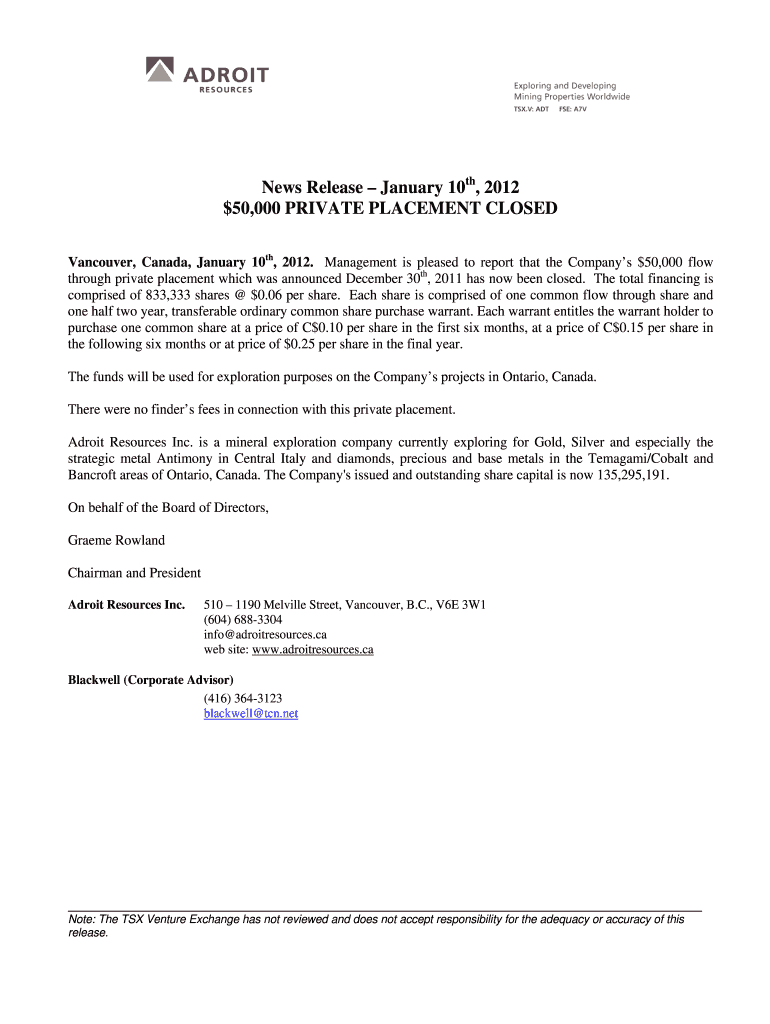
A private placement is a securities offering exempt from registration with the SEC, typically involving the sale of stocks, bonds, or securities to a small group of investors. The term "$50,000 PRIVATE PLACEMENT CLOSED" indicates that a private placement raising $50,000 has been completed. This financial arrangement permits companies to raise capital while maintaining fewer regulatory requirements than a public offering. It is commonly used by entities seeking to fund specific projects or expansions without the extensive disclosure obligations of public market transactions. The closure signifies the end of the funding round, where investors have committed the intended capital.
How to Use the $50,000 Private Placement
Private placements are versatile financial instruments used to support various business objectives. Companies can use the $50,000 capital injection to:
- Expand Operations: Increase production capacity or enter new markets.
- Fund Research and Development: Support the development of new products or technologies.
- Pay Down Existing Debt: Reduce interest expenses and improve cash flow.
- Enhance Working Capital: Provide liquidity for day-to-day operations.
The specific usage will depend on the company's strategic goals and financial priorities. Stakeholders should consider their organization's long-term plans and financial health before investing.
Steps to Complete the $50,000 Private Placement
Completing a private placement involves several critical steps:
- Identify Target Investors: Typically, institutional investors, high-net-worth individuals, or accredited investors.
- Draft Legal Documents: Prepare a private placement memorandum (PPM) detailing offer terms, risks, and company information.
- Set Terms and Conditions: Determine the valuation, share price, and any warrants or convertibles attached to the offering.
- Obtain Regulatory Compliance: Ensure adherence to SEC regulations and exemptions under Regulation D.
- Communicate with Investors: Present the offering to potential investors, addressing any queries or concerns.
- Close the Placement: Collect subscription agreements and funds from investors, and issue securities.
Key Elements of the $50,000 Private Placement Closed
Key elements to consider in a private placement include:
- Offering Memorandum: A detailed document that outlines the terms of the offering and potential risks involved.
- Subscription Agreement: The contract between the issuer and investor including commitments for investment.
- Securities Terms: Details of the securities offered, such as equity shares or convertible debentures.
- Investor Representation: A section ensuring investors meet specific criteria and acknowledge risks.
These components are crucial for legal compliance and informed decision-making by investors.
Legal Use of the $50,000 Private Placement
Private placements provide a legal avenue for companies to raise capital without undergoing the formal public offering process. Adherence to specific regulatory frameworks is essential, primarily the exemptions found under Regulation D for U.S.-based offerings. These legal frameworks stipulate the qualifications for who may invest and how the offerings can be marketed. Companies must thoroughly understand these stipulations to execute the placement legally and effectively.
Important Terms Related to $50,000 Private Placement Closed
Familiarity with specific terminology is vital:
- Accredited Investor: Individuals or entities meeting specific financial criteria that allow participation in private placements.
- Regulation D: SEC regulations providing exemptions for private placement offerings.
- Syndicate: A group of investors participating in the private placement.
- Dilution: Reduction in existing shareholders' ownership percentage following the issuance of new shares.
Understanding these terms helps stakeholders navigate the nuances of private placements effectively.
Penalties for Non-Compliance
Failing to comply with regulatory requirements can result in significant penalties, including:
- Fines: Imposed by regulatory bodies for violations of securities laws.
- Rescission Rights: Investors may have the right to rescind their purchase if terms are violated.
- Legal Action: Potential lawsuits from investors or regulators.
- Reputation Damage: Negative impact on public perception and future capital raising efforts.
Compliance with securities laws is crucial to avoid these risks.
Examples of Using the $50,000 Private Placement Closed
Private placement use cases are diverse:
- Technology Start-Ups: Raising initial seed funds to develop a prototype or market-entry strategy.
- Real Estate Projects: Funding property development or acquisition.
- Healthcare Innovations: Financing clinical trials or new medical equipment.
These scenarios illustrate the broad applicability of private placements across different industries. Each example highlights how private placements can offer crucial capital for strategic initiatives without the need for public market disclosure and regulatory burdens of traditional financing models.