







Definition & Meaning
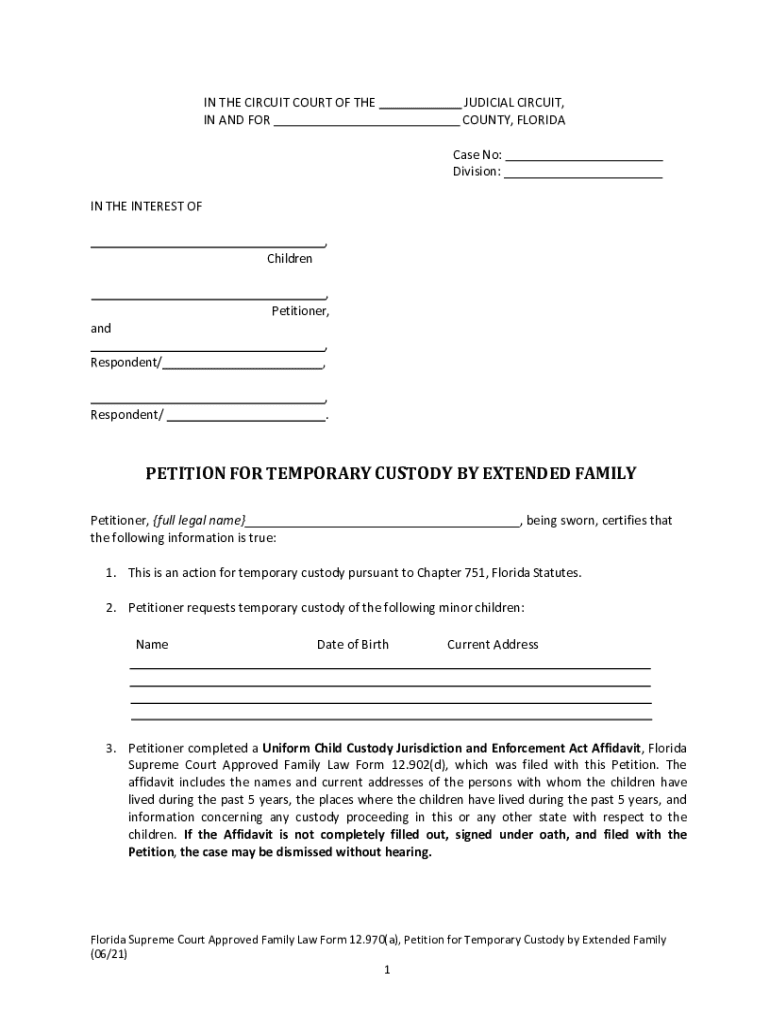
Florida Supreme Court Approved Family Law Form 12.970(a) is a legal document used in the state of Florida as a petition for temporary custody of a child by extended family members, pursuant to Chapter 751 of the Florida Statutes. This form allows individuals who qualify as extended family members, such as grandparents, aunts, uncles, or adult siblings, to seek custody if it is in the best interest of the child and the legal parents are unable or unwilling to care for them. Temporary custody enables the petitioner to make crucial decisions for the child's welfare, including medical, educational, and personal care matters.
How to Obtain the Form
Obtaining the form is relatively straightforward. It is available from several sources, including the Florida State Courts website, local courthouses, and online legal document services. To access the form online, visit the Florida Courts website, navigate to the "Family Law Forms" section, and locate Form 12.970(a). It's essential to ensure you have the latest version, as legal forms can undergo periodic updates. Some courthouses may offer paper copies upon request, and legal aid organizations provide assistance with obtaining and completing the form.
Steps to Complete the Form
- Fill in Personal Information: Provide the full names, addresses, and contact information for the petitioner, the child, and the child's parents.
- Explain Relationship: Detail how you are related to the child as an extended family member and justify your legal standing to file for temporary custody.
- State Reasons: Clearly articulate reasons for seeking temporary custody, focusing on the child’s best interests and the parents' current inability to fulfill their parental responsibilities.
- Financial Support: Describe any current financial contributions you make toward the child's upbringing.
- Additional Forms and Attachments: Include any additional required forms, such as the Uniform Child Custody Jurisdiction and Enforcement Act (UCCJEA) Affidavit, and attach relevant documents supporting your petition.
- Notarization and Filing: Get the completed form notarized and file it with the clerk of the family court in the county where the child resides.
Eligibility Criteria
Eligibility to file this form is specified under Chapter 751 of the Florida Statutes. You must be an extended family member of the child, which includes grandparent, aunt, uncle, adult sibling, or other relatives by blood or marriage who meet the statutory definition. The primary criterions are proving a substantial relationship with the child and the necessity to assume custody due to the parents' incapacity, consent, or unexpected circumstances preventing them from caring for their child.

Legal Use of the Form
The form is legally used to initiate proceedings for obtaining temporary custody of a child under specific circumstances. It becomes a tool through which extended family members can legally assume the day-to-day responsibilities for a child when it’s deemed necessary for their safety and well-being. Legal use is confined within the scope outlined by Florida statutes, and misuse or misrepresentation may result in legal consequences, including the dismissal of the petition or penalties.
Key Elements of the Form
Key elements within the form include:
- Child Information: Details about the child, including full legal name and birth date.
- Petitioner Information: Contact information and relationship to the child.
- Parent Status: Explanation of the current situation of the child's parents and reasons necessitating temporary custody.
- Child’s Best Interests: Evidence and arguments supporting that providing custody to the petitioner aligns with the child's interests.
- Acknowledgements: Confirmations under oath about the truthfulness of the information provided.
State-Specific Rules
In Florida, the use of Form 12.970(a) is governed by state-specific family law procedures. State statutes require filing in the child’s current county of residence and adherence to local judicial protocols, including mandatory mediation in some cases. It's advisable to review local jurisdiction criteria or consult with a family law attorney to understand intricate local rules that might affect your petition.
Important Terms Related to the Form
- Extended Family Member: As defined by Florida law, this may include relatives such as grandparents, aunts, uncles, or siblings.
- Temporary Custody: A legal arrangement granting the petitioner rights to provide daily care and make decisions on behalf of the child.
- UCCJEA Affidavit: A required document involving child custody details and jurisdiction.
Required Documents
When submitting Florida Supreme Court Approved Family Law Form 12.970(a), accompanying documents may include:
- UCCJEA Affidavit: A requirement to establish jurisdiction.
- Evidence Documents: Financial statements, proof of relationship, or any documentation supporting claims made within the form.
- Parental Consent Forms: If available, these can strengthen the petitioner's case.
Form Submission Methods
The form can be submitted through several channels:
- Online E-filing: Preferred by many for its convenience and speed.
- In-Person Filing: Submit directly at the courthouse to get immediate feedback on submission accuracy.
- Mail Submission: An option for those with geographical constraints or preferences for non-digital submission methods.
Examples of Using the Form
Consider the case of a grandparent whose adult child is unable to care for their child due to medical issues. The grandparent would use this form to petition for temporary custody, highlighting their close relationship and ability to ensure the child's well-being. Another instance might involve an aunt seeking to provide a stable living environment for a niece after the parents’ unexpected departure overseas.
Penalties for Non-Compliance
Failure to appropriately use or accurately complete the Florida Supreme Court Approved Family Law Form 12.970(a) can lead to several consequences including:
- Dismissal of Petition: Courts may dismiss the petition if there are inaccuracies or if the petition does not meet statutory requirements.
- Legal Repercussions: Providing false information can lead to legal actions against the petitioner.
Digital vs. Paper Version
While the digital version of the form is popular for its ease of access and submission, some still prefer paper for detailed reviews and manual completion. Both versions require identical content and completion, but the ease of e-filing and document management makes the digital form more appealing to many users.




