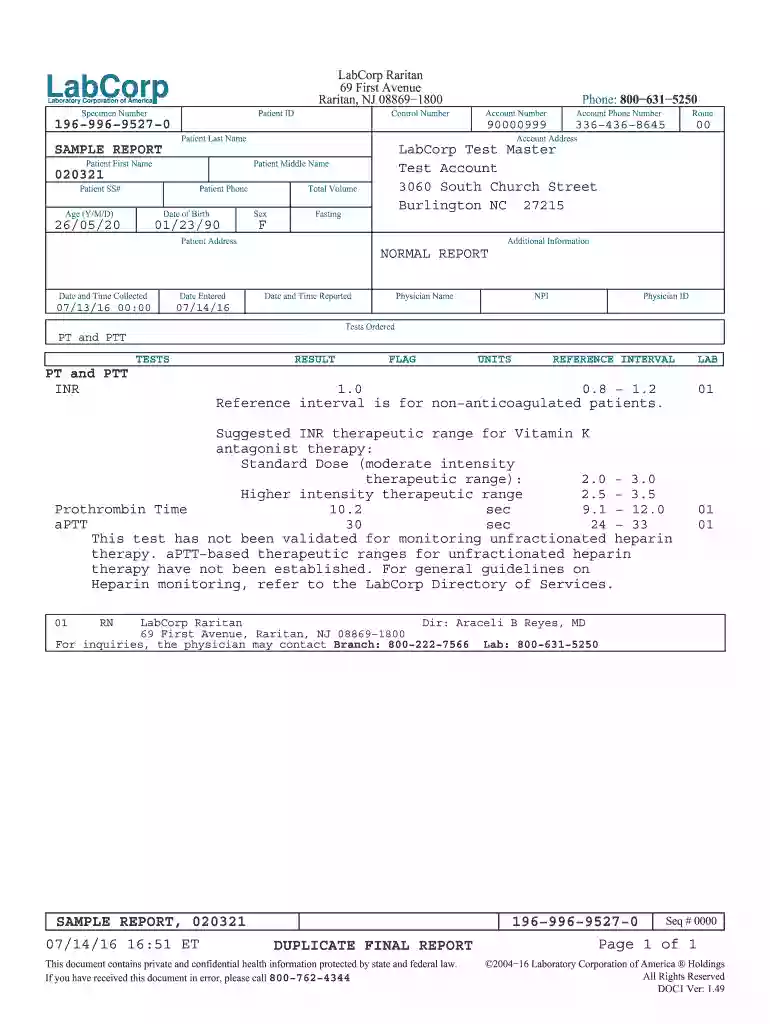
Definition and Meaning of the-0 Sample Report
The-0 SAMPLE REPORT details the results of laboratory tests conducted by a designated health care provider or laboratory, typically focused around analyses like prothrombin time (PT) and activated partial thromboplastin time (aPTT). This report serves as a documentation of a patient's coagulation status, which is critical in managing conditions such as bleeding disorders, liver disease, and monitoring anticoagulant therapy.
Key components of this laboratory report include:
- Patient Information: Contains patient's name, identification details, and relevant medical history.
- Test Results: Compares the patient's test results against established reference ranges, indicating normal or abnormal findings.
- Confidentiality Notice: Emphasizes the secure handling of sensitive health information according to HIPAA regulations, mandating confidentiality.
Such a sample report enables healthcare providers to make informed clinical decisions.
How to Use the-0 Sample Report
Using the-0 SAMPLE REPORT involves understanding its sections and interpreting the results accurately. Here’s how it can be effectively utilized:
Understanding Results: Carefully review the test results, focusing on INR, PT, and aPTT values:
- Compare against reference intervals.
- Note any abnormal results which require further medical evaluation.
Patient Communication: Share results with the patient, ensuring they understand their implications:
- Explain any terms that may be unfamiliar.
- Discuss next steps based on the results.
Clinical Decisions: Utilize the findings to adjust treatment plans, which may include:
- Modifying medications.
- Scheduling follow-up tests if required.
Documentation for Future Use: Store the report securely as part of the patient’s medical record for ongoing assessment and future reference.
Important Terms Related to the-0 Sample Report
Understanding key terms associated with the-0 SAMPLE REPORT is essential for accurate interpretation:
- Coagulation: Refers to the process by which blood changes from a liquid to a gel, forming a blood clot.
- Prothrombin Time (PT): A test measuring how long it takes for blood to clot, used primarily to assess coagulation status and effectiveness of blood-thinning medications.
- Activated Partial Thromboplastin Time (aPTT): A test that evaluates the intrinsic pathway of coagulation, providing insight into a patient’s bleeding risk.
- International Normalized Ratio (INR): A standardized number that doctors use to measure the time it takes for blood to clot and to adjust anticoagulant medication dosages reliably.
Being familiar with these terms aids in accurately discussing the sample report with healthcare providers.
Key Elements of the-0 Sample Report
The-0 SAMPLE REPORT consists of critical components that provide a comprehensive overview of the laboratory testing results:
- Patient Demographics: Includes name, date of birth, and unique identification number for accurate record-keeping.
- Testing Facility Information: Contains the name and address of the laboratory performing the tests.
- Test Type and Results: Lists specific tests performed, such as PT and aPTT, along with their results and comparison to normal ranges.
- Interpretation of Results: Provides a contextual interpretation of how test results relate to potential health conditions.
- Instructions for Further Action: May include recommendations for follow-up tests or actions the healthcare provider should take based on findings.
Each of these components contributes to a clearer understanding of the patient’s health situation.
Steps to Complete the-0 SAMPLE REPORT
Completing the-0 SAMPLE REPORT involves several essential steps:
- Collect Patient Information: Ensure accurate and complete demographic details are documented.
- Conduct Laboratory Tests: Perform PT and aPTT tests as required, following established protocols to ensure accuracy.
- Analyze Results: Once tests are complete, analyze the results in the context of patient history and symptoms.
- Document Findings: Record results in the SAMPLE REPORT format, ensuring clarity in presentation.
- Review and Sign Off: Have a qualified healthcare provider review the report for accuracy before finalizing.
- Distribute to Relevant Parties: Send the completed report to both the patient and referring physician securely.
Following these steps ensures the report is both accurate and useful for ongoing patient care.
How to Obtain the-0 SAMPLE REPORT
Obtaining the-0 SAMPLE REPORT requires a few simple steps, typically accessible through a healthcare provider or laboratory:
- Consult with a Healthcare Provider: Schedule an appointment to discuss the need for laboratory testing and referral for PT and aPTT tests.
- Laboratory Testing: Visit a designated laboratory for sample collection; the laboratory will conduct the necessary tests.
- Waiting for Results: The laboratory will analyze the samples and generate the report, usually available within a few business days.
- Receiving the Report: Access your report through an electronic health record (EHR) system, or request a physical copy from your healthcare provider or laboratory.
Understanding these steps ensures timely access to important health information.