






Definition and Purpose of Form 41 Fiduciary Income Tax Return
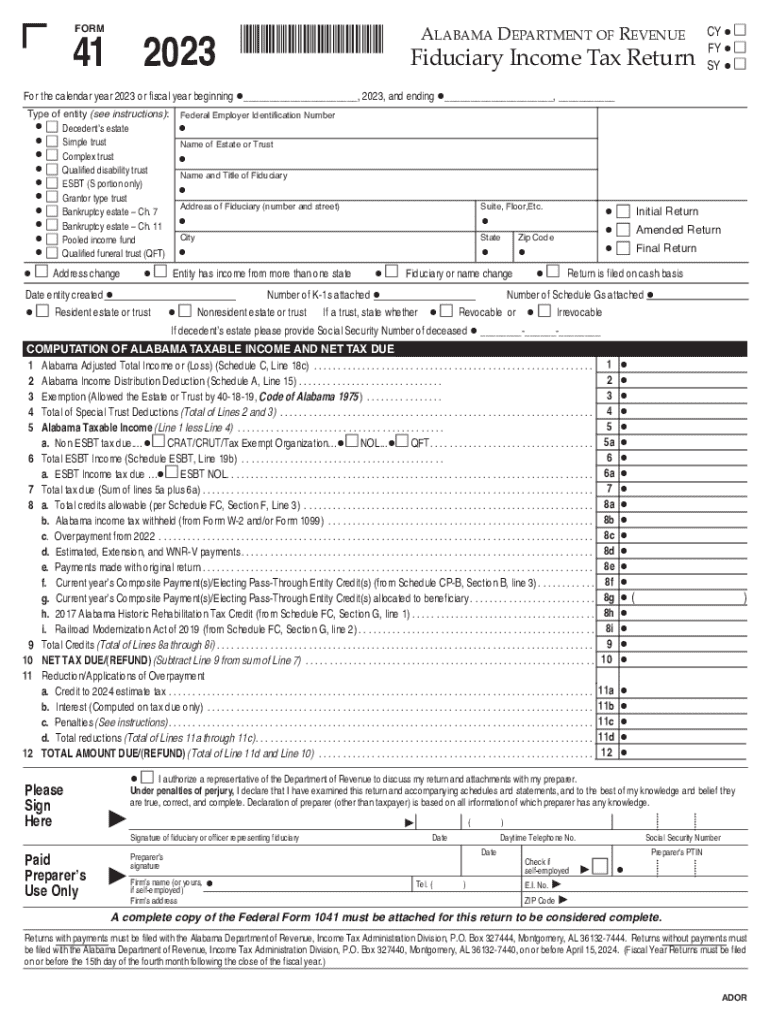
The Form 41 Fiduciary Income Tax Return is utilized to report the income, deductions, and credits for an estate or trust. It is crucial for those acting in a fiduciary capacity, such as executors or trustees, to communicate financial activities related to the fiduciary entity to the IRS. This form ensures that fiduciaries accurately declare all sources of income and claim allowable deductions, thereby complying with federal tax obligations. The form captures details like the type of entity—either a decedent's estate or a trust—and facilitates the precise calculation of Alabama taxable income and net tax dues.
Key Elements and Components
The form is organized into multiple sections to accommodate various financial activities and requirements. Key elements include:
- Income Section: Captures all income generated by the estate or trust, such as interest, dividends, and any other pertinent financial activities.
- Fiduciary Details: Requires specific information about the fiduciary, ensuring accountability and transparency in financial management.
- Deduction Schedules: Includes sections for claiming deductions on income distribution and charitable contributions, both of which are necessary to accurately assess the taxable income and liabilities.
Steps to Complete the Form 41 Fiduciary Income Tax Return
Filling out Form 41 involves a series of specific steps to ensure compliance and accuracy:
- Gather Required Documentation: Collect all relevant financial records, such as income statements, expense receipts, and prior tax filings.
- Identify the Fiduciary Entity: Specify whether the entity is a trust or an estate, as this will influence several aspects of the filing process.
- Complete Income Sections: Accurately report all forms of income accrued during the tax year to reflect the entity's financial position.
- Determine Deductions: Identify applicable deductions, including distributions and eligible charitable contributions, to optimize the tax outcome.
- Review and Verify Information: Ensure all entered data is accurate and complete, as discrepancies could lead to issues with the IRS.
- Submit the Form: Choose the appropriate submission method, either electronically or via mail, to file the completed return.
Required Documents for Form 41 Fiduciary Income Tax Return
To effectively complete the Form 41, fiduciaries must have access to several critical documents. These include:
- Annual Income Statements: Evidence of all income received by the entity.
- Previous Tax Returns: Copies of past returns to ensure continuity and accuracy.
- Expense and Distribution Records: Documentation for any deductions claimed to justify these figures.
Importance of Accurate Documentation
Having precise and comprehensive documentation is vital to avoid discrepancies that might attract scrutiny from the IRS. It helps in constructing a transparent and thorough tax return, thereby reducing the risk of penalties.
State-Specific Rules for Filing
For those filing in Alabama, it is essential to be aware of state-specific tax rules that may differ from federal regulations:
- Alabama Adjustments: Ensure that all adjustments to federal taxable income comply with Alabama's specific tax code requirements.
- State Deductions and Credits: Familiarize yourself with deductions and credits specific to Alabama to maximize benefits.
These rules require careful consideration during the filing process to ensure compliance with state tax obligations in addition to federal ones.
Penalties for Non-Compliance
Non-compliance with filing requirements can lead to various penalties:
- Late Filing Penalties: Charged when the return is not submitted by the deadline.
- Underpayment Penalties: Apply if the entity fails to pay the required tax amount.
- Interest on Overdue Taxes: Assessments accrue interest, increasing the overall liability over time.
Understanding these penalties emphasizes the importance of timely and accurate filing to mitigate financial risk.
Digital vs. Paper Versions of Form 41
Fiduciaries have the option to submit Form 41 in either digital or paper format, each with its pros and cons:
- Digital Submission: Offers faster processing times and easier tracking of documents. It requires reliable software or access to the IRS e-filing system.
- Paper Submission: Preferred by those less comfortable with digital solutions but can be slower due to mailing and manual processing.
Deciding on the preferred method depends on your comfort with technology and preference for either system's benefits.
Software Compatibility for Filing
Certain software tools, like TurboTax and QuickBooks, can aid in the preparation and filing of Form 41:
- TurboTax: Offers features tailored for fiduciary tax filings, ensuring accurate compliance.
- QuickBooks: Provides integrated accounting solutions to simplify tax preparation processes.
Using compatible software can alleviate much of the administrative burden associated with tax filing, enhancing efficiency and reducing errors.
Taxpayer Scenarios for Form 41 Use
Form 41 is applicable in various taxpayer scenarios, including:
- Trusts with Income: Where investments generate returns needing declaration.
- Estates in Probate: Facilitating the proper distribution of assets according to tax obligations.
Understanding the specific scenario in which Form 41 applies is crucial for fiduciaries to ensure accurate compliance with tax laws and obligations.