







Definition & Meaning
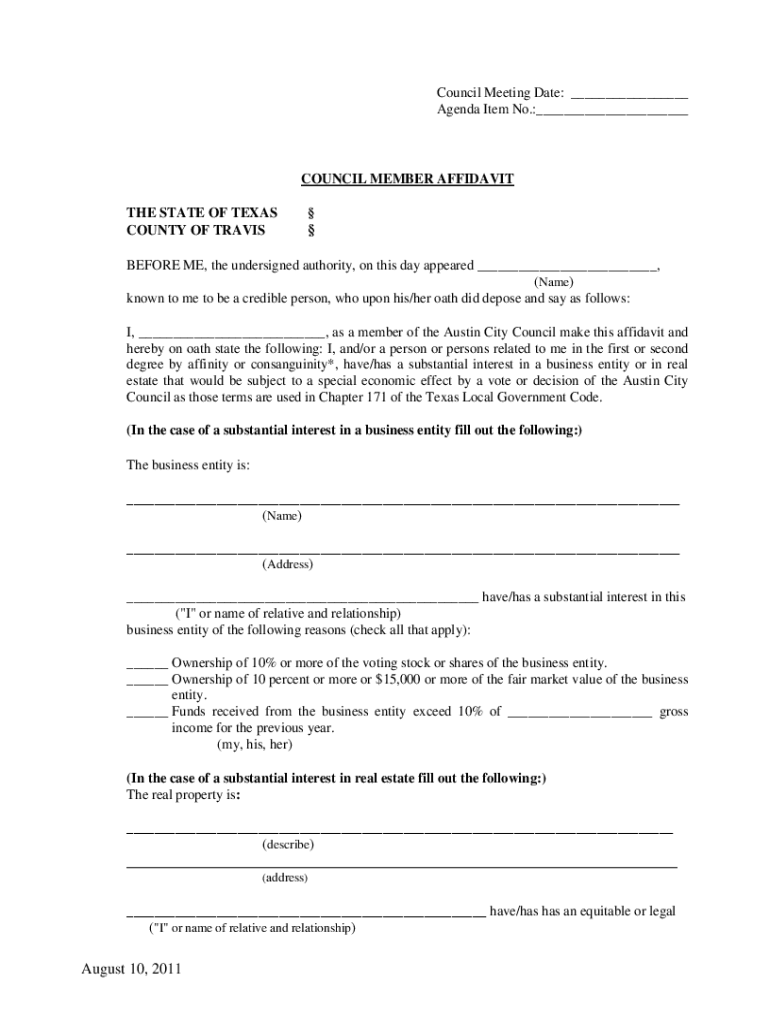
The AFFIDAVIT-CouncilCOICh171-2 doc is an official document used by Austin City Council members in Texas. It requires them to disclose any substantial interests in business entities or real estate that may be impacted by council decisions. The affidavit serves primarily as a transparency tool, ensuring that city council members act in the public interest without personal conflicts of interest influencing their decisions. Declaring these interests legally obliges council members to abstain from voting on matters where a conflict exists, thereby promoting ethical governance.
Key Elements of the AFFIDAVIT-CouncilCOICh171-2 doc
This document contains several critical components that must be accurately filled out to ensure compliance:
- Personal Information: Includes the name, address, and position of the council member.
- Business Interests: Details of any business entities in which the council member has a significant interest, typically defined as owning more than 10% of the company.
- Real Estate: Disclosure of real estate holdings that might be affected by council votes.
- Declaration of No Conflicts: A statement affirming that no undisclosed conflicts of interest exist.
- Signature and Date: The form must be signed and dated to affirm the accuracy and truthfulness of the details provided.
Each element is designed to capture a comprehensive view of potential conflicts, ensuring transparent governance.
Steps to Complete the AFFIDAVIT-CouncilCOICh171-2 doc
- Gather Information: Collect all necessary personal and business information. This includes understanding ownership percentages in businesses and the details of real estate holdings.
- Fill Personal Details: Begin by inputting your personal information, including your full name, position, and contact details.
- Declare Business Interests: List all business entities in which you hold significant interests. Make sure to detail the nature and extent of these interests precisely.
- Outline Real Estate Interests: Provide a comprehensive list of real estate properties and specify how these might be affected by council decisions.
- Review and Sign: Check all filled sections for accuracy. Once verified, sign and date the document to validate the information.
- Submit the Form: Submit the completed affidavit to the appropriate department or official, ensuring that it reaches the correct processing authority within the stipulated timeline.
Legal Use of the AFFIDAVIT-CouncilCOICh171-2 doc
This affidavit is legally binding and carries substantial significance in maintaining ethical standards within the city council. Here are some legal aspects to consider:
- Conflict of Interest Law Compliance: The affidavit fulfills legal requirements under Texas law for local government transparency.
- Voting Restrictions: It enforces abstention rules for council members with declared conflicts, protecting the decision-making process from being compromised by personal gains.
- Record Keeping: The affidavit serves as a formal record that can be referred to in potential future audits or legal disputes regarding council decisions.
Adhering to these legal principles is crucial for sustaining public confidence in local governance.
State-Specific Rules for the AFFIDAVIT-CouncilCOICh171-2 doc
The use of this affidavit is subject to specific rules set forth by the state of Texas:
- Periodic Updates: Council members must update their affidavits regularly, typically annually or whenever a new potential conflict of interest arises.
- Detailed Disclosures: Disclosures must be comprehensive and truthful, lacking which could result in penalties or even removal from office.
- Public Availability: These affidavits are often made available to the public to ensure transparency, allowing citizens to review potential conflicts of interest.
These state-specific guidelines ensure that the affidavit serves its intended purpose effectively.
Penalties for Non-Compliance
Failure to accurately complete the AFFIDAVIT-CouncilCOICh171-2 doc can have serious repercussions:
- Fines and Legal Action: Council members might face fines or legal action for omissions or false declarations.
- Disqualification from Voting: In some instances, non-compliance may disqualify a member from voting on matters where a conflict of interest is suspected.
- Reputational Damage: Beyond legal penalties, failure to comply can lead to reputational harm, impacting public trust and the member’s future in office.
The stringent penalties underline the importance of adhering to all procedural requirements associated with the affidavit.
Who Typically Uses the AFFIDAVIT-CouncilCOICh171-2 doc
The primary users of this form are:
- City Council Members: Particularly those serving in Austin, Texas, who are required to disclose potential conflicts of interest.
- City Administrative Officials: Sometimes ancillary users like city clerks may handle the filing and processing of these forms.
- Public Entities: Organizations and watchdog groups interested in monitoring local government actions might review these forms to ensure accountability.
The form serves a dual purpose of compliance and transparency for both the officials completing it and the public scrutinizing it.


Who Issues the Form
The document is typically issued by:
- Municipal Governments: Local government entities, such as the Austin City Council, are responsible for distributing and collecting these affidavits from their members.
- Ethics Compliance Offices: These offices oversee the documentation process and ensure that affidavits are filed accurately and timely.
Ensuring the form is correctly issued and processed is vital for maintaining the integrity of the city council’s operations.




