






Definition and Meaning
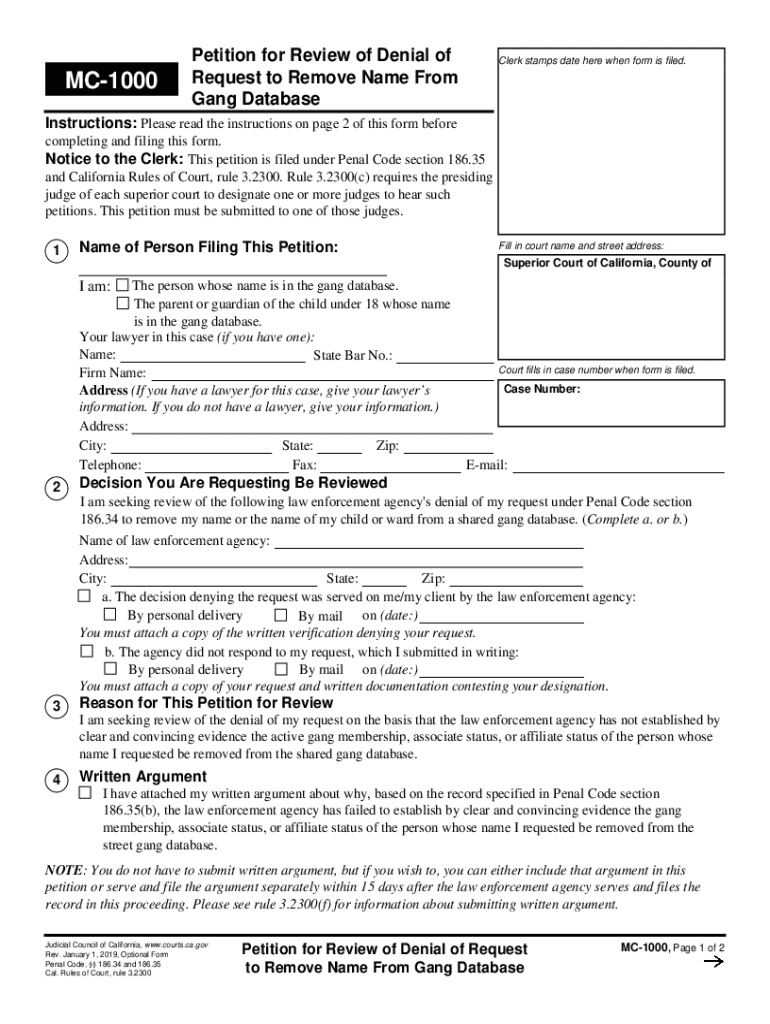
The MC-1000, also referred to simply as the Mc-1000, is a legal form used by individuals seeking judicial review of a law enforcement agency's refusal to remove their name or their child’s name from a gang database. This form is crucial under California Penal Code section 186.34, as it provides a procedural mechanism for contesting a denial and asserting one’s rights. The Mc-1000 helps petitioners present their case in a structured manner, allowing them to detail their personal information, the law enforcement agency involved, and the reasons for their request.
Steps to Complete the Mc-1000
Completing the Mc-1000 requires precision. Here is a step-by-step guide for filling out the form:
-
Personal Information: Start by accurately filling in your full name, address, and contact details. Ensure these details match any identification or documents you might submit alongside the form.
-
Law Enforcement Agency Information: Provide the name and contact information of the agency that denied your request for removal from the gang database.
-
Details of the Request: Clearly explain the reasons for your application. Include any relevant dates and incidents that support your request.
-
Attachments: Attach any additional documents that can fortify your petition, such as written arguments or records of communication with the agency.
-
Signatures and Declarations: Sign and date the petition in the appropriate section. If applicable, notarize the form to add credibility.
How to Obtain the Mc-1000
Acquiring the Mc-1000 is straightforward and can be done through the following methods:
-
Online Access: Visit the official website of the relevant court or legal portal in California to download the form directly.
-
Physical Copies: Obtain a physical copy from court facilities or legal aid offices within your county of residence.
-
Legal Representatives: Your attorney can also provide you with a copy of the form as part of their legal services.
Who Typically Uses the Mc-1000
The primary users of the Mc-1000 are individuals or guardians challenging the inclusion of their names or their children’s names in a gang database. This is often pertinent for:
- Parents advocating for their minor children who have been wrongly identified in law enforcement databases.
- Individuals who need judicial assistance to rectify what they believe to be erroneous or unjust entries.


Important Terms Related to Mc-1000
Understanding the terminology associated with the Mc-1000 form can aid in its completion:
- Petitioner: The person or entity filing the application for judicial review.
- Respondent: The law enforcement agency that made the original decision.
- Judicial Review: The process through which courts review the actions of law enforcement agencies for legal correctness.
Legal Use of the Mc-1000
The Mc-1000 serves as a legal remedy, guided by California Penal Code section 186.34. It allows petitioners to legally challenge the decisions of law enforcement agencies regarding gang database entries. Using this form can lead to a court-ordered change in the database status, provided the petitioner presents a compelling case.
Key Elements of the Mc-1000
The Mc-1000 form has several critical components:
- Request for Judicial Review: Formally asks the court to review the agency’s decision.
- Justification for Request: Offers a detailed explanation and events leading to the necessity of the form.
- Supplementary Evidence: Includes relevant attachments and arguments to support the petition.
State-Specific Rules for the Mc-1000
While the Mc-1000 is specific to California, it is subject to state-specific legal frameworks and standards. Petitioners must comply with California procedural laws, which dictate how forms are to be filed, the deadlines, and the requisite contents. Understanding these regulations is crucial for the successful submission and processing of the form.
Required Documents
In addition to the Mc-1000 form, several other documents may be required to complete a petition effectively:
- Proof of Identity: Government-issued identification to validate the petitioner’s identity.
- Correspondence Records: Any communication with the law enforcement agency regarding the initial request and their subsequent denial.
- Supporting Evidence: Written arguments or documents reinforcing the petitioner’s case, such as sworn statements or character references.
Penalties for Non-Compliance
Failure to submit a complete and accurate Mc-1000 form, or missing critical deadlines, can have consequences:
- Dismissal of Petition: The court may dismiss incomplete applications, requiring the petitioner to restart the process.
- Judgment Against Petitioner: An unfavorable judgment might occur if necessary evidence or arguments are not presented effectively.