






Definition & Meaning
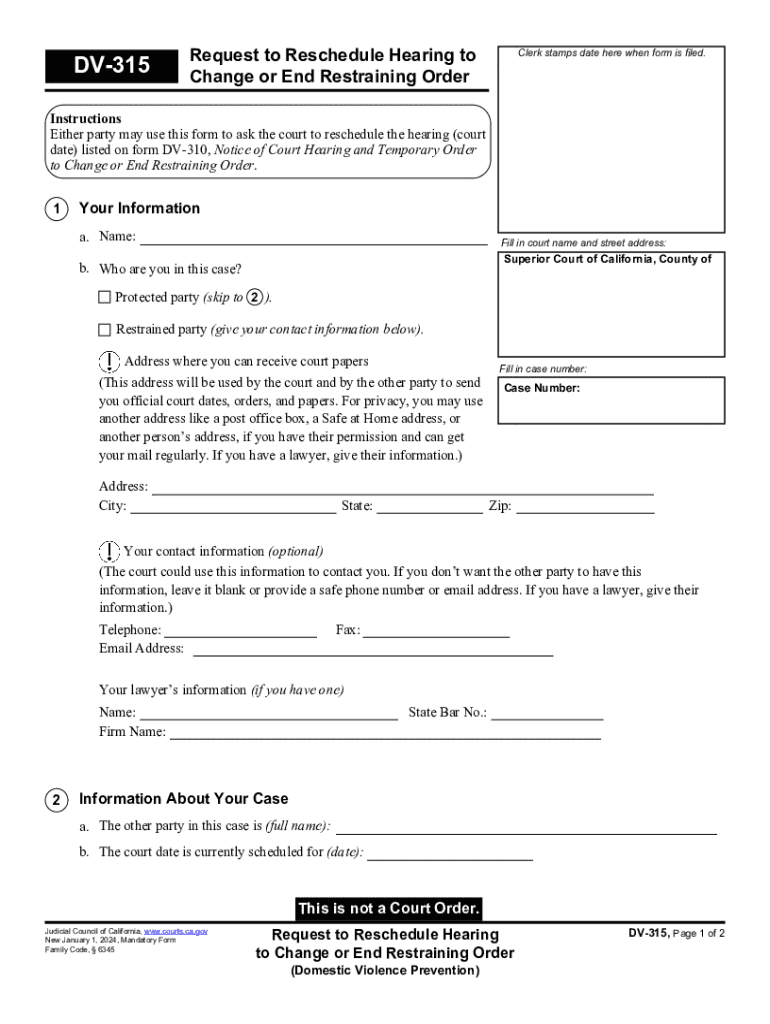
The DV-315 form is specifically designed for individuals in California seeking to reschedule a court hearing related to the modification or termination of a restraining order. Its primary function is to facilitate the legal process by providing a standardized method for requesting a change in the court schedule. By using the DV-315, both parties involved gain clarity on the procedure and necessary steps in altering their hearing dates. This form serves a crucial role in upholding the judicial process by ensuring all parties are properly informed and prepared for their day in court.
How to Use the DV-315
To effectively utilize the DV-315, individuals must first ensure their eligibility to request a hearing reschedule related to a restraining order in California. Upon confirming eligibility, the form must be filled out comprehensively, detailing personal information, the reason for the rescheduling request, and any supporting documentation that may aid the court in decision-making. After accurately completing the form, it should be submitted to the appropriate court handling the restraining order case. It is imperative to follow up with the court for confirmation and any further instructions.
Submitting the DV-315
- Ensure the form is complete: Double-check for any missed sections to avoid delays.
- Include necessary attachments: Provide supporting documents to justify the reschedule request.
- Submission methods: Depending on the court’s protocols, submit the form online, via mail, or in person.
Steps to Complete the DV-315
Completing the DV-315 involves several detailed steps to ensure compliance with legal standards:
- Personal Information: Fill out your details, including name, address, and contact information.
- Case Details: Provide specific information about the restraining order case, including the court case number and the names of all parties involved.
- Rescheduling Justification: Clearly articulate the reasons for the request to reschedule, providing any relevant context or evidence.
- Review and Confirm: Once completed, review the entire form for accuracy and completeness.
- Submit: Deliver the form to the relevant courtroom as specified, adhering to their submission guidelines.
Tips for Completing
- Accuracy is key: Double-check for errors that could lead to a denial.
- Clear writing: Ensure all information is legible, particularly if submitting a handwritten version.
- Timeliness: Submit as early as possible to accommodate any potential issues.
Important Terms Related to DV-315
Understanding certain legal terms can be vital when dealing with the DV-315:
- Restraining Order: A court order intended to protect an individual from harassment or harm by another person.
- Hearing: A legal proceeding where an issue is presented before a judge.
- Reschedule: Requesting a change in the timing of a court appearance.
- Petitioner: The individual who initiates the court request.
Legal Use of the DV-315
The legal applicability of the DV-315 is strictly related to the adjustment of court dates for cases involving restraining orders in California. It is only to be used in circumstances where a party has a valid reason to change a scheduled hearing. Proper use of the form ensures procedural fairness and adheres to California’s court rules, providing both the petitioner and respondent adequate opportunity to prepare for the case.
Key Elements of the DV-315
Several critical components must be present in the DV-315 to meet the court’s criteria for rescheduling:
- Petitioner and Respondent Details: Complete and accurate identification of both parties involved.
- Reason for the Request: A thorough explanation of why the rescheduling is necessary.
- Proof of Service: Documents proving the other party has been notified of the reschedule request, if required.
- Signature: An authorized signature to validate the submission.
State-Specific Rules for the DV-315
The DV-315 is governed by California state laws and regulations, which dictate its usage and handling. Adhering to these state-specific requirements ensures the form is processed without legal hitches. These rules emphasize properly completing the form, timely filing, and respecting the policies related to restraining orders and hearings in the California judicial system.
California Specifics
- Form Exclusivity: Only applicable within California jurisdictions.
- Compliance with State Laws: Must align with state-mandated timelines and procedures.
Examples of Using the DV-315
A practical example of using the DV-315 could involve a petitioner who has a medical emergency and cannot attend the originally scheduled hearing. By thoroughly completing the DV-315 with medical documentation as supporting evidence, they can request a new date. Similarly, a respondent needing more time to gather necessary evidence for the hearing may use the form to request a reschedule, providing the court a valid reason for their need. These examples illustrate the form's utility in accommodating unforeseen circumstances while maintaining judicial efficiency.