






Definition and Purpose of the 6700 029 Daily Crash Cart Checklist
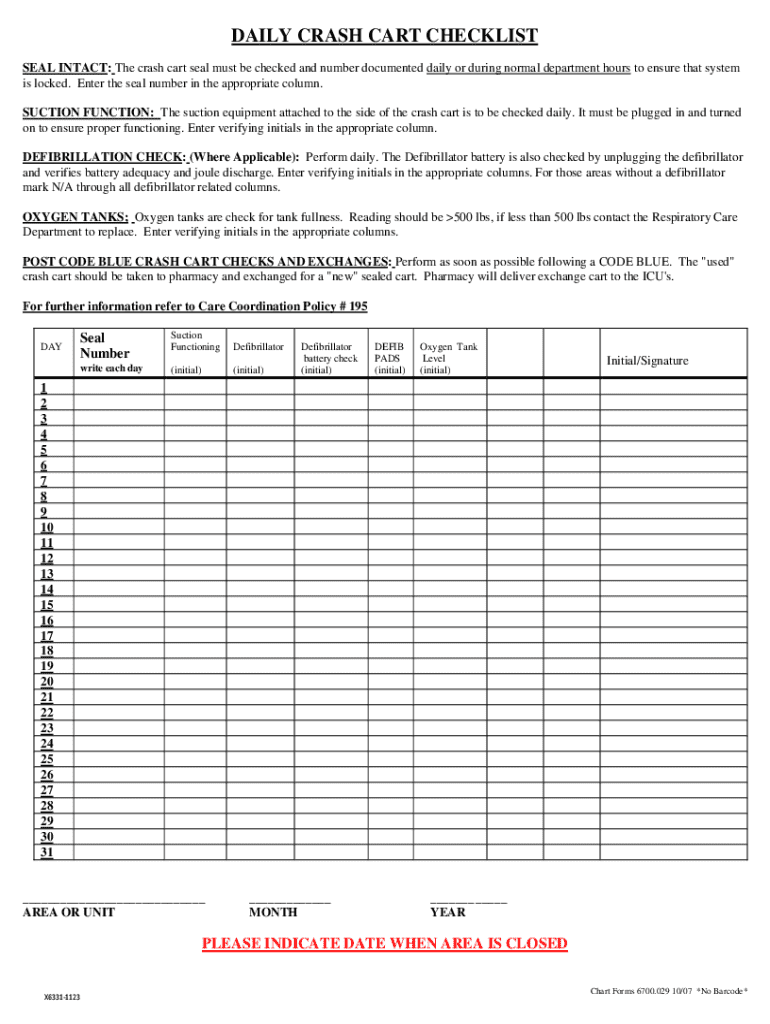
The "6700 029 Daily Crash Cart Checklist doc" is a standardized form used in medical settings to ensure crash carts are maintained in a state of readiness for emergencies. Crash carts, essential for managing critical medical situations like cardiac arrests, contain vital equipment such as defibrillators, medications, and life-support tools. This checklist mandates the daily verification of each cart's integrity and readiness to affirm that all equipment is functional and accessible.
The checklist serves several purposes:
- Enhances Readiness: Ensures that all necessary equipment and medications are present and fully operational.
- Facilitates Accountability: Provides spaces for staff to initial and sign off on inspections, promoting responsibility and traceability.
- Standardizes Procedures: Aligns practices across different healthcare facilities, promoting uniformity in crash cart maintenance.
How to Use the 6700 029 Daily Crash Cart Checklist
Initial Setup and Daily Use
-
Familiarize with the Checklist: Understand the different sections and what needs to be checked. This includes seals, equipment functions, and documentation spaces.
-
Conduct Daily Inspections:
- Check Integrity of Seals: Ensure the crash cart's tamper-evident seal is intact to verify no unauthorized access.
- Inspect Equipment Functionality: Confirm that the defibrillator is operational, suction devices function properly, and oxygen tanks are full.
- Verify Medications and Supplies: Ensure all medications are in date and supplies are adequately stocked.
-
Document Findings: Record initials and any findings or deviations in the designated spaces on the checklist. Use the provided sections for additional notes if needed.
-
Report and Address Issues: If any discrepancies are found, report them to the supervising medical staff and rectify immediately to ensure the cart remains ready for use.
Example of Usage Scenario
A registered nurse, preparing for her shift in the Emergency Department, initiates her routine by taking the crash cart checklist. During her inspection, she finds that the suction device is non-functional. She logs the discrepancy and notifies the biomedical engineering team for immediate repair while ensuring a backup cart is available.
Steps to Complete the 6700 029 Daily Crash Cart Checklist doc
Detailed Instructions for Filling Out the Checklist
-
Begin with Identification:
- Location and Date: Enter the specific location of the crash cart and the current date.
-
Seal Inspection:
- Verify Seal Condition: Confirm that the cart's seal is intact. If it is broken, this may indicate prior unauthorized access.
- Record Findings: Note seal conditions, and if replacement is required, document the replacement seal number.
-
Equipment and Supply Checks:
- Suction Devices: Ensure units are operating correctly. Perform a functional check and note any deficiencies.
- Defibrillator: Conduct a self-test if applicable and verify battery charge and electrode availability.
- Oxygen and Medications: Check levels and expiration dates, respectively. Log discrepancies and orders for replacements if required.
-
Signature and Accountability:
- Sign Off by Inspector: Initial each section after inspection completion, indicating responsibility.
- Final Approval: A supervising personnel cross-verifies and signs the checklist, confirming readiness of the crash cart.
Importance of the 6700 029 Daily Crash Cart Checklist
Ensuring Continuous Preparedness
-
Immediate Response Capability: A correctly maintained crash cart allows for rapid and effective response during medical emergencies, potentially saving lives.
-
Regulatory Compliance: Fulfilling these checks is critical for meeting healthcare standards and regulations, mitigating the risk of legal liabilities.
-
Risk Management: Helps in identifying potential failures in the cart’s equipment and supplies that could compromise patient safety.
Key Elements of the 6700 029 Daily Crash Cart Checklist
Critical Components to be Reviewed
- Seal Integrity: Confirms no tampering or unauthorized access, ensuring contents are secure and untouched.
- Equipment Functionality: Includes defibrillator, suction devices, and monitors; each must be operational.
- Medication and Supply Levels: Ensures availability and adherence to expiration dates for all drugs and consumables.
- Documentation and Accountability: Tracks inspections with dates, signatures, and notes for audit trails and accountability.
Additional Considerations
- Redundancy Protocols: Includes instructions for using secondary carts if a primary one is found lacking.
- Post-Emergency Protocols: Steps to replenish or replace a cart immediately following a "code blue" or similar event.
Examples of Using the 6700 029 Daily Crash Cart Checklist
Real-world Implementations
In a busy urban hospital, staff use the checklist to prepare for an unexpected influx of trauma patients following a local incident. Due to consistent checklist adherence, the hospital manages increased demand without compromising patient care quality.
Training Scenarios
During a simulation drill, medical students learn to use the checklist effectively. Instructors simulate a sudden cardiac arrest scenario, requiring students to verify cart readiness, and enabling rapid deployment of lifesaving equipment.
Legal Use and Compliance with the 6700 029 Daily Crash Cart Checklist
Ensuring Legal and Regulatory Adherence
-
State Regulations: Adapting checklist usage to comply with specific state laws and healthcare regulations.
-
Documentation for Audits: Provides necessary documentation during audits, evidencing compliance and operational transparency.
Avoiding Legal Pitfalls
- Standard Operating Procedures: Establish a routine to ensure everyone adheres to the checklist consistently, reducing risk and enhancing legal defenses in case of disputes.
Who Typically Uses the 6700 029 Daily Crash Cart Checklist


Key Personnel and Their Roles
-
Nurses and Medical Technicians: Primary users responsible for performing daily checks and ensuring compliance.
-
Pharmacists and Laboratory Personnel: Involved in medication verification and swapping depleted or expired drug sets.
Supporting Staff
- Supervisory and Security Staff: Oversee checklist adherence and maintain security of high-value medical equipment.
- Biomedical Engineers: Perform advanced diagnostic and repair functions on malfunctioning equipment as documented in the checklist.
Through these structured and comprehensive processes, healthcare providers ensure that their emergency response systems are always ready, significantly impacting patient outcomes and operational efficiency.