







Definition & Meaning
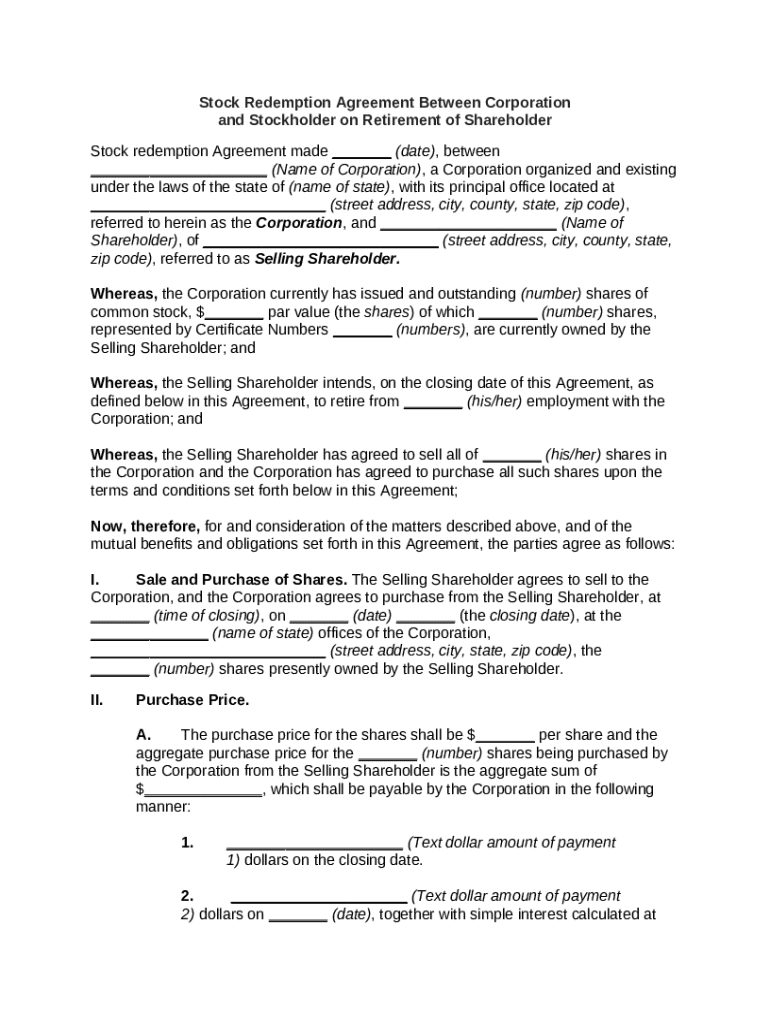
A Stock Redemption Agreement is a legal document between a corporation and a selling shareholder that details the terms under which the corporation agrees to purchase back shares owned by the shareholder. This agreement is often used when a shareholder is preparing to retire or wishes to sell their shares back to the company rather than selling them on the open market. It ensures a smooth transition of ownership, outlines the valuation of shares, and guarantees compliance with corporate governance and legal standards.
Key Components
- Shares Involved: Specifies the total number of shares the shareholder plans to sell and the corporation intends to repurchase.
- Purchase Price: Defines how the value of the shares is determined, whether via a fixed price, book value, or another valuation method.
- Payment Structure: Details whether the payment will be a lump sum or in installments, including any relevant interest rates for deferred payments.
Key Elements of the Stock Redemption Agreement
Valuation Method
Determining the share price is critical in stock redemptions. Popular valuation methods include:
- Book Value: The corporation's assets minus liabilities, divided by the total number of shares.
- Fair Market Value: Price a willing buyer and seller agree upon in an open market.
- Agreed Value: Pre-determined price established in a shareholder’s agreement or corporate bylaws.
Closing Procedures
Outlines the steps required for completing the stock redemption, such as:
- Review of Shareholder's Records: Validation of the shareholder's identity and ownership.
- Documentation: Preparation and signing of required legal documents by both parties.
- Payment Transfer: Timely execution of payment in accordance with the agreed schedule.
Steps to Complete the Stock Redemption Agreement
To effectively execute a Stock Redemption Agreement, follow these steps:
- Draft the Agreement: Ensure it includes all pertinent details, such as the number of shares, pricing, and payment terms.
- Legal Review: Have legal advisors from both parties review to ensure compliance with laws and business bylaws.
- Negotiation: Parties may negotiate terms regarding pricing, payment, or other elements before finalizing.
- Signing: Both the corporation and the selling shareholder must sign the agreement.
- Payment Execution: Follow the structured payment agreement once the document is signed to avoid breach of contract.
- Closure Documentation: Complete any further documentation required by state laws or corporate policy.
Important Terms Related to Stock Redemption Agreement
Key Legal Terms
- Arbitration Clause: Specifies the mechanism for resolving disputes without court involvement.
- Governing Law: Indicates which state’s laws will apply to interpret the agreement.
Contractual Obligations
- Representations and Warranties: Declarations each party makes about their authority and ability to perform under the agreement.
- Modifications: Outlines how amendments to the agreement can be made post-signing.
Legal Use of the Stock Redemption Agreement
A Stock Redemption Agreement is critical in ensuring legal and smooth transitions of stock. It helps to:
- Prevent disputes by clearly defining rights and responsibilities.
- Control the company’s stock ownership structure.
- Avoids the chaos of dispersed ownerships, thus maintaining tight control.
Arbitration Requirements
By including arbitration clauses, parties can handle disputes efficiently without litigation, making it a preferred method for resolving conflicts. Arbitration can help avoid the high costs and prolonged timelines associated with court cases.
Who Typically Uses the Stock Redemption Agreement


Common Users
- Corporations: That want to repurchase shares to reduce stock dilution or consolidate ownership.
- Shareholders: Looking to exit their investment, particularly in closely-held or family businesses.

Real-world Examples
- Family-Owned Businesses: A retiring family member sells back shares to maintain ownership within the family.
- Employee-Shareholders: An employee nearing retirement who was given stock options sells shares back to the corporation.
State-Specific Rules for the Stock Redemption Agreement
State laws can significantly impact how a Stock Redemption Agreement is structured and enforced. While federal guidelines govern securities, states may impose additional requirements, such as:
- Financial Solvency Tests: Certain states require the corporation to demonstrate enough financial capacity to carry out the redemption without impairing capital.
- Notice Requirements: Laws may dictate how and when other shareholders must be informed about redemptions.
Penalties for Non-Compliance
Failure to comply with the terms outlined in a Stock Redemption Agreement can lead to:
- Financial Penalties: Interest charges or fees for late payments or default.
- Legal Consequences: Breaches could result in lawsuits or forced arbitration under the terms set out in the agreement.
Other Consequences
- Reputation Damage: Non-compliance can harm the company's reputation, impacting investor confidence.
- Business Continuity: Mismanaged stock redemptions can disrupt corporate governance and decision-making.
Business Types that Benefit Most from Stock Redemption Agreement
Best-Suited Business Models
- Closely-Held Corporations: Where control and limited share dispersion are prioritized.
- Professional Practices: Law or medical practices unable to have outside shareholders due to regulatory restrictions.
Advantages for Non-Public Entities
- Ensure company stock or ownership remains within desired hands, avoiding external influence or instability.
- Offer a structured exit strategy for key individuals without destabilizing the ownership structure.




