Family Court Services Intake Form 2026

Get Form
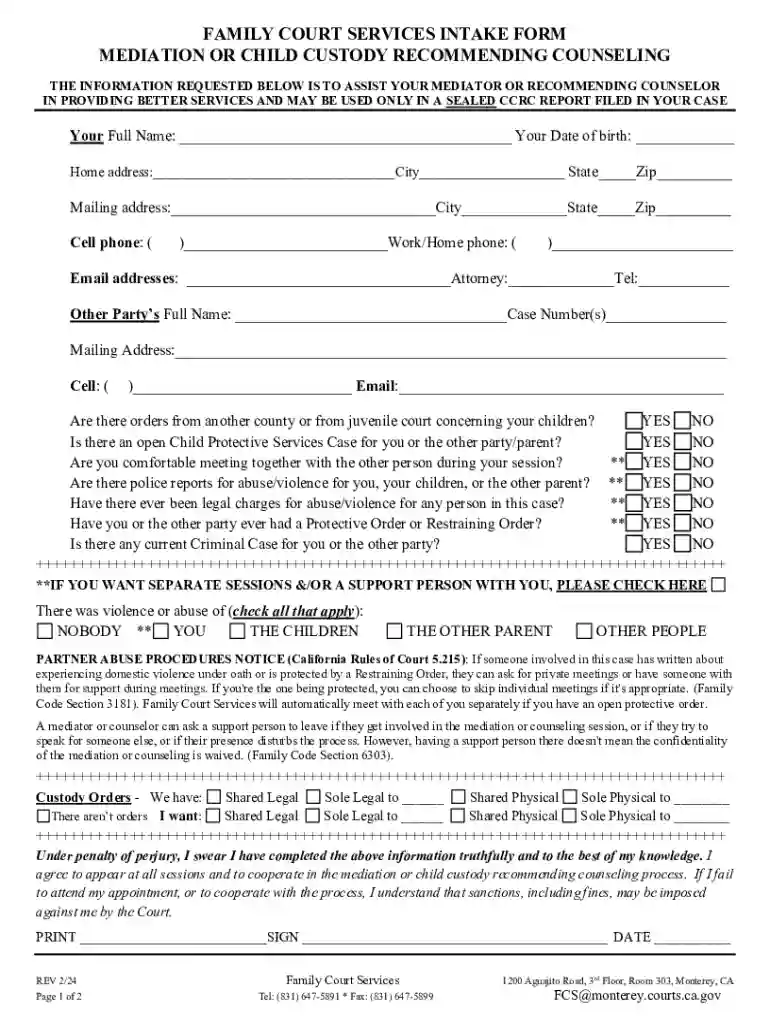
Family Court Services Intake Form Preview on Page 1

Here's how it works

01. Edit your form online
Type text, add images, blackout confidential details, add comments, highlights and more.

02. Sign it in a few clicks
Draw your signature, type it, upload its image, or use your mobile device as a signature pad.

03. Share your form with others
Send it via email, link, or fax. You can also download it, export it or print it out.

Definition and Purpose of the Family Court Services Intake Form

The Family Court Services Intake Form serves as an essential tool in the mediation and child custody evaluation processes. Its primary function is to gather comprehensive personal information from the parties involved in a family law case. This includes contact details, case numbers, and specific questions related to any history of abuse or protective orders. The information collected via this form enables mediators to provide effective, tailored services while ensuring confidentiality and safety for all parties during the mediation process. The form also aids in setting parenting schedules, outlining mediation goals, and detailing children's information related to the case.

Steps to Complete the Family Court Services Intake Form

  1. Obtain the Form:

    • The form can typically be obtained from the family court services department or downloaded from a relevant legal website.
  2. Filling Personal Information:

    • Accurately input your contact details, including full name, address, phone number, and email.
    • Provide information about the involved parties, such as names and relationships to any children.
  3. Case Details:

    • Include the case number and relevant court information to align your form with the judicial records.
  4. History of Abuse or Protective Orders:

    • Honestly disclose any history of abuse or existing protective orders to ensure proper measures are taken for safety during mediation.
  5. Parenting Schedules and Mediation Goals:

    • Outline proposed parenting schedules and specific objectives you wish to achieve through mediation.
  6. Review and Sign:

    • Carefully review your entries before signing the form. Ensure all required fields are completed for the processing of the form.

Key Elements of the Family Court Services Intake Form

  • Personal Detail Section:

    • Includes names, address, contact numbers, and email addresses for each party.
  • Children Information Section:

    • Gather details such as names, ages, and any specific needs or considerations for children involved in the case.
  • Case Identification:

    • Requires case number and jurisdictional details to facilitate coordination with court records.
  • History and Safety Concerns:

    • Questions concerning past abuse, existing protective orders, and any other safety concerns to tailor the mediation accordingly.
  • Parenting Time Schedules:

    • Proposed custody and visitation schedules to streamline discussions during mediation.

Who Typically Uses the Family Court Services Intake Form

  • Parents:

    • Those undergoing divorce or separation requiring custody or visitation agreements.
  • Legal Guardians:

    • Individuals appointed by the court to care for children when parents are unable to.
  • Mediators:

    • Professionals who facilitate communication and agreements between disputing parties using data from the form.
  • Family Law Attorneys:

    • Attorneys assist their clients with the completion and submission of this form as part of legal proceedings.
decoration image ratings of Dochub

Obtaining the Family Court Services Intake Form

  • In-Person:

    • Visit the local family court services department where the staff can provide you with a printed form and assistance if needed.
  • Online:

    • Many jurisdictions offer downloadable versions of the form through their official websites, enabling users to access, fill, and print the form conveniently.

Legal Use of the Family Court Services Intake Form

  • Court Proceedings:

    • The form is used in legal proceedings to provide a factual basis for mediation discussions and court decisions.
  • Mediation Preparation:

    • Serves as a preparatory tool that mediators and courts use to understand the family dynamics and issues at hand.
  • Confidentiality Assurance:

    • Information collected via this form is kept confidential, used only for the purposes of mediation and legal proceedings, per privacy laws.

Required Documents Accompanying the Form

  • Identification Proof:

    • Examples include a driver’s license or state ID to verify personal information provided.
  • Court Documents:

    • Any court orders or relevant documentation that supports claims or provides context for the case.
  • Supporting Claims:

    • Documentation regarding any abuse or protective orders mentioned in the form may be required to substantiate claims.

State-Specific Rules for the Family Court Services Intake Form

  • Varied Questions:

    • Some states might have additional questions reflecting specific policies or legal requirements relevant to family law in that jurisdiction.
  • Submission Guidelines:

    • Rules for submitting the form may differ, with some states requiring in-person submissions while others accept electronic versions.
  • Legal Relevance:

    • Certain states may have unique aspects of family law affecting how information on the form is used in mediation or court proceedings.

Form Submission Methods: Online, Mail, and In-Person

  • Online:

    • In jurisdictions providing online services, forms can often be submitted electronically through secure portals, enhancing convenience and speed.
  • Mail:

    • Forms may also be mailed to the relevant family court services department, especially in areas where electronic submission is not available.
  • In-Person Submission:

    • Direct submission at the family services desk ensures immediate receipt and can provide an opportunity for immediate feedback or assistance.
be ready to get more

Complete this form in 5 minutes or less

Get form

Got questions?

We have answers to the most popular questions from our customers. If you can't find an answer to your question, please contact us.
Contact us
Emotions: The inability of parents to consistently control their emotions, and avoid emotional decision making, is the most common mistake we see in child custody cases. The reason: it is such an easy mistake to make, and so pervasive in all aspects of the case.
Focus on how you provide for your children, how much time you spend with them, and how involved you have been throughout their lives, rather than bashing the other parent. Be prepared to answer a lot of basic questions such as your childrens clothing sizes, the names of their teachers, what their preferences are, etc.
Types of Evidence (Documents) Required In Child Custody Court Income information such as pay stubs and tax returns showing financial stability; Medical records demonstrating the child receives proper care; School records showing the childs grades; Police reports documenting any incidents with the other parent;
Here are five things all defendants will want to avoid saying to a criminal judge: I Did It. They Didnt Tell Me Expletives. Lies, Lies, Lies. I Will Represent Myself.
Learn the ropes. Understand how to present your case. Make sure your evidence is relevant and admissible. Get organised. Provide proof for what you say. Remember you must also prove your loss. Comply with court orders and rules. Show respect for the judge, the court and the process.

Security and compliance

At DocHub, your data security is our priority. We follow HIPAA, SOC2, GDPR, and other standards, so you can work on your documents with confidence.
Learn more
ccpa2
pci-dss
gdpr-compliance
hipaa
soc-compliance

People also ask

Disrespectful Language: Avoid insults, sarcasm, or any derogatory remarks. Personal Attacks: Never make personal comments about the judges character or past decisions, such as ``You always rule against people like me. Interrupting: Speaking over the judge or interrupting them can be seen as disrespectful.
Avoid criticizing the other parent and let the judge weigh the facts. Dont make threats or promises. Avoid criticizing the child for wanting to spend time with the other parent. Avoid discussing the custody battle on social media it will be used against you.

Related links