







Definition and Meaning
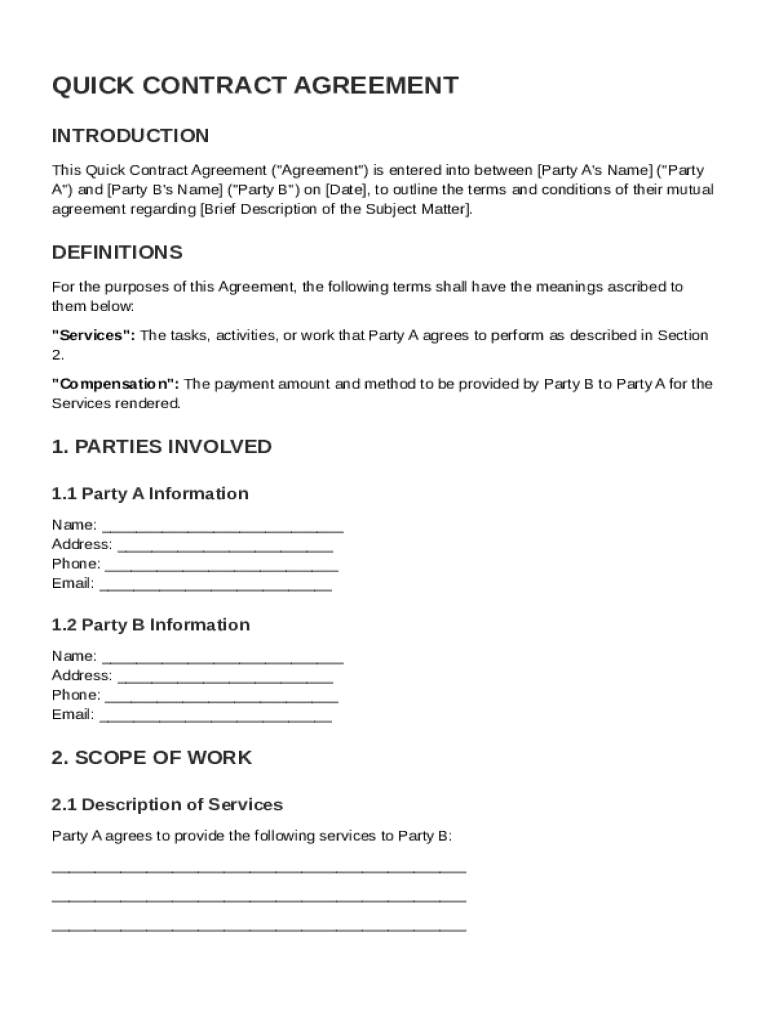
The "Quick Contract Template" is a streamlined document designed to facilitate the rapid creation of agreements between two or more parties. It typically outlines the essential terms and conditions that govern the relationship, including services provided, compensation, duration, confidentiality, dispute resolution, and amendment procedures. This template serves to ensure mutual understanding and legal protection for all parties involved, reducing the time and effort traditionally required to draft a comprehensive contract from scratch. By using a standardized format, parties can quickly agree on terms and securely move forward with their business dealings.
How to Use the Quick Contract Template
Using the Quick Contract Template is straightforward and can significantly expedite the contract creation process:
-
Identify the Parties Involved: Start by clearly identifying all parties involved in the contract, typically referred to as Party A and Party B.
-
Define the Services or Obligations: Specify the services to be provided or obligations to be fulfilled, including detailed descriptions to avoid ambiguity.
-
Outline Compensation Details: Clearly state how and when compensation will be delivered, including the amount and method of payment.
-
Set the Contract Duration: Determine the start and end dates of the contract. If ongoing, specify terms for contract review or renewal.
-
Include Confidentiality Clauses: Address any confidentiality requirements to protect sensitive information shared between the parties.
-
Establish Dispute Resolution Procedures: Define how disputes will be handled, often through mediation or arbitration before legal proceedings.
-
Specify Amendments Process: Detail how changes to the contract can be proposed and agreed upon by all parties.
-
Review and Sign: Once all sections are completed, ensure each party reviews the contract. Collect signatures to finalize the agreement.
Steps to Complete the Quick Contract Template
Completing the Quick Contract Template involves several key steps to ensure accuracy and comprehensiveness:
-
Download the Template: Obtain a copy of the template from a reliable source or document management platform.
-
Fill in Basic Information: Enter the names, addresses, and contact information of each party involved in the agreement.
-
Detail the Specifics of the Agreement: Utilize the space provided to thoroughly document each party’s responsibilities and expectations.
-
Customize Clauses: Tailor standard clauses—such as confidentiality and dispute resolution—to fit the specific needs and circumstances of the agreement.
-
Review for Accuracy: Thoroughly check all entries for accuracy and completeness to prevent potential misunderstandings or legal issues.
-
Collect Signatures: Arrange for all parties to sign the document, preferably with legally binding electronic signatures for expediency.
-
Archive the Final Contract: Store a copy of the signed agreement in a secure, easily accessible location for future reference.
Important Terms Related to Quick Contract Template
Understanding the terminology used in the Quick Contract Template is crucial for accurate completion and interpretation:
- Parties: Refers to the individuals or entities entering into the contract.
- Consideration: The benefit each party receives or expects to receive from the contractual arrangement.
- Breach: Occurs when a party fails to fulfill their contractual obligations.
- Indemnity: A provision to compensate for loss or damage incurred as a result of contract performance.
- Force Majeure: A clause that frees parties from obligations due to extraordinary events beyond their control.
- Governing Law: Specifies which jurisdiction’s laws will be used to interpret the contract.
Legal Use of the Quick Contract Template
The Quick Contract Template is designed to ensure legal compliance and enforceability, adhering to standard contract law principles:
- Adherence to Legal Standards: The template is structured in accordance with U.S. contract law, ensuring it covers essential components that confer legal validity.
- Customization for Jurisdiction: While the template provides a generic framework, it can be modified to meet specific legal requirements or preferences dictated by state law.
- Documenting Mutual Intent: By clearly outlining the intentions and agreement of the parties, the template provides documentation that can be used in legal proceedings if necessary.
Key Elements of the Quick Contract Template
Several key elements typically form the backbone of a robust Quick Contract Template:
- Introduction and Recitals: Provides context by highlighting the intentions behind the contract.
- Definitions: Clarifies important terms used throughout the agreement.
- Detailed Body Text: Describes obligations, rights, and duties of each party.
- Termination Clause: Specifies conditions under which the contract may end prematurely.
- Signatures: Confirms the understanding and acceptance of terms by all parties.
Business Types That Benefit Most from Quick Contract Template
The Quick Contract Template is particularly advantageous for various business types:
- Startups and Small Businesses: These entities often require cost-effective and time-sensitive solutions to formalize agreements quickly.
- Freelancers and Consultants: Individuals can efficiently outline work agreements with new clients, securing terms and compensation.
- Agencies and Creative Firms: Utilize streamlined templates to manage multiple client accounts with varied requirements.
State-by-State Differences
Contracts may need to be adjusted based on state-specific regulations:
- Terminology Variations: Certain states may require the use of specific terms or legal phrases.
- Enforceability Conditions: Some jurisdictions impose unique limitations on non-compete clauses or confidentiality agreements.
- Contractual Formalities: States like California may have distinct requirements for certain types of contracts to ensure legality.
Examples of Using the Quick Contract Template
Practical application of the Quick Contract Template spans diverse scenarios:
- Client Service Agreements: Professionals such as graphic designers draft these for client projects, defining deliverables and payment terms.
- Vendor Contracts: Businesses use the template to manage supplier relationships, outlining goods provided and timelines.
- Partnership Agreements: Two companies entering a joint venture can use the template to establish roles, contributions, and revenue sharing.
By detailing how different entities utilize this template, its versatility in accommodating various professional needs becomes transparent.




