
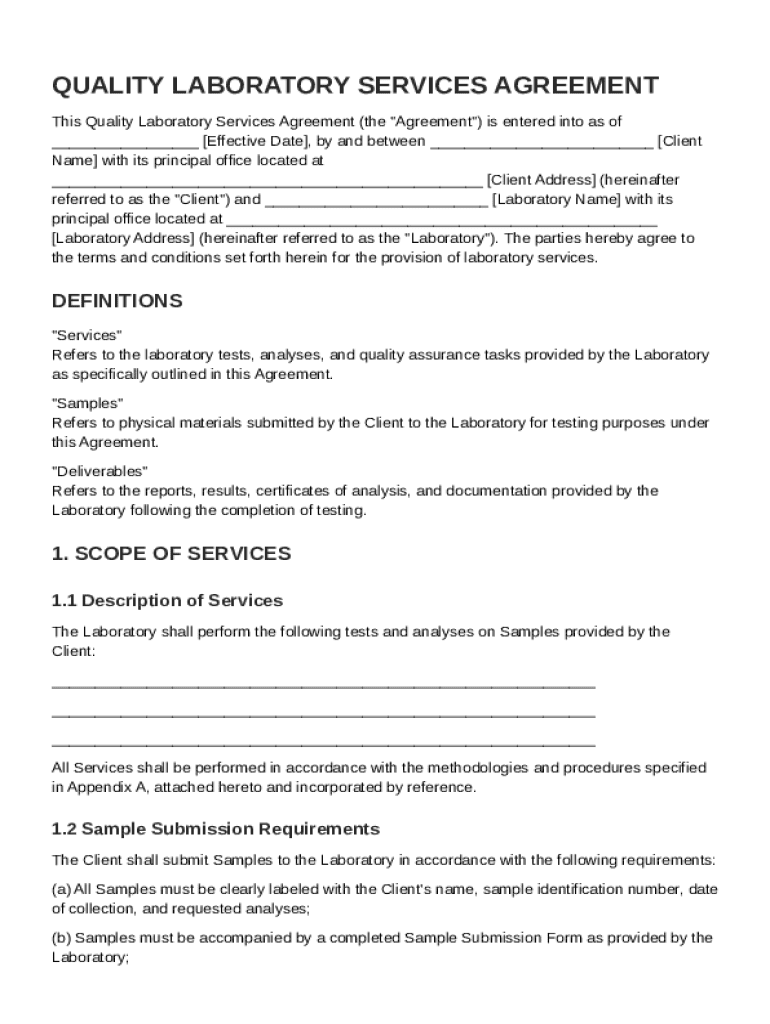







Definition and Purpose of the Quality Laboratory Contract Template
The Quality Laboratory Contract Template is a comprehensive document designed to outline the terms of engagement between a client and a laboratory for the provision of testing and analysis services. This template is crucial in defining key aspects of the relationship, such as services to be rendered, testing standards, and obligations of both parties. The template typically includes provisions regarding the submission of samples, quality control metrics, and confidentiality agreements to protect proprietary data. By formalizing these details, the contract ensures that both parties have a clear understanding of their responsibilities and expectations, facilitating smoother collaborations and reducing the potential for disputes.
How to Use the Quality Laboratory Contract Template
Utilizing the Quality Laboratory Contract Template involves several key steps to ensure all necessary information is captured and that the contract is enforceable:
- Review the Template: Begin by examining the entire document to understand each section's function and ensure no critical elements are missing.
- Customize the Contract: Modify sections as necessary to reflect the specific requirements of your agreement, such as unique service standards or sample handling procedures.
- Define Responsibilities: Clearly specify the duties and responsibilities of both the client and the laboratory.
- Set Quality Parameters: Establish the quality metrics against which the laboratory's performance will be evaluated.
- Add Confidentiality Clauses: Where necessary, include sections that protect both parties' confidential information.
- Finalize and Sign: Once both parties agree to the terms, sign the document to enforce the contract legally.
Key Elements of the Quality Laboratory Contract Template
The template includes several critical components that are integral to formalizing the agreement:
- Service Descriptions: Detailed listing of the laboratory services to be provided, including specific tests.
- Submission Guidelines: Procedures for preparing and submitting samples, including packaging and shipping instructions.
- Quality Standards: Clearly articulated standards for laboratory testing, along with consequences for non-compliance.
- Confidentiality and Data Security: Provisions to ensure the confidentiality of sensitive information and compliance with relevant data protection laws.
- Payment Terms: Outline of the pricing structure, payment schedule, and accepted methods of payment.
- Liability and Indemnification: Statements defining the limits of responsibility and mechanisms for addressing breaches.
Important Terms Related to Quality Laboratory Contract Template
Understanding the terminology used in the Quality Laboratory Contract Template is essential for both parties to navigate the document effectively:
- Analytical Services: Refers to the various tests and evaluations performed by the laboratory on provided samples.
- Chain of Custody: Documentation that tracks the handling of samples from collection to analysis, ensuring integrity.
- Turnaround Time (TAT): The time required by the laboratory to complete testing and deliver results.
- Scope of Work: The section that outlines the specific tasks and services the laboratory will provide under the contract.
Steps to Complete the Quality Laboratory Contract Template
Completing this template requires a systematic approach to ensure all necessary information is included:
- Gather Information: Collect all pertinent data related to the services, such as sample types and testing requirements.
- Identify Parties: Clearly list the legal names and addresses of both the client and the laboratory.
- Detail Services: Specify the tests to be conducted, including any necessary equipment or technology.
- Outline Deliverables: Clearly state the expected outcomes, reports, and any interpretations from tests conducted.
- Set Deadlines and Timelines: Define timelines for sample submission and expected delivery of test results.
- Review Legal Aspects: Ensure all legal obligations, including compliance with state and federal laws, are met.
Legal Use of the Quality Laboratory Contract Template
The Quality Laboratory Contract Template must be legally sound to safeguard both parties. It includes several critical legal components:
- Compliance: Ensures adherence to applicable laws, such as EPA guidelines, state-specific lab regulations, and industry standards.
- Enforceability: Establishes legal standing for the contract, making it binding and enforceable in a court of law.
- Governing Law: Specifies jurisdictional rules that will apply in case of disputes, typically aligning with the state laws where the laboratory operates.
- Dispute Resolution: Outlines mechanisms for resolving disagreements, which can include arbitration or mediation procedures.
Examples of Using the Quality Laboratory Contract Template
This template can be applied across various scenarios:
- Pharmaceutical Testing: A pharmaceutical company contracts a laboratory for quality analysis of raw materials.
- Environmental Monitoring: An environmental agency uses the contract to ensure compliance with local regulations for soil and water testing.
- Food Safety: A food production company partners with a laboratory to test for contaminants in processed foods.
Software Compatibility
The Quality Laboratory Contract Template is adaptable across numerous document processing platforms, ensuring flexibility and ease of use:
- DocHub: Utilize DocHub's capabilities to edit and sign the templates online seamlessly.
- Microsoft Word: Offers extensive formatting tools to customize the contract as per agreement needs.
- Google Docs: Provides collaboration features that enable multiple stakeholders to review and revise the contract in real-time.
- PDF Editors: Maintain a non-editable format while allowing for electronic signatures, ensuring security during electronic transmission.
By comprehensively addressing these critical aspects, the Quality Laboratory Contract Template becomes an invaluable tool for laboratory service agreements, ensuring clarity, compliance, and mutual accountability.




