
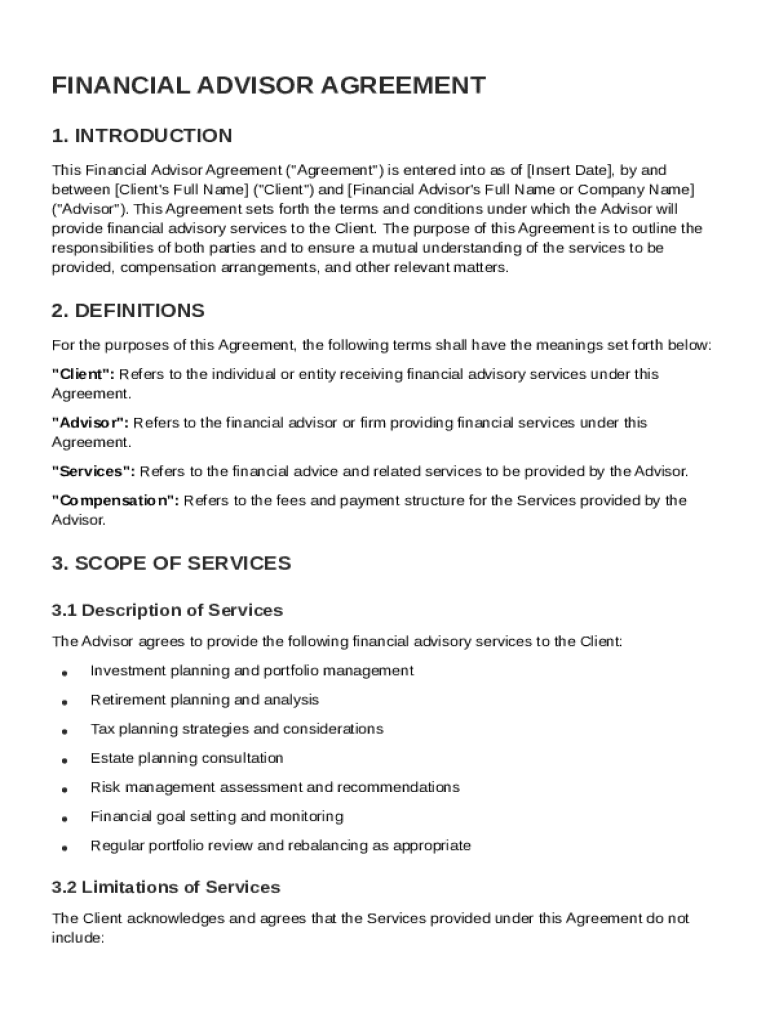







Definition and Meaning
A Financial Advisor Contract Template outlines the contractual terms between a financial advisor and their client. This document establishes clear agreements on aspects such as the scope of provided services, payment structures, confidentiality agreements, and any dispute resolution processes. This template serves as a foundational document ensuring both parties have a mutual understanding of their responsibilities and expectations within the advisory relationship.
Practical Applications
- Service Scope: Clearly lists the services the financial advisor will provide, such as investment strategies, retirement planning, or tax advice.
- Client Expectations: Sets expectations regarding the client's role, such as providing necessary information or documents in a timely manner.
- Documentation: Offers a formal record of the relationship, useful for maintaining transparency and clarity.
Key Elements of the Financial Advisor Contract Template
The contract encompasses several vital components, each aimed at ensuring a comprehensive understanding and smooth operation of the advisory relationship.
Essential Clauses
- Scope of Services: Defines what the advisor will provide under the agreement, detailing specific areas like financial planning or wealth management.
- Compensation Structure: Explains how the advisor will be paid—hourly, flat fee, or percentage of assets managed.
- Confidentiality Obligation: Outlines how sensitive information provided by the client will be handled and protected by the advisor.
Protective Measures
- Dispute Resolution: Specifies how conflicts will be handled, whether through arbitration, mediation, or legal proceedings.
- Termination Clause: Details under what circumstances and how either party may terminate the contract.
Who Typically Uses the Financial Advisor Contract Template
A variety of individuals and entities utilize this template to formalize advisory relationships.


Typical Users
- Financial Advisors: Professionals seeking a standard contract to present to new clients to outline the terms of their professional relationship.
- Clients: Individuals or businesses looking to engage a financial advisor with a formalized agreement that specifies services and compensation.
Business Context
- Corporate Clients: Companies looking for advisory services for employee benefits or corporate financial planning.
- Individual Investors: Those seeking personalized advice to grow personal wealth or manage retirement funds.
Steps to Complete the Financial Advisor Contract Template
Completing this template involves several careful steps to ensure all details are adequately captured.
Step-by-Step Process
- Review the Template: Begin by thoroughly understanding the document's provisions to ensure they match your needs.
- Customize Service Scope: Modify the template to reflect the specific services and expertise of the advisor in question.
- Specify Financial Terms: Clearly define payment terms and any potential additional costs that may arise.
- Detail Responsibilities: Ensure client and advisor roles are explicitly stated to avoid potential misunderstandings.
- Finalize with Signatures: Conclude by having both parties review the finalized document and sign to acknowledge acceptance.
Legal Use of the Financial Advisor Contract Template
A legally binding document, this template must adhere to specific legal standards to maintain enforceability.
Compliance Considerations
- Adherence to Law: Must comply with relevant local, state, and federal laws that govern financial services and contracts.
- ESIGN Act Compliance: Digital signatures should comply with regulations to ensure online agreements are valid.
Litigation Avoidance
- Clear Language: Use unambiguous, clear language to prevent potential disputes.
- Recorded Amendments: Document any changes to the original contract in an addendum signed by both parties.
State-Specific Rules for the Financial Advisor Contract Template
Different jurisdictions may have varied requirements or standards applicable to this type of contract.
Key Variations
- State Regulations: Each state might impose unique requirements on how financial advisory services are contracted.
- Licensing Requirements: Advisors must be properly licensed in the states where they offer services.
Local Adaptations
- State-Specific Clauses: Include specific language relevant to the jurisdiction governing the contract.
- Notarization Needs: Some states may require notarization for the agreement to be legally enforceable.
Important Terms Related to Financial Advisor Contract Template
Understanding specific terminology within the template can aid in better comprehension and execution.
Glossary
- Assets Under Management (AUM): Refers to the total market value of the investments that a financial advisor manages.
- Fiduciary Duty: The obligation advisors have to act in the best interests of their clients.
Application Insights
- Delegation: Details how responsibility for certain tasks may be allocated between advisor staff and clients.
- Rebalancing: The advisor's responsibility to adjust client portfolios to maintain desired risk levels.
Examples of Using the Financial Advisor Contract Template
Real-world applications illustrate the utility and adaptability of this template across various scenarios.
Case Studies
- Individual Retirement Planning: An individual engaging an advisor to plan for retirement and ensure investments align with financial goals.
- Corporate Planning: A company hires an advisor to manage employee retirement options and corporate investment strategy.
Varied Contexts
- Family Trusts: Used to manage extensive estate planning for family wealth preservation.
- Tax Optimization: Engaging services specifically for strategies designed to minimize tax liabilities.




