




01. Edit your form online
Type text, add images, blackout confidential details, add comments, highlights and more.

Type text, add images, blackout confidential details, add comments, highlights and more.

Draw your signature, type it, upload its image, or use your mobile device as a signature pad.

Send it via email, link, or fax. You can also download it, export it or print it out.
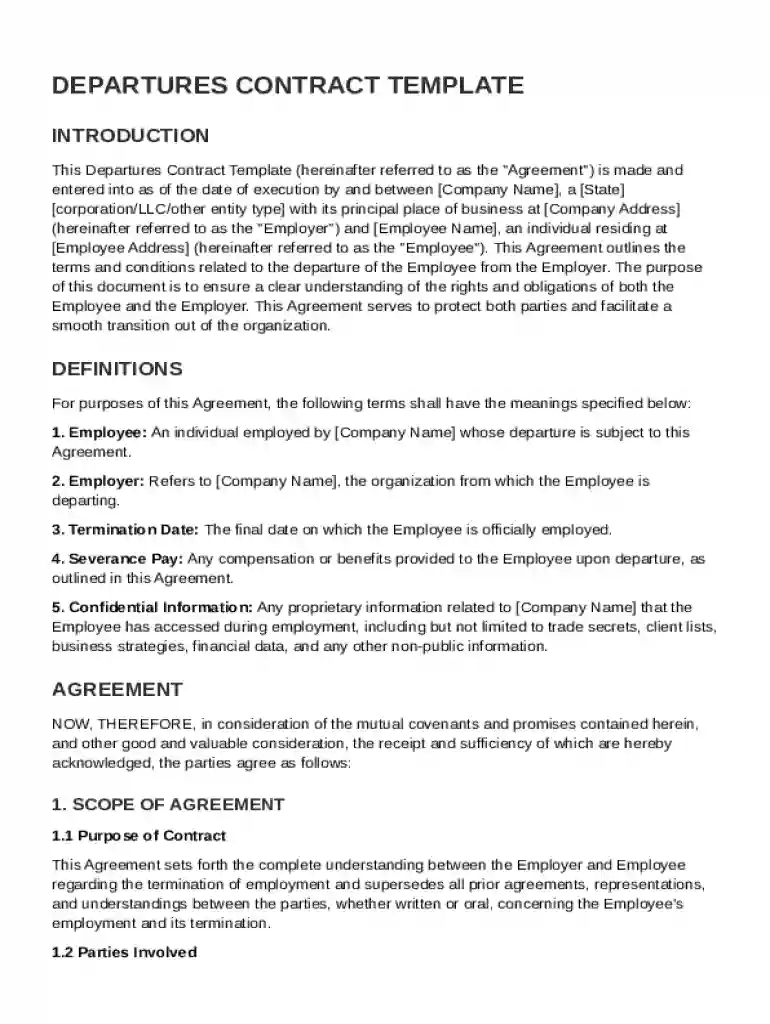
The Departures Contract Template is a vital document used to outline the terms of an employee's departure from a company. It serves as a legally binding contract that details the respective rights and obligations of both the employer and the departing employee. This template provides clarity on critical issues such as final pay, severance entitlements, confidentiality obligations, and the handling of company property. Ensuring that both parties have a clear understanding of these terms helps in facilitating a smooth transition and protects against future disputes.
Definitions: This section clearly defines terms used throughout the contract, ensuring both parties have a mutual understanding of the language.
Departure Details: Outlines the specific conditions of the employee's departure, such as the effective date and the reasons for termination.
Entitlements: Details the final pay and severance packages, including any accrued benefits and unused vacation days.
Confidentiality Obligations: Sets out the requirements for the departing employee to maintain confidentiality about company information.
Return of Company Property: Lists the items the employee must return upon departure, such as laptops, phones, and access cards.
Release of Claims: Ensures the employee agrees not to pursue legal action against the employer in relation to the employment or its termination.
Governing Law and Signatures: Specifies the legal jurisdiction governing the contract and provides space for both parties to sign.
Gather Information: Collect all necessary details about the employee's role, entitlements, and any relevant company policies.
Customize the Template: Adjust the template to reflect the specific circumstances of the departure, making changes to accommodate unique situations.
Include Specific Clauses: Insert any additional clauses that may be required based on the company's policies or the employee's contract.
Review with Legal Counsel: Have the document reviewed by legal experts to ensure compliance with applicable laws and regulations.
Discuss with Employee: Present the document to the departing employee and discuss each section to ensure clarity and agreement.
Finalize and Sign: Once both parties agree, finalize the contract and obtain the necessary signatures to make it legally enforceable.
The legal enforceability of the Departures Contract Template is crucial for protecting both parties involved. It must comply with federal and state employment laws to be valid. Employers should ensure the template aligns with the Fair Labor Standards Act (FLSA) and any other applicable labor laws. Inclusion of release of claims clauses can help protect the company from future lawsuits, provided these clauses are specific and clear.
Different states may have unique requirements for departures contracts. For example, California has specific rules about including non-compete clauses, whereas states like Texas may have different stipulations regarding severance pay. It's important for employers to research state-specific regulations or consult with legal experts to ensure the contract is fully compliant.
The Departures Contract Template is primarily used by human resources departments, legal teams, and managers within organizations of all sizes. It is especially valuable in larger corporations where standardization of exit procedures is necessary to manage numerous departures consistently. Small businesses also benefit by managing departures professionally and legally, minimizing the risk of disputes.


Organizations can access a standard Departures Contract Template through various sources, such as legal document providers or HR software platforms. Many companies choose to work with legal professionals to create a customized template that meets their specific needs. Online platforms, like DocHub, offer tools for creating and editing such documents, allowing for easy customization and electronic signing to streamline the process.
Each of these scenarios demonstrates the importance of a well-drafted Departures Contract Template to ensure clarity and protection for both parties involved.
At DocHub, your data security is our priority. We follow HIPAA, SOC2, GDPR, and other standards, so you can work on your documents with confidence.



This contract constitutes the entire agreement between the parties. Any additions or changes shall be in writing and mutually agreed upon by the parties. D
The document is divided into ten Parts, and within seven of these Parts there are several sub-headings (Parts and sub-headings are listed in the Table of
The Contractor shall complete all work on an as ordered basis throughout the Contract period which is Calendar Days after the Notice-. Page 4. 4 | Page.


