




Definition & Meaning
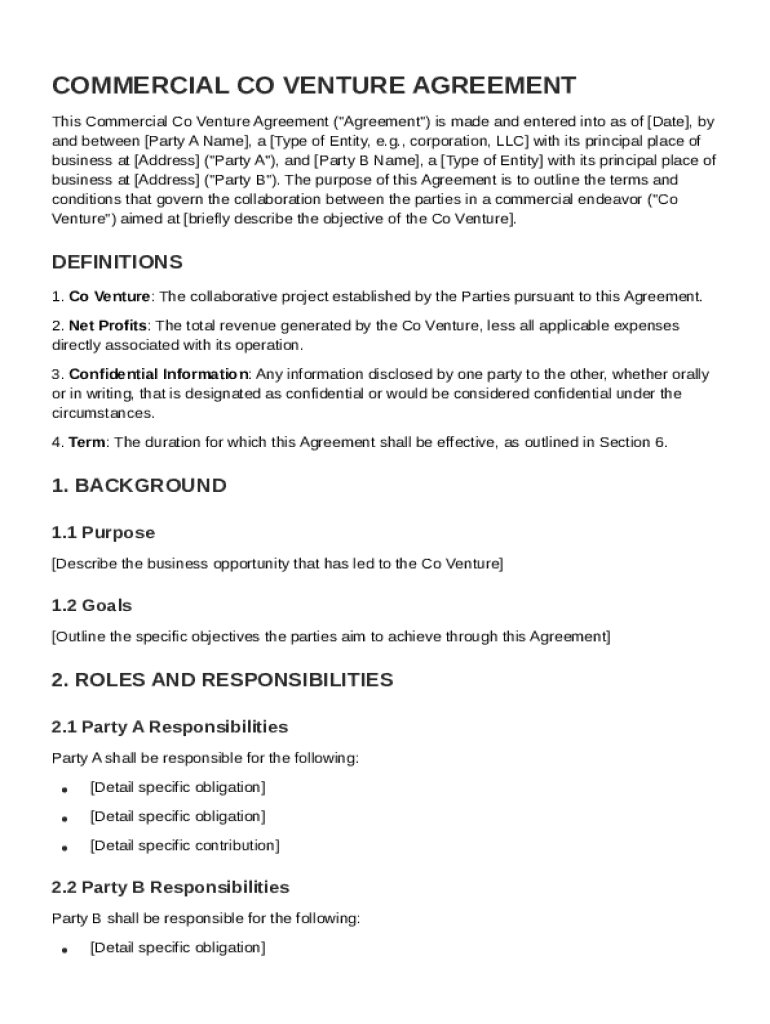
A Commercial Co-Venture Agreement is a legal contract between two or more parties collaborating on a commercial project. This agreement defines the roles, responsibilities, and financial arrangements between participants, often labeled as Party A and Party B. The specific terms within the contract clarify what constitutes a 'Co Venture,' outline how 'Net Profits' are calculated, and emphasize the protection of 'Confidential Information.' These elements ensure that all parties are on the same page, reducing ambiguity and potential conflicts throughout the partnership.
How to Use the Commercial Co-Venture Agreement Template
To effectively utilize the Commercial Co-Venture Agreement Template, parties should first identify the specific roles and contributions that each will make to the commercial project. This involves detailing tasks, deliverables, and timelines. Users should customize the template by inserting the relevant information into sections regarding financial terms, such as how profits and expenses will be shared. By adapting the standardized template to the unique requirements of their venture, parties can ensure that the agreement is thorough and reflective of their collective intentions.
Steps to Complete the Commercial Co-Venture Agreement Template
- Gather Information: Collect details on each party's responsibilities and the project's objectives.
- Customize the Template: Fill in specific sections such as partner roles, financial contributions, and profit-sharing ratios.
- Include Confidentiality Provisions: Ensure clauses addressing the handling of confidential information are clearly defined.
- Define Dispute Resolution Mechanisms: Specify procedures for resolving any disagreements that might arise during the project.
- Finalize and Sign: Review the completed template for accuracy and legality before all parties sign.
Key Elements of the Commercial Co-Venture Agreement Template
- Participant Roles: Clearly specifies the duties and roles of each party involved in the venture.
- Financial Terms: Outlines how profits, losses, and expenses are to be divided.
- Confidentiality Obligations: Details the handling of sensitive information, ensuring proprietary content is protected.
- Dispute Resolution: Provides mechanisms for addressing conflicts, which may include arbitration or mediation.
- Termination Conditions: Describes the circumstances under which the agreement may be dissolved or voided.
Important Terms Related to Commercial Co-Venture Agreement Template
Understanding specific terms used in the agreement is crucial for its successful implementation:
- Co Venture: Collaborative project between parties.
- Net Profits: The remaining revenue after deducting expenses.
- Confidential Information: Proprietary data that must be protected under the agreement.
- Intellectual Property Rights: Ownership rights over creations such as designs, inventions, or trademarks used during the venture.
Legal Use of the Commercial Co-Venture Agreement Template
These agreements must comply with legal standards, particularly those pertaining to contract law in the U.S. The agreement's terms must be clear, mutual, and legally binding. Parties are advised to consider state-specific regulations and may need to consult legal counsel to ensure the template's terms are enforceable and applicable to their specific jurisdiction.
Business Types that Benefit Most from Commercial Co-Venture Agreement Template
Various businesses can leverage this template effectively, including:
- Startups: Partnering to share resources and expertise.
- Franchise Models: Collaborating with franchisees to launch joint initiatives.
- Retail Chains: Engaging in localized marketing campaigns with local vendors.
State-by-State Differences
While the Commercial Co-Venture Agreement provides a baseline for collaboration, individual states may have unique requirements affecting its application. For instance, some states may have specific disclosure or registration requirements for joint ventures. Therefore, parties should review state laws to ensure compliance and may need to modify their agreements accordingly.