
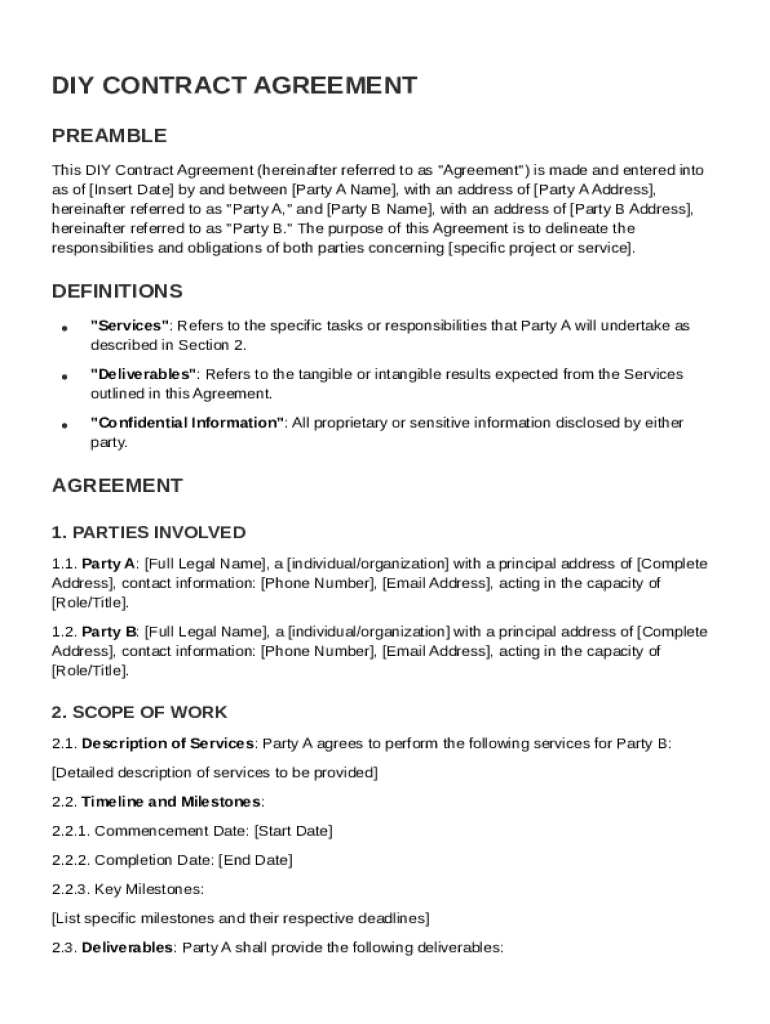







Definition and Meaning
A DIY contract template serves as a pre-designed agreement form that parties can use to set the terms and conditions of various professional arrangements without needing extensive legal expertise. This template is a ready-made legal document that typically includes the necessary sections such as service descriptions, payment conditions, duration, confidentiality clauses, liability limitations, and dispute resolutions. Its primary purpose is to facilitate agreements by providing a clear framework, allowing the involved parties to personalize the template to suit their specific needs while ensuring essential legal and professional standards are met.
Key Elements of the DIY Contract Template
A comprehensive DIY contract template contains several critical components that ensure its effectiveness as a legal agreement:
- Scope of Work: Clearly defines the tasks or services to be completed, along with any deliverables expected from each party.
- Payment Terms: Outlines the compensation details, including payment amount, schedule, and method, to ensure transparency regarding financial obligations.
- Confidentiality Clauses: Ensures that sensitive information shared during the partnership remains protected and is not disclosed to unauthorized parties.
- Liability Limitations: Sets the boundaries of each party's responsibility to minimize potential legal disputes.
- Dispute Resolution Procedures: Provides a mechanism for handling disagreements, whether through mediation, arbitration, or litigation.
- Amendment Provisions: Details how changes to the agreement can be made after its execution, ensuring flexibility while maintaining control over contract terms.
How to Use the DIY Contract Template
When utilizing a DIY contract template, follow these critical steps:
- Review the Template: Familiarize yourself with the framework and all included sections to understand what needs custom adjustments.
- Customize for Specific Needs: Adjust the template to fit the particular details of the agreement using editable fields. Include specifics like names, project descriptions, and unique clauses pertinent to your situation.
- Clarify Terms: Ensure both parties clearly understand and agree on all terms outlined in the customized contract to avoid future misunderstandings.
- Consult a Professional if Necessary: For assurance of legal compliance and to address any unique or complex aspects, consult a legal professional.
- Finalize and Execute: After finalizing the contract, both parties should review it one more time before signing. The signed document should be distributed to all involved parties for records.
Legal Use of the DIY Contract Template
Legal compliance is fundamental in using a DIY contract template. These templates must adhere to applicable local and federal laws to be enforceable. Here are important considerations:
- Jurisdictional Requirements: Ensure the contract is compliant with specific laws of the state where the contract will be enforced.
- Validity of Signatures: In the United States, electronic signatures are acceptable under the ESIGN Act, providing a convenient method for executing contracts.
- Amendments and Termination: Include clear instructions on how the agreement can be modified or terminated legally.
Why Should You Use a DIY Contract Template?
Opting for a DIY contract template offers several advantages:
- Cost-Effective: Reduces the legal costs typically associated with drafting contracts from scratch.
- Time-Saving: Facilitates a quicker preparation process by providing a structured foundation that only requires detail-specific customization.
- Flexibility: Allows easy adaptability to meet the unique needs of various professional and personal agreements.
- Accessibility: Empowers individuals and small businesses to create legally binding agreements without needing extensive legal knowledge.
Important Terms Related to DIY Contract Template
Understanding the terminology used in contract templates is vital for effective use:
- Parties: The entities or individuals entering into the contract.
- Consideration: The benefit or value exchanged between the parties, typically involving payment for services rendered.
- Warranties: Assurances provided by either party regarding the conditions or quality of the services or goods exchanged.
- Force Majeure: A clause that frees all parties from liability in the event of an extraordinary occurrence, such as a natural disaster, that prevents fulfilling contractual obligations.
- Indemnification: A promise by one party to compensate the other for any potential loss or damage that arises.
Examples of Using the DIY Contract Template
DIY contract templates can be utilized in a variety of scenarios:
- Freelance Services: A graphic designer and a client use the template to outline project specifics, deliverable timelines, and payment terms.
- Consulting Agreements: A consulting firm employs the template to define the responsibilities of both the company and its client, ensuring alignment on deliverables and performance expectations.
- Real Estate Transactions: Buyers and sellers use the template to detail transaction conditions, inspection requirements, and closing procedures.
Steps to Complete the DIY Contract Template
Completing a DIY contract template involves several structured steps:
- Gather Information: Collect all necessary details, including the names of involved parties, agreement date, and essential terms.
- Customize the Template: Fill in the blank sections with the specific terms that apply to your arrangement.
- Review and Revise: Carefully review to ensure all necessary sections are completed accurately and comprehensively.
- Engage Both Parties: Both parties should discuss the final version, making sure all terms are fully understood and agreed upon before signing.
- Sign and Distribute: Obtain signatures from all involved parties and distribute copies for record-keeping and verification purposes.
State-Specific Rules for the DIY Contract Template
State laws may impact how a DIY contract template is executed and enforced:
- Varied Contractual Requirements: Each state may have different mandates regarding contract formation and enforceability, especially concerning electronic agreements and signatures.
- Consumer Protection Statutes: Some states have specific consumer protection laws that may require additional clauses to safeguard party rights.
- Usury Laws: When financial transactions are involved, state-specific usury laws may regulate interest rates and financial agreements within the contract.




