




Key Elements of the Business Ownership Contract Template
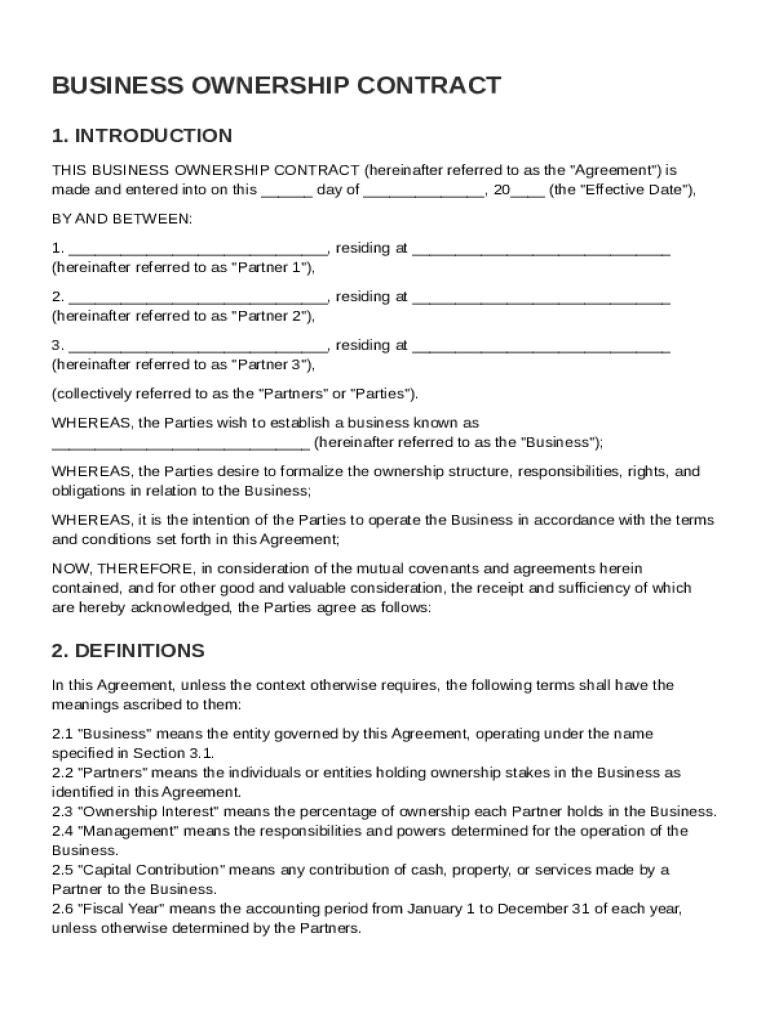
The Business Ownership Contract Template is an essential document for establishing clear terms between business partners. Key elements of this template include:
-
Ownership Structure: Defines each partner's percentage of ownership based on their contributions. For example, if one partner contributes more capital, they may receive a higher stake.
-
Capital Contributions: Details the initial capital each partner contributes and outlines future funding obligations. This section ensures transparency and sets expectations for ongoing financial responsibilities.
-
Profit Distribution: Establishes how profits and losses will be shared among partners. Typically, this is proportional to ownership stakes but can be customized.
-
Management Roles and Decision-Making: Clarifies each partner's role in the day-to-day operations and decisions. This section also specifies voting rights and decision-making processes for major business actions.
-
Transfer of Ownership: Explains the procedure for transferring ownership stakes, including any restrictions or requirements for approval from other partners.
-
Dispute Resolution: Provides mechanisms for resolving disagreements, such as mediation or arbitration, to avoid costly and time-consuming litigation.
-
Termination of Agreement: Outlines the conditions under which the contract may be terminated and the consequences of termination, such as the distribution of remaining assets.
Legal Use of the Business Ownership Contract Template
The Business Ownership Contract Template must adhere to legal requirements to ensure enforceability and protect the interests of all parties involved.
-
Compliance with State Laws: The contract should conform to the relevant state laws governing business partnerships. Variations might exist, so it's crucial to tailor the template according to state-specific regulations.
-
Legally Binding Provisions: All clauses must be clear and unambiguous to prevent disputes over interpretation. Seeking legal advice during drafting can ensure all terms are enforceable.
-
Acknowledgment of Responsibilities: Both parties should understand and agree to the responsibilities and obligations outlined in the contract. A section requiring signatures ensures both partners acknowledge and accept the terms.
-
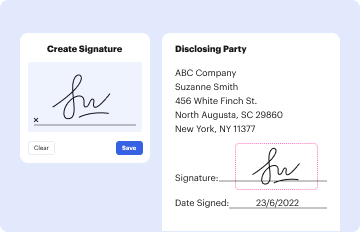
Use of Electronic Signatures: To facilitate ease and efficiency, the template allows for electronic signatures, which are legally binding under the ESIGN Act. This capability is beneficial for partners in different locations.
Steps to Complete the Business Ownership Contract Template
Completing the template requires careful attention to detail to ensure accuracy and compliance with legal standards.
-
Review and Customize the Template: Ensure the template aligns with the specific needs of your partnership. Adjust sections to reflect unique business agreements and state requirements.
-
Define Ownership Terms: Clearly state the ownership percentages, based on initial capital contributions or other criteria. Include conditions for adjusting these percentages if further investments are made.
-
Outline Management Structures: Detail each partner's responsibilities, including management roles, operational duties, and decision-making authority.
-
Specify Financial Arrangements: Include sections covering capital contributions, profit sharing, and financial reporting. Clearly define how profits and losses will be allocated.
-
Address Legal Considerations: Incorporate guidelines for resolving disputes, handling breaches of contract, and terminating the agreement under specified conditions.
-
Final Review and Signing: Have all partners review the completed document and consult legal professionals if necessary. Once all terms are agreed upon, gather signatures from all parties to finalize the contract.
Important Terms Related to Business Ownership Contract Template
Understanding the terminology used in the Business Ownership Contract Template is crucial for effective use and compliance.
-
General Partnership: A business arrangement where two or more individuals share ownership responsibilities and liabilities.
-
Limited Partnership: Partners have limited liability relative to their investment in the business, with at least one partner having unlimited liability.
-
Indemnification: A provision to protect partners from certain liabilities, ensuring that one partner can recover losses caused by another's actions.
-
Fiduciary Duty: Partners are obligated to act in the best interest of the partnership, maintaining trust and responsibility in their actions.
-
Quorum: The minimum number of partners that must be present to make decisions binding, often included in decision-making sections of the contract.
Who Typically Uses the Business Ownership Contract Template
The template is primarily utilized by individuals entering into partnership arrangements to establish and operate a business.

Common Users
-
Entrepreneurs: Individuals starting a new venture with a partner benefit from clearly defined terms that promote successful collaboration.
-
Small Business Owners: As businesses grow, additional partners might be brought in, and having a solid contract helps maintain operational harmony.
-
Family Businesses: Family-run businesses often use these contracts to clarify roles and prevent disputes over management and ownership.

Scenarios
-
Mergers: When two businesses merge, a new Business Ownership Contract can consolidate terms and clarify ownership and roles.
-
Franchise Operations: Some franchisee partnerships may require detailed contracts to define operational and financial responsibilities.
Examples of Using the Business Ownership Contract Template
Real-world applications of the contract template illustrate its versatility and importance in various business setups.
-
Tech Startups: A tech startup in Silicon Valley utilized the template to define each co-founder’s share, roles in software development, marketing, and fundraising.
-
Retail Partnerships: Two entrepreneurs opening a retail store in New York City adapted the template to assign profit-sharing percentages and day-to-day management tasks.
-
Consulting Firms: Partners in a Chicago-based consulting firm applied the template to delineate client acquisition responsibilities and revenue distribution.
These examples highlight how the template can be customized to fit diverse business environments and needs.
State-Specific Rules for the Business Ownership Contract Template
Certain states have unique requirements that may impact the construction of a business ownership contract.
Key Considerations
-
California: Requires specific language regarding management and profit-sharing for partnerships to be enforceable.
-
Texas: Has unique regulations on non-compete clauses within partnership agreements, requiring these to be carefully drafted.
-
New York: Demands inclusion of specific dispute resolution mechanisms and mandates particular disclosures.
Variations
Adjustments to the template should be made to reflect these regional variations. Consulting with a legal expert familiar with state laws can ensure compliance.
Digital vs. Paper Version
Selecting between a digital or paper version of a Business Ownership Contract Template offers varying advantages.
Digital Version
-
Efficiency: Easier to edit and share, with provisions for electronic signatures, allowing partners in different locations to collaborate seamlessly.
-
Security: Protected with measures like 256-bit SSL encryption to safeguard sensitive information.
Paper Version
-
Traditional Preference: Some partners may prefer paper for its tangibility, especially in industries more accustomed to physical documentation.
-
Notary Services: Paper versions can easily incorporate notarization, often required for additional legal validation.
Both formats offer flexibility depending on business needs and partner preferences.