
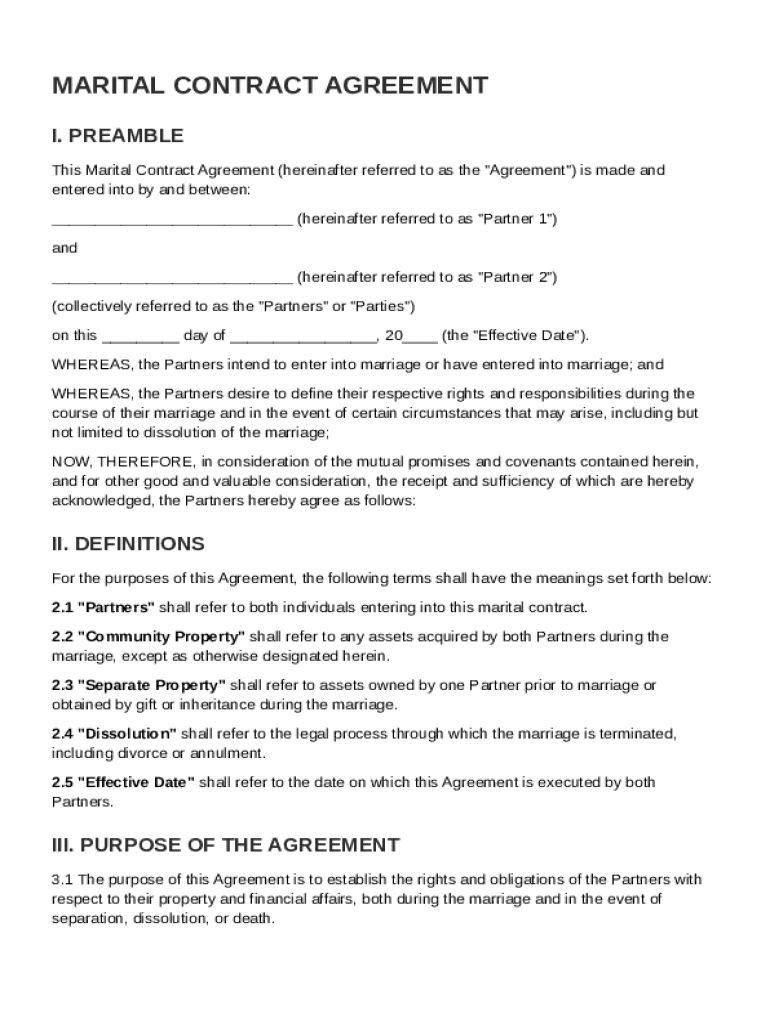







Definition & Meaning
The Marital Contract Template, commonly known as a prenuptial or postnuptial agreement, outlines the legal understanding and financial arrangements between two partners entering into marriage. This document typically covers areas related to community and separate property, alimony, property division, and debt responsibility, alongside laying the groundwork for potential future changes in the marital status of the partners. By clearly defining these terms, the agreement ensures that both parties have a mutual understanding and sets expectations regarding financial and property matters throughout the marriage. This helps avoid disputes and promote harmony by addressing financial matters proactively.
Key Elements of the Marital Contract Template
A well-structured Marital Contract Template includes several crucial components to ensure comprehensiveness and enforceability. Key elements often found in this template are:
- Identification of Assets and Liabilities: Clearly lists and categorizes properties and debts, distinguishing between individual and jointly owned assets.
- Spousal Support: Specifies terms for alimony, detailing conditions under which support will be paid, such as marriage duration or significant life changes.
- Property Division: Outlines how properties will be allocated or divided upon separation or divorce, following community property or equitable distribution laws.
- Inheritance Rights: Addresses arrangements concerning inheritance and estate planning, ensuring alignment with personal wishes and existing estate plans.
- Debt Responsibility: Defines how liabilities incurred before and during the marriage will be handled to protect spouses from undesired debt burdens.
By including these elements, the Marital Contract Template provides a comprehensive framework for managing a variety of marital and financial issues.
Who Typically Uses the Marital Contract Template
The Marital Contract Template is typically used by couples who wish to define the terms and conditions of their marital relationship in advance. While prenups are most common among individuals with significant personal or family wealth, they are also increasingly used by couples who want to ensure financial transparency and clarity. People entering a marriage for the second time or those with children from previous relationships often seek a marital contract to safeguard individual assets for future heirs. This document is beneficial for any couple seeking to plan for their financial future responsibly and equitably.

Steps to Complete the Marital Contract Template
- Gather Financial Information: Both parties should compile a comprehensive list of assets, debts, income, and expenses, providing a transparent view of their financial standing.
- Consult Legal Counsel: Seek advice from a family law attorney experienced in drafting marital contracts to ensure the document meets legal standards and reflects personal intentions.
- Draft Initial Agreement: Using the Marital Contract Template, draft an agreement outlining the distribution of assets, spousal support, and other key elements, using clear and legally sound language.
- Review and Revise: Both parties should carefully examine the draft, discuss terms openly, and make necessary revisions to accommodate any concerns or changes in circumstances.
- Finalize and Sign: Once both parties are satisfied with the terms, sign the document in the presence of witnesses or a notary to give it legal standing.
By meticulously following these steps, couples can create a solid foundation for their marital relationship.
Legal Use of the Marital Contract Template
The Marital Contract Template serves as a legally binding agreement when executed correctly. To ensure its enforceability, the document must be voluntarily entered into by both parties with full disclosure of their financial situations. State laws govern the validity of marital contracts, and it is crucial for the agreement to comply with state-specific legal requirements. Additionally, both parties should have separate legal representation to ensure that the agreement is understood and agreed upon without undue pressure. When completed properly, a marital contract provides a reliable legal framework for managing marital and financial affairs.
State-Specific Rules for the Marital Contract Template
The enforceability and provisions of a Marital Contract Template vary by state. Each jurisdiction has its own family law, which dictates acceptable terms and requisite formalities for these agreements. For example, community property states like California and Texas have distinct rules regarding the division of assets in a marital dissolution.
Key considerations include:
- Community vs. Equitable Distribution: States follow one of these principles to divide marital assets.
- Specific Provisions: Some states disallow certain terms, such as those affecting child support or child custody.
- Execution Formalities: Requirements for notarization and involvement of legal counsel differ among states.
When drafting a Marital Contract Template, understanding these state-specific nuances is crucial for maintaining its legal validity.
How to Use the Marital Contract Template
The Marital Contract Template presents a standardized format to facilitate the drafting of a personalized agreement. Once both parties agree to use the template, they need to:
- Customize Sections: Modify clauses related to property division, alimony, and debt liability to address personal circumstances.
- Add Specific Provisions: Incorporate additional clauses that might be pertinent, such as those regarding work commitments or future income.
- Review Regularly: Periodically assess the document’s relevance to any changed conditions, ensuring it remains aligned with evolving financial and personal circumstances.
By tailoring the Marital Contract Template to specific needs, couples can ensure a balanced and relevant agreement.
Important Terms Related to Marital Contract Template
When dealing with a Marital Contract Template, understanding particular key terms is essential for clarity and agreement efficacy:
- Community Property: Refers to assets acquired during the marriage, considered jointly owned by both spouses in certain states.
- Separate Property: Denotes assets owned solely by one spouse, often acquired before the marriage or through inheritance/gifts.
- Equitable Distribution: A principle used in some states where marital property is divided fairly, though not necessarily equally, during a divorce.
- Spousal Support/Alimony: Financial support granted to a spouse post-divorce to maintain a comparable living standard.
- Full Disclosure: The act of openly sharing all relevant financial information between parties to ensure informed agreement signing.
Familiarity with these terms helps in drafting an unambiguous and comprehensive marital contract.




