
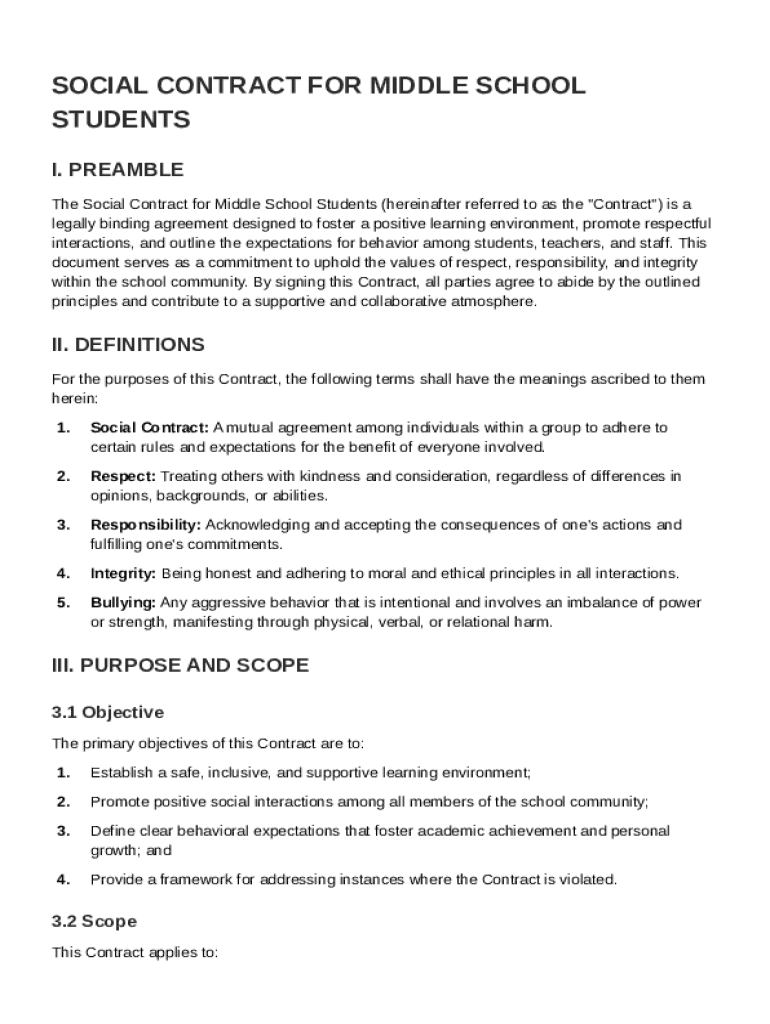







Definition and Purpose of the Social Contract for Middle School
The Social Contract for Middle School Students is an important document designed to foster a positive and safe learning environment by setting behavioral standards within the school community. This contract aims to promote mutual respect, responsibility, and integrity among students, teachers, and staff members. The framework provided by the contract outlines expectations for student conduct, conflict resolution procedures, and the roles of faculty and parents in maintaining a supportive educational atmosphere.
How to Use the Social Contract Template
When employing the Social Contract template, it serves as a guide for drafting a precise agreement tailored to the unique needs and environment of a specific middle school. Start by customizing sections related to respectful communication, accountability, and conflict resolution to align with the school's values and standards. This involves adapting the document to reflect the school's specific culture, policies, and expectations while ensuring consistent messaging across the school community.
Steps to Complete the Social Contract Template
- Gather Input: Begin by consulting with key stakeholders, including teachers, administrators, students, and parents, to gather perspectives on essential elements to include.
- Customize Sections: Tailor sections related to behavior expectations, conflict resolution strategies, and the roles of all parties to reflect the school's ethos.
- Review and Edit: Go over each component to ensure clarity, consistency, and alignment with school policies and legal requirements.
- Finalize the Draft: Compile feedback from stakeholders and finalize the contract draft.
- Communicate to Stakeholders: Share the finalized version with students, parents, and school staff to ensure a mutual understanding of responsibilities.
- Collect Signatures: Gather signatures from students, parents, and staff as an acknowledgment of their commitment to uphold the contract’s tenets.
Key Elements of the Social Contract
- Behavioral Expectations: Clear definitions of acceptable and non-acceptable behaviors within the school setting.
- Conflict Resolution Procedures: Step-by-step processes for addressing conflicts and misunderstandings among students and staff.
- Roles and Responsibilities: Detailed descriptions of the roles played by students, teachers, and parents in maintaining a supportive environment.
- Accountability Measures: Plans for addressing misbehavior and promoting accountability for actions among students.
- Continuous Feedback and Improvement: Mechanisms for regular review and updates of the contract to reflect changing dynamics and requirements of the school environment.
Who Typically Uses the Social Contract Template
The Social Contract is commonly utilized by school administrators, teachers, and guidance counselors to set a standardized code of conduct within the school community. It's also employed by parents and students as a reference guide to understand their roles and responsibilities in promoting a positive school climate.

Legal Use and Compliance
The Social Contract functions as more than just a guideline - it establishes a legally recognized framework within the school setting. While it is not a legal document like a statutory contract, it requires compliance with school district policies and any relevant state laws governing educational conduct and student behavior.
Examples of Implementing the Social Contract
Consider a scenario where a school faces issues with bullying. The contract might include a zero-tolerance policy towards bullying behaviors, coupled with a clearly defined reporting and resolution process. By implementing these measures, the contract plays a critical role in developing an environment of respect and accountability.
State-Specific Rules for the Social Contract
Different states may have varying educational mandates or guidelines regarding student conduct, which might influence the content of a Social Contract. Schools should review state-specific regulations to ensure their contract aligns with all relevant legal expectations and educational standards.
Digital vs. Paper Version
Schools can choose between digital or paper versions of the contract, depending on their administrative preferences and technological capabilities. A digital version allows for easier updates and broad distribution through school platforms, while a paper version offers tangible documentation that can be physically signed and filed.




