
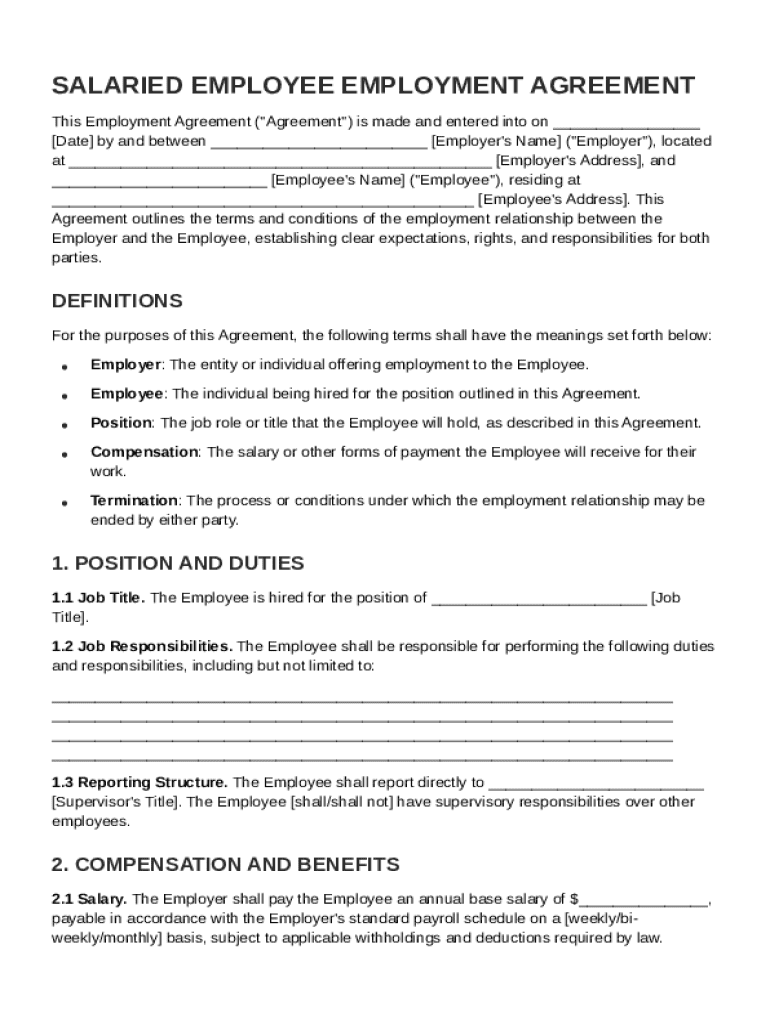







Definition and Meaning
A "Salaried Employee Contract Template" outlines the terms and conditions of employment for salaried employees. This document serves as a formal agreement between an employer and an employee, detailing roles, responsibilities, and expectations. For employers, it provides a framework to clearly communicate job positions, duties, compensation, and other key employment terms. For employees, it offers transparency and protection regarding their rights and obligations at the workplace.
Components of a Typical Contract
- Job Position and Duties: Specifies the role and responsibilities expected from the employee.
- Compensation and Benefits: Details the salary, bonuses, and any additional benefits such as health insurance or retirement plans.
- Work Schedule: Outlines the expected working hours and days.
- Confidentiality Obligations: Defines what constitutes confidential information and the employee's responsibilities in protecting it.
- Termination Procedures: Describes conditions under which either party can terminate the agreement and any notice period required.
- Governing Law: Indicates the legal jurisdiction applicable to the contract.
Key Elements of the Salaried Employee Contract Template
The template typically includes several crucial sections that ensure comprehensive coverage of employment terms.
Job Position and Responsibilities
This section describes the job title, department, and detailed job responsibilities. It serves as a reference for performance evaluations and provides clarity on what is expected from the employee.
Compensation Structure
Includes details of the annual salary, frequency of payments, and any performance-related bonuses. Employers might also outline conditions for salary increases or evaluations here.
Benefits and Perks
Enumerates benefits such as health insurance, vacation days, sick leave, and retirement savings plans. Employers may include additional perks like gym memberships or company cars if applicable.
Confidentiality and Non-Disclosure
This part mandates the employee to protect the employer's confidential information. It often includes restrictions on sharing trade secrets or proprietary information with outsiders.
Steps to Complete the Salaried Employee Contract Template
Guide on filling out the Salaried Employee Contract Template accurately to ensure all legal requirements are met.
Collect Necessary Information
- Gather employee’s full name, address, and contact details.
- Ensure you have the job title, department, and supervisor’s name.
- Determine the salary, benefits, and any probationary period conditions.
Drafting and Reviewing
- Start by inserting all personal and job-related details into the template.
- Thoroughly review each section to ensure it complies with company policies and legal standards.
- Consider consulting legal advisors to vet the contract for compliance with state and federal laws.
Legal Use of the Salaried Employee Contract Template
Legal considerations to ensure the contract is enforceable and compliant with employment law.
Compliance with Labor Laws
Ensuring the contract template complies with federal and state labor laws helps prevent disputes. This includes adherence to minimum wage laws and regulations related to working hours and overtime pay.
Enforceability of Terms
Clauses such as non-compete and confidentiality should be clearly defined and reasonable in scope to ensure they are enforceable in court. Vague or overly restrictive terms can render these clauses void.
Important Terms Related to Salaried Employee Contract Template
Understanding the specific legal and employment-related terms found within the contract.
Definitions Section
- Exempt vs. Non-Exempt Employees: Defines how the employee’s classification affects overtime pay eligibility.
- At-Will Employment: Clarifies the conditions under which an employer can terminate an employee without cause.
Termination Clauses
Include voluntary and involuntary termination conditions, ensuring both employee and employer understand notice periods and severance expectations.
State-Specific Rules for the Salaried Employee Contract Template
Variation in Employment Laws
Different states have unique requirements for employment contracts. For example, California imposes strict rules on non-compete clauses, while Texas may have more lenient conditions. Understanding state-specific rules can prevent legal issues down the line.
Examples of Using the Salaried Employee Contract Template
Real-World Scenarios
- A Software Developer: Hired on a full-time basis, the contract specifies remote working conditions, annual salary, stock options, and IT equipment provisions.
- A Marketing Manager: Provided with a template outlining performance-based bonuses, travel allowances, and professional development opportunities.
Understanding these scenarios helps users tailor the template to fit diverse employment contexts, ensuring alignment with both job and industry standards.
Business Types that Benefit Most from the Salaried Employee Contract Template
Small and Medium Enterprises (SMEs)
For SMEs, these templates standardize employment terms and reduce the risk of disputes. They are particularly beneficial when hiring employees across different locations with varying state laws.
Large Corporations
Corporations might adapt these templates for different departments, ensuring that employment policies are uniformly communicated across the organization.




