
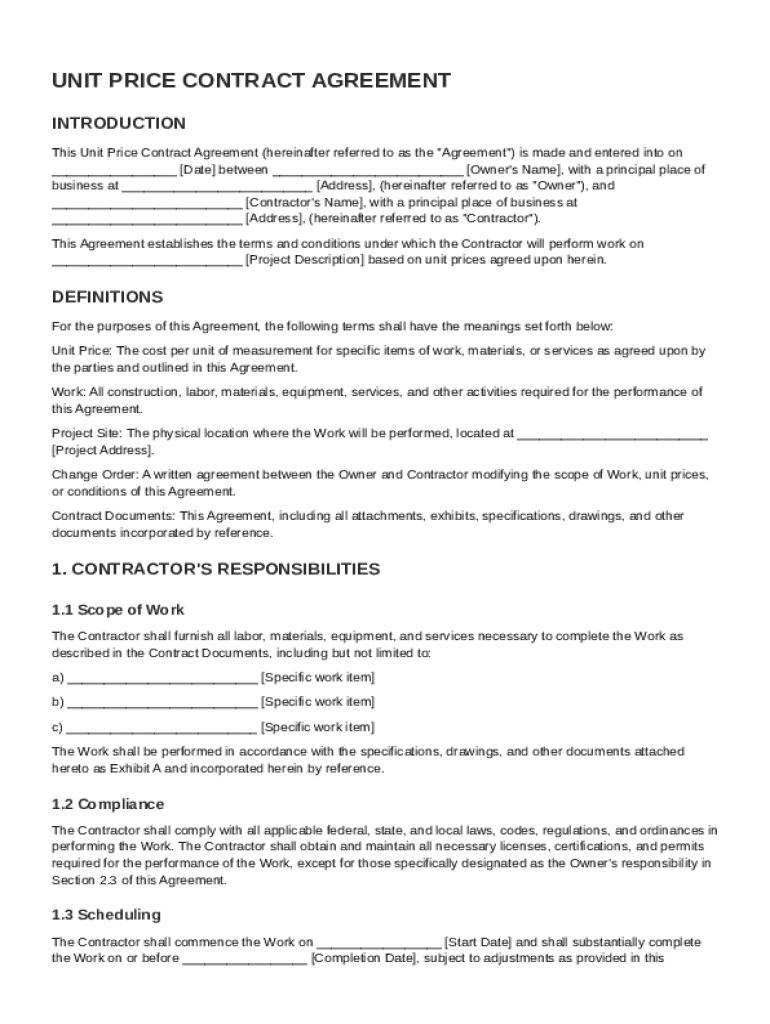







Definition & Meaning of the Unit Price Contract Template
A Unit Price Contract Template serves as a contractual framework outlining the agreement between an owner and a contractor for construction projects based on predetermined unit prices. This template details the responsibilities and expectations of both parties concerning tasks associated with the construction project. It includes, but is not limited to, aspects such as payment terms, dispute resolution mechanisms, and termination clauses. The template is designed to be comprehensive, ensuring both contractor and owner have a clear understanding of project management aspects, from scheduling and invoicing to confidentiality obligations.
How to Use the Unit Price Contract Template
Using a Unit Price Contract Template involves several key steps to ensure it fits the specific needs of a construction project. Begin by identifying and listing all project components that will be priced on a unit basis. Subsequently, these components must have their respective unit prices agreed upon by both parties. Ensure that every pertinent section, such as payment terms and responsibilities, is customized to the specifics of the project. User-friendly software like DocHub can simplify filling and modifying this template, providing essential tools for annotations and edits, thereby ensuring the contract aligns perfectly with the project's requirements.
Key Elements of the Unit Price Contract Template
Several key elements are integral to a Unit Price Contract Template. These include:
- Project Scope: Defines the work to be completed and each task's specific details.
- Unit Prices: Lists agreed-upon prices for each measurable unit of work.
- Payment Terms: Outlines how payments will be made based on completed units, including schedules and methods.
- Change Orders: Provides instructions for handling changes in project scope or terms.
- Dispute Resolution: Describes how disputes will be handled, often including mediation or arbitration clauses.
- Termination Conditions: Details circumstances under which the contract can be terminated.
Comprehensive understanding and use of these elements ensure clarity and prevent potential conflicts during the project execution.
Steps to Complete the Unit Price Contract Template
Completing a Unit Price Contract Template requires a structured approach:
- Gather Information: Collect all relevant details about the construction project, including scope, timeline, and resource requirements.
- Define Unit Prices: Work with stakeholders to determine pricing on a per-unit basis for all project tasks clearly outlined.
- Customize the Template: Use software tools to input specific details into the template, ensuring sections align with the project's context.
- Review Legal Aspects: Confirm the contract complies with regional laws and industry standards.
- Sign and Execute: Once all terms are agreed upon and documented, both parties should sign the contract, ensuring its legal enforcement.
Who Typically Uses the Unit Price Contract Template
The Unit Price Contract Template is primarily utilized by:
- Construction Companies and Contractors: These entities use the template to formalize agreements for projects that involve significant material or labor quantification.
- Project Owners: Individuals or businesses owning the construction venture, employing the template to ensure they pay fairly for completed work.
- Legal Advisors: Attorneys who assist in crafting and reviewing these contracts, ensuring compliance with applicable laws and standards.
These users benefit from the transparency and structure the template provides in managing construction contracts.


Legal Use of the Unit Price Contract Template
The legal use of a Unit Price Contract Template is crucial for ensuring enforceability. It must comply with federal and state laws in the U.S., including statutory regulations governing labor, material standards, and payment practices. The template also supports legal provisions such as the ESIGN Act, making it possible to create binding electronic signatures through platforms like DocHub. Legal compliance ensures that both parties are protected against breaches and have clear recourse in dispute situations.
Important Terms Related to Unit Price Contract Template
Several terms are vital in understanding and utilizing a Unit Price Contract Template:
- Owner: The party owning the project and typically responsible for payments.
- Contractor: An individual or company contracted to execute work detailed in the project scope.
- Units of Measure: Quantifiable elements of the project, such as cubic yards, tons, or square footage, each associated with a specific price.
- Change Order: An amendment procedure for contract alterations post-signing.
Familiarity with these terms is essential for effectively navigating and leveraging the contract template.
Examples of Using the Unit Price Contract Template
In practice, Unit Price Contract Templates are used in several scenarios, such as:
- Infrastructure Projects: Roads, bridges, and utilities where specific elements are priced per unit (e.g., ton of asphalt, square footage of pavement).
- Residential Construction: New homes or large renovations where materials and labor are priced per square foot or linear foot.
- Public Works: Government or municipal projects that require clear budget definitions and accountability through unit-based pricing.
These examples illuminate the document's flexibility, making it a vital tool in diverse construction projects.




