
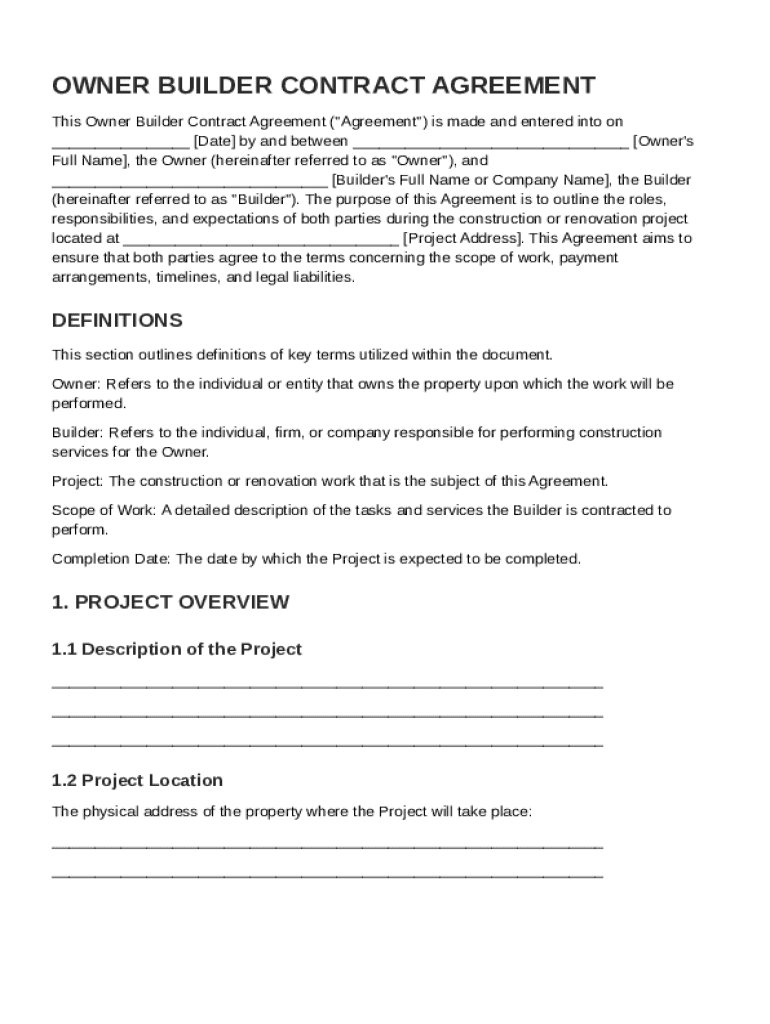







Definition and Meaning
An Owner Builder Contract Template serves as a formal agreement between a property owner and a builder, detailing the terms governing a construction or renovation project. This document is crucial as it outlines obligations, payment schedules, project scope, timelines, insurance requirements, and processes for dispute resolution and termination. By defining these elements, the contract aims to prevent misunderstandings and ensure a smooth project execution.
Key Elements of the Owner Builder Contract Template
- Project Scope: Defines what the construction or renovation project will entail, including specific tasks, materials to be used, and quality standards.
- Roles and Responsibilities: Clarifies the duties of both the owner and the builder, ensuring that each understands their obligations.
- Payment Terms: Outlines the payment schedule and amounts, often linked to project milestones.
- Timelines: Specifies start and end dates for the project, along with deadlines for major stages.
- Insurance Requirements: Lists necessary insurance policies to protect against liabilities or damages during the project.
How to Use the Owner Builder Contract Template
Using the Owner Builder Contract Template involves several key steps to ensure that all aspects of the construction project are comprehended and agreed upon by both parties.
Steps to Complete the Owner Builder Contract Template
- Review and Customize: Begin by carefully reading the template and modifying any sections that need adaptation to your specific project. This may include adding unique project details or altering existing terms.
- Consult Professionals: It is advisable to have a legal expert review the customized contract to ensure compliance with local regulations and to safeguard against future disputes.
- Mutual Agreement: Both the property owner and the builder should thoroughly review the finalized document, ensuring mutual understanding and agreement on all provisions.
- Sign and Execute: Once both parties agree, signatures should be obtained to make the document legally binding.
Legal Use of the Owner Builder Contract Template
The Owner Builder Contract Template must adhere to applicable local laws to ensure that it is enforceable. This includes complying with zoning laws, building codes, and state-specific contractor licensing requirements.
Key Legal Considerations
- Compliance with Local Regulations: Ensure that the project complies with all local land use and building codes.
- Contractor Licensing: Verify that the builder holds any necessary state-specific licenses or certifications.
- Dispute Resolution Clauses: Include provisions for mediation or arbitration to expediently resolve any disagreements that may arise.
Important Terms Related to the Owner Builder Contract Template
Understanding the terminology associated with the Owner Builder Contract Template is essential for effective use and interpretation.
Common Terms
- Milestone Payments: Payments made at specific project milestones rather than upon final completion.
- Liquidated Damages: A specified sum that one party will pay to the other in the case of a breach, particularly delays.
- Termination Clause: Specifies the conditions under which either party can terminate the contract early.
Who Typically Uses the Owner Builder Contract Template
This template is predominantly utilized by homeowners embarking on construction projects and professional builders or contractors who undertake residential renovations or constructions.


User Profiles
- Homeowners: Individuals looking to enhance their properties by hiring builders for construction or renovation work.
- Builders/Contractors: Professional parties responsible for delivering construction services, ensuring they meet outlined specifications and standards.
State-Specific Rules for the Owner Builder Contract Template
Laws and regulations regarding construction contracts can vary significantly between states.
Examples of State Variations
- Licensing Requirements: Some states may enforce more stringent licensing laws for builders, affecting who can legally execute a contract.
- Contractor Limitations: Certain states limit the types of projects that qualify for owner-builder contracts.
Examples of Using the Owner Builder Contract Template
An Owner Builder Contract Template can be utilized in various scenarios, offering a robust framework for different types of construction projects.
Practical Scenarios
- Major Home Renovations: A homeowner looking to undertake a complete kitchen remodel would use the template to set agreements over the process and costs with the builder.
- New Construction: When building a new home, the template establishes the construction scope and payment schedule.
Versions or Alternatives to the Owner Builder Contract Template
While the Owner Builder Contract Template is widely used, there are other versions or similar documents that can be considered based on project complexity or specific requirements.
Alternative Documents
- General Contractor Agreement: Used for larger or more complex projects where various subcontractors may be involved.
- Letter of Intent: A precursor to a contract, outlining basic agreements before final terms are set.
The Owner Builder Contract Template provides a comprehensive and legally sound basis for managing construction projects, fostering clear communication and understanding between property owners and builders.




