
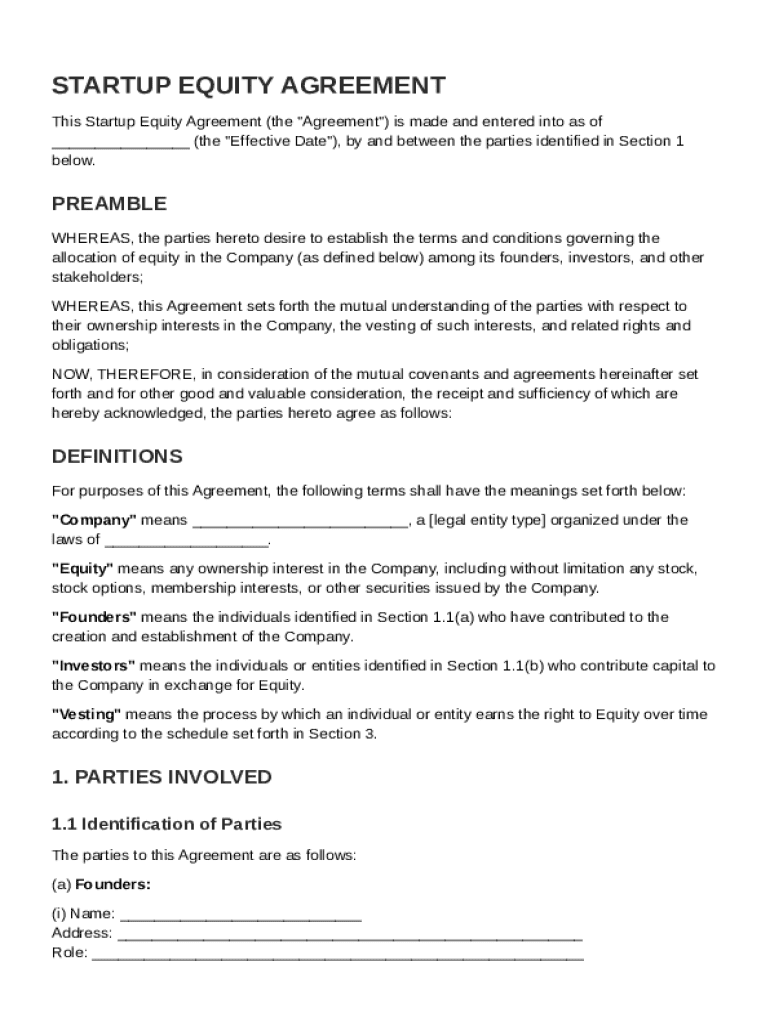







Definition & Purpose of a Startup Equity Agreement Template
A Startup Equity Agreement Template serves as a foundational document that delineates the sharing and transfer of ownership in a startup company. Primarily, it outlines the allocation of equity among founders, investors, and early employees. The agreement is structured to ensure clear communication of roles, responsibilities, and entitlements related to ownership stakes. It also includes provisions on vesting schedules, shareholder rights, and transfer restrictions. Understanding this template is crucial for maintaining alignment and legal compliance in the company's equity distribution.
Core Components of the Agreement
- Equity Allocation: Specifies the percentage of ownership given to stakeholders, including founders, investors, and key employees.
- Vesting Schedules: Details the timeline over which equity is earned, often to encourage long-term commitment.
- Shareholder Rights and Obligations: Outlines the entitlements and responsibilities of shareholders within the company.
- Transfer Restrictions: Contains clauses that control how shares can be transferred or sold, ensuring company stability.
Real-world Example
Consider a startup with three co-founders who decide to equally split their initial equity. The agreement also outlines a four-year vesting schedule with a one-year cliff, which means each founder must stay for at least one year to earn any equity and will acquire 25% of their shares annually thereafter. This structure aligns incentives and protects against premature departures.
Key Elements of the Startup Equity Agreement Template
Understanding the key elements of a Startup Equity Agreement is essential for effective negotiation and utilization. The template generally includes several critical components:
Core Provisions
- Definitions: Clearly defines key terms such as 'Company,' 'Equity,' 'Founders,' and 'Investors' to avoid ambiguity.
- Equity Classes: Different classes of equity might be offered, reflecting varying rights and preferences.
- Governing Law: Indicates the legal framework governing the agreement, which often aligns with the jurisdiction where the company is incorporated.
Practical Implementation
When implementing the agreement, it's crucial to tailor the clauses to the specific needs and structure of the company. For instance, the inclusion of anti-dilution provisions can protect investors if additional equity is later issued.
Steps to Complete the Startup Equity Agreement Template
Completing a Startup Equity Agreement Template involves several structured steps to ensure accuracy and comprehensiveness. These steps are designed to guide startups through the process of formalizing equity allocations:
- Identify Participants: List all stakeholders, including founders, advisors, and investors, with corresponding roles and responsibilities.
- Determine Equity Split: Decide on the allocation percentages for each stakeholder, accounting for potential future fundraising.
- Draft Vesting Terms: Establish vesting schedules with possible cliffs to transition equity over time.
- Incorporate Legal Provisions: Consult legal advisors to include necessary legal clauses, such as dispute resolution mechanisms.
- Review and Revise: Regularly review the terms with all parties to ensure mutual understanding and agreement.
- Execute the Agreement: Obtain signatures from all parties to formalize the agreement.
Common Pitfalls
- Lack of Clarity: Vague language can lead to disputes; clarity is key.
- Inadequate Legal Review: Failing to engage legal counsel can result in unenforceable clauses.
Important Terms in the Startup Equity Agreement Template
A comprehensive understanding of the terminology used in a Startup Equity Agreement is integral to its execution and enforcement. Key terms often include:
- Vesting: The process by which the ownership rights become accessible over time.
- Dilution: Refers to the reduction in existing shareholders' ownership percentage when new shares are issued.
- Preemption Rights: Allow existing shareholders to purchase additional shares before new investors can.
Example of Vesting
For instance, a software engineer may be offered a position with a startup under a typical four-year vesting plan with a one-year cliff. If the individual departs five months into the role, they receive no equity. However, if they leave a year and a half later, they receive 37.5% of their total equity grant.
Legal Use of the Startup Equity Agreement Template
The Startup Equity Agreement Template must be constructed and utilized within the bounds of applicable laws to ensure it is enforceable. It serves primarily as a legal tool for formalizing the equity distribution process in a manner that aligns with statutory requirements.
Legal Considerations
- Compliance with the ESIGN Act: Electronic signatures used in the agreement should comply with the Electronic Signatures in Global and National Commerce Act.
- State Laws: Be aware of the specific legal requirements in the state of incorporation, as regulations can vary.
Legally Binding Nature
Once signed, the agreement serves as a binding legal contract, enforcing the terms and conditions contained within it. Careful drafting and mindful compliance with state-specific laws are necessary to prevent future legal challenges.
Software Compatibility and Digital Use
Integration with document management systems, such as DocHub, enhances the utility of the Startup Equity Agreement Template. Using digital solutions allows for streamlined collaboration, editing, and signing processes.
Benefits of Digital Platforms
- Real-time Collaboration: Multiple stakeholders can access and edit documents simultaneously.
- Version Control: Ensures the most recent version of the agreement is always accessible.
- Enhanced Security: Digital tools provide encryption and secure storage for sensitive information.
Compatibility with Google Workspace
Digital forms like the Startup Equity Agreement Template are easily manageable within the Google Workspace ecosystem. Files can be imported from Google Drive, edited in a platform like DocHub, and saved directly back to Google Drive, facilitating efficient workflows.
State-Specific Rules for Startup Equity Agreements
Different states within the United States have their own nuances and rules concerning equity agreements. It is essential to ensure that the template adheres to these regulations to remain legally valid.
Notable State Differences
- California: Strict laws regarding employee equity compensation require careful adherence to legal standards.
- Delaware: As a preferred state for incorporation, Delaware has established business-friendly laws facilitating startup formation and equity issuance.
Practical Impact
State-specific legal requirements can affect how equity is distributed and taxed. Consulting a legal expert familiar with state laws is advisable to tailor the agreement appropriately.
Examples of Use Cases for the Startup Equity Agreement Template
Illustrating practical applications of the Startup Equity Agreement Template helps in understanding its versatility and importance across various scenarios:
Founders Agreement
A group of fresh graduates starts a tech company and uses the template to allocate equity, assign vesting schedules, and establish ground rules, ensuring clear expectations from the outset.
Employee Stock Option Plan
A startup with rapid growth potential uses the template to prepare an Employee Stock Option Plan to attract and retain talent by promising equity incentives tied to performance and tenure.
Investor Relations
An early-stage venture seeking seed funding presents a well-prepared equity agreement to potential investors, showcasing their transparent and structured approach to managing equity distribution.
By leveraging a Startup Equity Agreement Template, companies can effectively manage equity distribution, uphold legal standards, and foster trust among team members and investors.




