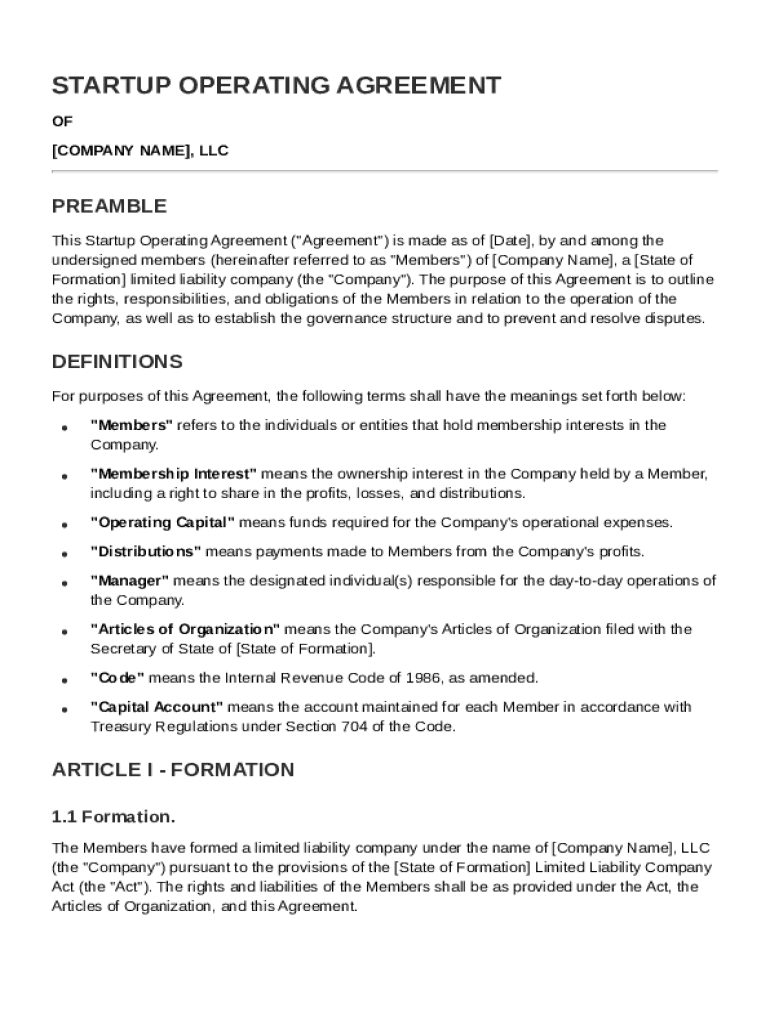







Definition and Meaning
A Startup Operating Agreement Template is a foundational legal document specifically designed for limited liability companies (LLCs) that delineates the company's operational framework, governance structures, and the roles and responsibilities of its members. This agreement is crucial for establishing clear operational guidelines and mitigating potential disputes among members. It includes definitions of key terms like membership interests, capital contributions, and distributions. While not mandatory in every state, having a comprehensive operating agreement is considered best practice for ensuring transparency and protecting member interests.
Key Elements of the Startup Operating Agreement Template
An effective Startup Operating Agreement Template encompasses several vital components that guide the management and operation of the LLC. Key elements typically included are:
- Company Formation: Details about the LLC's establishment, including its name, location, and the purpose of its business activities.
- Membership Interests: Specifies the ownership structure, including the percentage interests, rights, and voting powers of each member.
- Management Structure: Outlines whether the LLC will be managed by its members or by appointed managers, along with specific duties and powers.
- Distributions: Defines how profits and losses will be allocated among members and the timing and process of distributions.
- Meetings and Voting: Describes the requirements for meetings, how voting will be conducted, and any quorum requirements.
- Transfer of Membership Interests: Sets forth conditions and procedures for transferring ownership interests to maintain company stability.
- Dissolution Procedures: Provides a framework for the company's dissolution and the orderly distribution of its remaining assets.
Steps to Complete the Startup Operating Agreement Template
Filling out a Startup Operating Agreement Template involves several key steps to ensure accuracy and legal compliance:
- Gather Information: Compile necessary details about the LLC, including member names, capital contributions, and proposed business operations.
- Select a Management Structure: Decide on whether the LLC will be member-managed or manager-managed.
- Complete the Template: Fill in all applicable sections, such as capital structure, voting rights, and profit distribution methods, based on your LLC's specific needs.
- Review for Accuracy: Cross-check the completed agreement for inaccuracies or inconsistencies. It is advisable to consult with a legal professional for verification.
- Member Approval: Ensure all members review and agree to the terms outlined in the agreement.
- Sign and Date: Obtain signatures from all members or managers involved to formalize the agreement.
- Store Safely: Keep the signed operating agreement in a secure location and provide copies to all members.
Importance of Using an Operating Agreement Template
Using a Startup Operating Agreement Template is crucial for several reasons:
- Legal Protection: Provides a structured approach to handle disputes and clarifies operational processes, which can protect the LLC legally.
- Clarity and Transparency: Establishes clear roles and responsibilities, reducing potential misunderstandings among members.
- Customization for Specific Needs: Templates can be modified to reflect the unique circumstances and agreements of your LLC, offering a tailored solution.
- Facilitates Growth and Expansion: Clearly defined terms and processes can ease transitions and scaling efforts as the business grows.
State-Specific Rules for the Startup Operating Agreement Template
While a Startup Operating Agreement is beneficial for all LLCs, particular states in the U.S. have specific rules or requirements governing these documents:
- California: While not mandatory, California encourages LLCs to have an operating agreement, especially when it concerns multi-member LLCs.
- New York: Requires LLCs to adopt a written operating agreement within 90 days of filing their articles of organization.
- Texas: Does not mandate an operating agreement, but having one can clearly define relationships and terms, preventing defaults to state law standards.
Understanding state-specific differences can help ensure compliance and strengthen the enforceability of the agreement in your jurisdiction.
Legal Use of the Startup Operating Agreement Template
A Startup Operating Agreement Template fulfills several legal functions:
- Clarifying State Law Defaults: Provides an alternative and more tailored approach than default state regulations on certain matters.
- Regulating Transactions and Disputes: Facilitates the handling of internal transactions or disputes by setting clear expectations and processes.
- Proof of Agreement: Acts as evidence of mutual understanding and agreement among members, essential during legal proceedings.
Business Types that Benefit Most from Startup Operating Agreement Template
Different business types can significantly benefit from using a Startup Operating Agreement Template:
- New LLCs: Ensures a strong foundational document for brand-new companies establishing their management structures and member roles.
- Multi-Member LLCs: Provides clarity and structure that prevents conflicts in companies with multiple owners.
- Family-Owned Businesses: Helps parse out family dynamics from business operations through clear, unbiased governance rules.
- Real Estate Investment Groups: Clarifies the investment structure, roles, and profit-sharing mechanisms for real estate projects.
Examples of Using the Startup Operating Agreement Template
Practical examples of how a Startup Operating Agreement Template can be used include:
- Tech Startup LLC: A tech company utilizes the template to define its member-managed structure and assign specific roles for tech development and business operations.
- Boutique Consultancy: A consulting firm with multiple specialties uses the template to determine profit sharing based on their respective contribution to projects.
- Online Retail LLC: An e-commerce enterprise establishes clear operational guidelines in the agreement to accommodate potential growth and external investments.